BEHAVIORAL HEALTH SERVICES PROVIDER IN PENNSYLVANIA
By Fatumata Kaba · 2025-10-08 · 6 min read
Becoming a behavioral health services provider in Pennsylvania requires navigating a complex regulatory landscape overseen by the Department of Human Services (DHS), the Office of Mental Health and Substance Abuse Services (OMHSAS), and the Office of Developmental Programs (ODP). To successfully launch and maintain an agency, providers must harmonize federal compliance standards with state-specific licensing, Medicaid enrollment through PROMISe™, and regional contracting with Behavioral Health-Managed Care Organizations (BH-MCOs).
Understanding the Regulatory Hierarchy and Governing Agencies
The behavioral health ecosystem in Pennsylvania is segmented by population needs and funding sources. The primary authority is the Pennsylvania Department of Human Services (DHS). Within DHS, the Office of Mental Health and Substance Abuse Services (OMHSAS) acts as the lead for general behavioral health and mental health services, while the Office of Developmental Programs (ODP) provides oversight for specialized supports tailored to individuals with intellectual or developmental disabilities (IDD) under specific waiver programs.
Operational success depends on aligning with the correct entities for oversight and reimbursement. Behavioral Health-Managed Care Organizations (BH-MCOs) function as the gatekeepers for the HealthChoices program, authorizing services and managing the clinical network. Furthermore, while state agencies manage implementation, providers must ensure their clinical practices and administrative workflows satisfy the overarching federal compliance mandates established by the Centers for Medicare & Medicaid Services (CMS). Engaging with these agencies necessitates a deep understanding of the Pennsylvania Department of State and Department of Health (DOH) requirements, which govern facility-based licensing and legal business standing.
- OMHSAS: Sets policy for Medicaid-funded behavioral and mental health services across all counties.
- BH-MCOs: Coordinate, authorize, and manage behavioral health services for HealthChoices enrollees.
- ODP: Administers behavioral supports for individuals with IDD via state waiver programs.
- DOH: Manages facility regulation, clinic licensure, and health safety standards.
- CMS: Establishes the federal framework for Medicaid compliance and service integrity.
Core Behavioral Health Services and Clinical Scope
Approved providers in Pennsylvania deliver a spectrum of interventions designed to promote stability, functionality, and community integration. These services are grounded in evidence-based practice and must be documented according to strict Medicaid standards. Whether operating as an outpatient clinic or a community-based support provider, agencies must demonstrate that their clinical offerings address the specific needs of their patient population, ranging from routine therapy to intensive crisis intervention.
Clinical service delivery encompasses a variety of modalities, including individual and group psychotherapy, Applied Behavior Analysis (ABA) for ASD populations, and Mobile Therapy/Behavioral Health Rehabilitation Services (BHRS). Additionally, the use of Functional Behavioral Assessments (FBA) to develop Behavior Support Plans (BSP) is a cornerstone of support for individuals with developmental disabilities. Providers must ensure that all services, from initial psychiatric evaluations and medication management to ongoing Behavioral Specialist Consultant (BSC) oversight, are captured through robust documentation, including service notes, encounter forms, and billing logs that justify the medical necessity of the care provided.
The Provider Enrollment and Licensure Roadmap
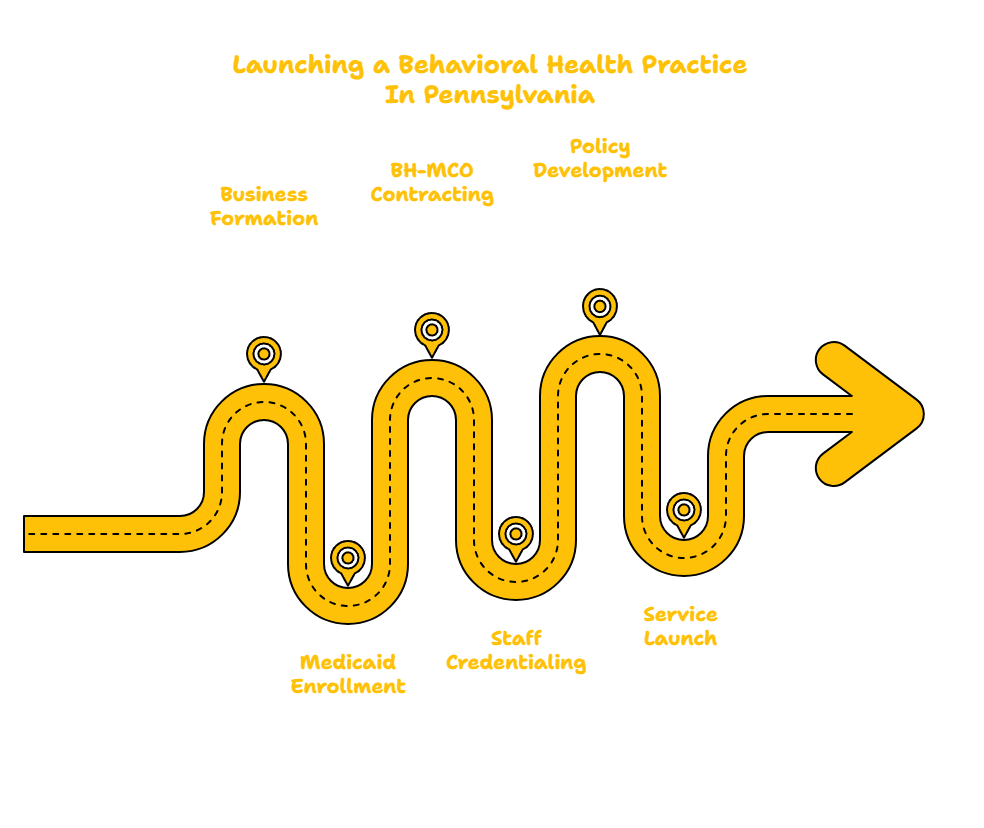
The path to becoming a recognized Medicaid provider involves a sequenced approach to business and regulatory compliance. It begins with the formal registration of the legal business entity with the Pennsylvania Department of State, followed by obtaining an Employer Identification Number (EIN) and a Type 2 National Provider Identifier (NPI). If the business model involves a physical facility or clinic, the provider must secure the appropriate mental health agency or outpatient psychiatric clinic license through the Department of Health.
Once legal and licensing requirements are met, the provider must enroll in the PROMISe™ (Provider Reimbursement and Operations Management Information System) portal. This step is critical, as it establishes the provider’s status within the Pennsylvania Medicaid system. Following PROMISe™ enrollment, the provider must seek contracts with regional BH-MCOs, such as Community Care Behavioral Health, Magellan, or PerformCare, depending on the geographic service area. These contracts are essential for obtaining service authorizations and receiving reimbursement for covered services.
Developing Compliant Policies and Documentation Protocols
A comprehensive Behavioral Health Services Policy & Procedure Manual is the bedrock of any audit-ready organization. This manual must be tailored to align with both OMHSAS regulations and CMS guidelines, covering the entire lifecycle of client care—from intake and risk screening to emergency crisis response. Policies must clearly define standards for treatment plan development, progress note maintenance, and the handling of sensitive client information in accordance with HIPAA regulations.
Audit readiness is maintained through systematic documentation. Agencies must implement standardized templates for service notes that clearly delineate the clinical rationale, the specific intervention provided, and the client's response to treatment. Staff training must include not only clinical skills but also rigorous adherence to confidentiality, billing accuracy, and quality assurance protocols. By centralizing these procedures, providers can ensure consistent service delivery and demonstrate transparency during oversight reviews or state audits.
Staffing, Supervision, and Clinical Credentialing
The quality of behavioral health services is inherently tied to the expertise and credentials of the staff. Licensed professionals, including LCSWs, LPCs, LMFTs, and psychologists, are required to deliver therapy, while individuals with specialized training—such as a BSC license or autism endorsement—are required for specific behavioral intervention roles. Because staffing requirements are stringent, providers must invest in a robust credentialing process that verifies licenses, education, and relevant clinical experience for every hire.
Beyond initial hiring, agencies must maintain detailed supervision logs and support the continuous professional development of their workforce. This includes ensuring all staff members complete required background checks (FBI, Child Abuse, and PA State Police) and participate in mandatory annual training on trauma-informed care and abuse prevention. Continuous quality improvement depends on the supervisor’s ability to conduct regular clinical reviews, ensuring that all practitioners are working within their scope of practice and meeting the evolving regulatory requirements of the Pennsylvania behavioral health system.
Frequently Asked Questions
What is the difference between BH-MCOs and ODP for behavioral services?
BH-MCOs generally manage outpatient, mobile, and psychiatric services for the broader Medicaid population under HealthChoices. In contrast, the Office of Developmental Programs (ODP) provides oversight for individuals with intellectual or developmental disabilities who receive specialized behavioral support services through specific HCBS waivers.
How long does the provider enrollment process typically take?
The timeline varies based on organizational readiness but generally spans several months. Business formation and licensure applications typically take 1–2 months, while Medicaid enrollment (PROMISe™) and BH-MCO contracting require an additional 2–3 months. Staff hiring and credentialing run concurrently, often adding 30–60 days to the pre-launch phase.
What documentation is required to pass a state audit?
Providers must maintain comprehensive clinical records, including individualized treatment plans, signed progress notes, billing logs, and evidence of required background checks. Furthermore, agencies must demonstrate that they have an active Policy & Procedure manual and proof that all staff members have completed mandatory trainings on HIPAA, trauma-informed care, and client rights.
Key Takeaway
Success in the Pennsylvania behavioral health market hinges on strict adherence to the regulatory standards set by OMHSAS, ODP, and the relevant BH-MCOs. By establishing a robust infrastructure for licensing, Medicaid enrollment via PROMISe™, and clinical documentation, providers can effectively navigate the complexities of the system while ensuring the delivery of high-quality, evidence-based care to the populations that need it most.
Last verified: October 2023. Disclaimer: This information is for educational purposes only and does not constitute legal or professional consulting advice. Requirements and program rules are subject to change; always consult with the Pennsylvania Department of Human Services and your specific BH-MCOs for the most current guidance on provider obligations.