BEHAVIORAL HEALTH SERVICES PROVIDER IN OHIO
By Fatumata Kaba · 2025-09-17 · 6 min read
PROMOTING MENTAL WELL-BEING AND EMOTIONAL STABILITY THROUGH PERSON-CENTERED SUPPORTS
Establishing a Behavioral Health Services agency in Ohio requires navigating a multi-layered regulatory environment involving state, federal, and Medicaid-specific oversight. Providers must balance clinical excellence with rigorous administrative compliance to deliver essential therapeutic supports and behavioral interventions to individuals with mental health conditions or developmental disabilities within home and community settings.
Understanding the Regulatory Landscape and Governing Agencies
Operating a behavioral health agency in Ohio requires ongoing collaboration with several key state and federal entities. Each agency serves a distinct role in ensuring that service delivery meets the high standards required for Medicaid reimbursement and client safety. Navigating these requirements effectively is the foundation of any successful and compliant agency.
The Ohio Department of Mental Health and Addiction Services (OhioMHAS) acts as the primary licensing body for community behavioral health agencies, setting the clinical and operational standards for service delivery. Simultaneously, the Ohio Department of Medicaid (ODM) oversees the financial integrity of the programs, managing the billing processes and state plan requirements. For agencies serving individuals with developmental disabilities, the Ohio Department of Developmental Disabilities (DODD) provides the framework for waiver-specific behavioral supports. Finally, the Centers for Medicare & Medicaid Services (CMS) provides federal oversight, ensuring that all Medicaid-funded services adhere to quality, safety, and person-centered planning mandates.
- Ohio Department of Medicaid (ODM): Manages funding, billing, and state plan behavioral health services.
- Ohio Department of Mental Health and Addiction Services (OhioMHAS): Handles agency licensing and clinical service standards.
- Ohio Department of Developmental Disabilities (DODD): Coordinates behavioral support services for developmental disability waiver participants.
- Centers for Medicare & Medicaid Services (CMS): Sets federal standards for Medicaid compliance and quality of care.
Core Behavioral Health Service Offerings
Effective behavioral health programs are built upon a foundation of evidence-based practices that address the complex needs of the population served. Services are designed to improve daily functioning, prevent crisis episodes, and foster independence within an individual’s own home or community environment. Programs must be structured to provide both immediate support and long-term therapeutic growth.
Providers offer a variety of services, ranging from clinical therapy to practical case management. Common service lines include individual and group therapy for managing conditions like PTSD or anxiety, and behavior support services that help reduce harmful behaviors through structured, personalized plans. Other critical components include Community Psychiatric Supportive Treatment (CPST), peer support services for recovery-oriented guidance, and medication management to monitor psychiatric health. Each of these services requires meticulous documentation, including treatment plans, progress notes, and billing logs, to maintain compliance with Medicaid auditing standards.
Navigating Licensing and Provider Enrollment
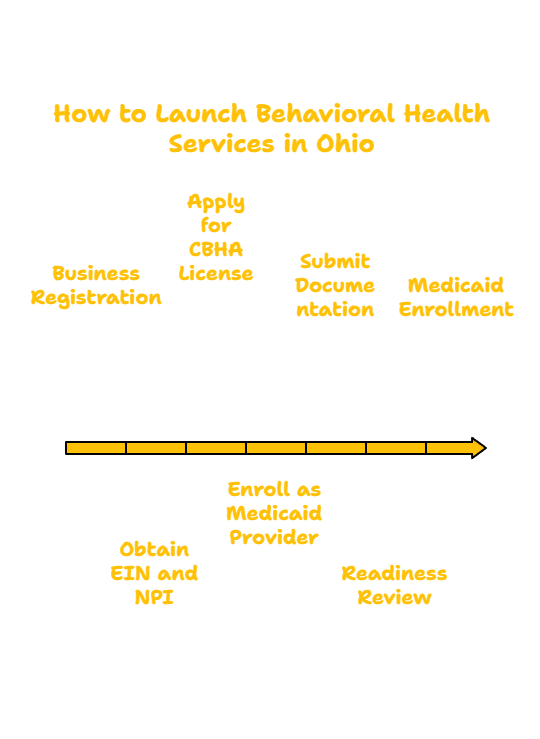
The transition from a business concept to a fully operational Medicaid provider involves a structured, sequential process. Prospective agency founders must first ensure their business is legally registered with the Ohio Secretary of State and possesses the necessary tax identifiers, such as an EIN and a Type 2 NPI. Once the legal structure is in place, the focus shifts to obtaining the appropriate license from OhioMHAS and navigating the enrollment portal managed by ODM.
The enrollment timeline involves multiple stages, including a thorough readiness review. OhioMHAS will perform a site visit to evaluate the agency’s capacity to deliver safe and compliant care. Following license approval, the agency must apply through the ODM Provider Enrollment Portal to gain billing authorization. Throughout this period, agencies must maintain adequate general and professional liability insurance and develop robust internal policies covering HIPAA compliance, clinical protocols, and staff safety.
Essential Documentation and Operational Infrastructure
A successful audit readiness strategy hinges on the quality and completeness of an agency’s policy and procedure manual. This manual serves as the operational blueprint for the organization, detailing how the agency handles everything from diagnostic assessments to client grievance procedures. Documentation must be living, breathing proof of the agency's commitment to quality care and regulatory compliance.
Required documentation includes, but is not limited to, Articles of Incorporation, proof of NPI registration, and valid liability insurance certificates. Internally, the agency must maintain systems to track staff credentials, continuing education, and clinical performance. Furthermore, policies regarding incident reporting, de-escalation protocols, and HIPAA-compliant record-keeping must be readily accessible to all staff to ensure consistency in service delivery and reporting to the governing agencies.
Staffing Requirements and Clinical Oversight
The quality of behavioral health services is intrinsically linked to the qualifications and training of the staff. Regulatory standards dictate that clinical directors or program administrators must possess independent licensure, such as an LISW-S, LPCC-S, or IMFT-S, to provide necessary administrative and clinical supervision. Similarly, direct-service staff must meet specific educational and certification requirements to ensure they are equipped to handle the complexities of the population served.
- Clinical Director: Requires an independent license and significant supervisory experience.
- Licensed Behavioral Health Providers: Must hold LSW, LPC, MFT, or higher credentials.
- Psychiatric Prescribers: Must be a licensed psychiatrist or a psychiatric nurse practitioner (PMHNP).
- Behavioral Specialists: Typically require a bachelor's degree in a human services field.
- Peer Support Workers: Must hold an OhioMHAS Peer Recovery Supporter certification.
Accessing Medicaid Waiver Programs
Behavioral health services are integrated into several Medicaid waiver programs, providing a comprehensive safety net for Ohioans. Programs like the Individual Options (IO) Waiver, the SELF Waiver, and the Level One Waiver offer pathways for developmental disability-related supports. For the broader population, the Ohio Home Care Waiver and PASSPORT Waiver provide mental health supports for individuals in home settings, while MyCare Ohio integrates behavioral health within managed care structures.
Understanding which waiver programs align with an agency’s mission is crucial for strategic growth. Agencies should be prepared to work closely with managed care organizations and waiver case managers to ensure that individuals are connected to the appropriate services. Whether through the state plan or specific waiver enrollment, these programs are designed to keep individuals thriving in their communities rather than in institutional settings.
Frequently Asked Questions
What is the typical timeline for launching a behavioral health agency in Ohio?
The process generally takes six to nine months, depending on the complexity of the agency and its readiness. Business setup and policy development usually require one to two months, followed by two to three months for licensing, 60-90 days for the OhioMHAS readiness review, and 30-45 days for final Medicaid billing activation.
What are the primary clinical staff requirements?
Staff must be properly credentialed based on their role. This includes independent licensure for supervisors (e.g., LISW-S, LPCC-S), specific degrees for behavioral specialists, and state certification for Peer Recovery Supporters. All staff must undergo training in HIPAA, de-escalation, and documentation.
Where can I find more information on licensing and enrollment?
Official guidance and portals are managed by the Ohio Department of Mental Health and Addiction Services (mha.ohio.gov) and the Ohio Department of Medicaid (medicaid.ohio.gov). These websites provide the most current updates on provider requirements and application procedures.
Key Takeaway
Launching a Behavioral Health Services agency in Ohio is a rigorous commitment that requires strict adherence to state and federal standards. By focusing on comprehensive policy development, hiring qualified and licensed staff, and maintaining meticulous documentation, agencies can successfully navigate the licensing and Medicaid enrollment processes to provide high-quality care to their communities.
WCG supports new and existing agencies in launching Medicaid-compliant Behavioral Health Services in Ohio, including: Business setup and OhioMHAS licensure support, Medicaid enrollment and clinical documentation systems, Policy manual development for mental health and behavioral service lines, Staff training and credentialing toolkits, Medicaid billing setup, service logs, and quality monitoring tools, Branding, website creation, and referral marketing materials, and Partnership development with waiver teams, health systems, and managed care entities.
Last verified: May 2024. This information is for educational purposes only and does not constitute legal or professional advice. Always consult directly with the Ohio Department of Mental Health and Addiction Services (OhioMHAS) and the Ohio Department of Medicaid (ODM) for the most current regulations and specific requirements for your agency.