BEHAVIORAL HEALTH SERVICES PROVIDER IN NORTH DAKOTA
By Fatumata Kaba · 2025-09-18 · 5 min read
SUPPORTING MENTAL WELL-BEING THROUGH THERAPEUTIC INTERVENTIONS AND PERSONALIZED CARE
Behavioral Health Services in North Dakota play a critical role in assisting individuals with mental health challenges, substance use disorders, and complex behavioral difficulties. By offering professional therapeutic interventions, counseling, and structured support, these services promote emotional stability, enhance essential coping skills, and significantly improve the quality of life for participants within the Medicaid Home and Community-Based Services (HCBS) waiver programs.
What Are the Governing Agencies for Behavioral Health in North Dakota?
The regulatory landscape for Behavioral Health Services in North Dakota is managed by a coalition of state and federal entities that ensure the safety, clinical efficacy, and financial integrity of the programs. The North Dakota Department of Human Services (NDDHS) serves as the primary administrator, overseeing the critical functions of Medicaid waiver funding, provider enrollment, and reimbursement protocols. Their oversight ensures that services remain consistent with state goals for mental health and disability care.
Complementing the NDDHS, the North Dakota Behavioral Health Division offers essential clinical guidance, shaping the standards for mental health and substance use treatment practices. The North Dakota Medical Services Division (MSD) manages the specific mechanics of Medicaid waiver service delivery and provider participation. At the federal level, the Centers for Medicare & Medicaid Services (CMS) provides the overarching regulatory framework, ensuring that all Medicaid-funded interventions meet national standards for quality, safety, and person-centered care.
Which Core Services Are Provided Under Medicaid Waivers?
Behavioral Health Services are designed to provide comprehensive, wraparound support to individuals navigating mental health challenges or addiction. Approved providers are expected to offer a multi-faceted approach to care that addresses both immediate symptoms and long-term recovery goals. By delivering a variety of therapeutic modalities, providers help participants transition from crisis toward stability and community integration.
Approved providers may deliver:
- Individual Therapy: One-on-one counseling to address specific emotional and behavioral challenges.
- Group Therapy: Facilitated sessions that encourage peer support and social skill development.
- Family Counseling: Supporting healthy family dynamics and improving communication strategies.
- Substance Use Treatment: Evidence-based counseling, relapse prevention planning, and recovery support.
- Crisis Intervention: Immediate, short-term support during emotional or behavioral crises.
- Case Management: Coordinating services, community resources, and long-term support networks.
- Behavioral Modification Plans: Tailoring interventions to reduce maladaptive behaviors and improve functioning.
- Psychiatric Assessment and Medication Management: Evaluating mental health needs and monitoring the ongoing effectiveness of prescribed medications.
What Are the Essential Licensing and Provider Approval Requirements?
Establishing a Behavioral Health Agency in North Dakota requires a rigorous, multi-step commitment to regulatory compliance. Before a provider can begin billing, they must formalize their business status by registering with the North Dakota Secretary of State and obtaining an Employer Identification Number (EIN) from the IRS. Furthermore, a Type 2 National Provider Identifier (NPI) is necessary to uniquely identify the organization for billing purposes within the Medicaid system.
Beyond the foundational business registration, providers must obtain specific licensure as a Behavioral Health Agency from the North Dakota Department of Health. This process involves proving organizational readiness, which includes securing general and professional liability insurance and developing a comprehensive Policy and Procedure Manual. These documents must clearly outline protocols for clinical care, crisis management, and the protection of client safety, while also verifying that all staff have cleared mandatory background checks and hold current, active licensures.
How Do Providers Navigate the Enrollment Process in North Dakota?
The path to becoming a Medicaid-enrolled provider begins with the North Dakota Medicaid Management Information System (MMIS). Interested organizations must complete an initial provider enrollment application specifically designated for Behavioral Health Services under the HCBS waivers. This initial filing acts as the gateway to the review process, where the NDDHS and the Behavioral Health Division evaluate the provider’s readiness to serve the population.
The review process is comprehensive and documentation-heavy. Applicants must submit their Articles of Incorporation, proof of NPI and EIN registration, and verified proof of insurance. Furthermore, the state conducts a program readiness review to assess the agency's internal protocols, including clinical standards and safety measures. Once the state confirms that the agency meets all qualifications, the provider is officially enrolled and authorized to begin billing Medicaid for approved services using specific, pre-designated billing codes.
What Are the Staffing and Documentation Standards?
The quality of behavioral health care is directly tied to the credentials of the clinical staff. A Behavioral Health Program Director is required, typically holding a Master’s or Doctorate in mental health or psychology, along with licensure as a Licensed Clinical Social Worker (LCSW) or Licensed Professional Counselor (LPC). Therapists must be licensed mental health professionals, while Psychiatric Nurse Practitioners must maintain active state licensure to oversee medication management. Case Managers are expected to hold a Bachelor’s degree in social work or human services.
Ongoing compliance is maintained through meticulous documentation and continuous staff development. All personnel must undergo training in therapeutic interventions, crisis response, and client rights under HIPAA regulations. Annual competency evaluations are mandatory to ensure that clinical practices remain aligned with state standards. Providers must keep detailed records of every therapy session, progress note, and outcome report to support Medicaid billing and demonstrate clinical progress during potential state audits.
Frequently Asked Questions
Which Medicaid waiver programs allow for Behavioral Health Services?
Behavioral Health Services are currently authorized under the Aged and Disabled Waiver, the Technology Dependent Waiver, the Developmental Disabilities Waiver, and the standard Home and Community-Based Services (HCBS) Waiver.
How long does the startup process typically take for a new agency?
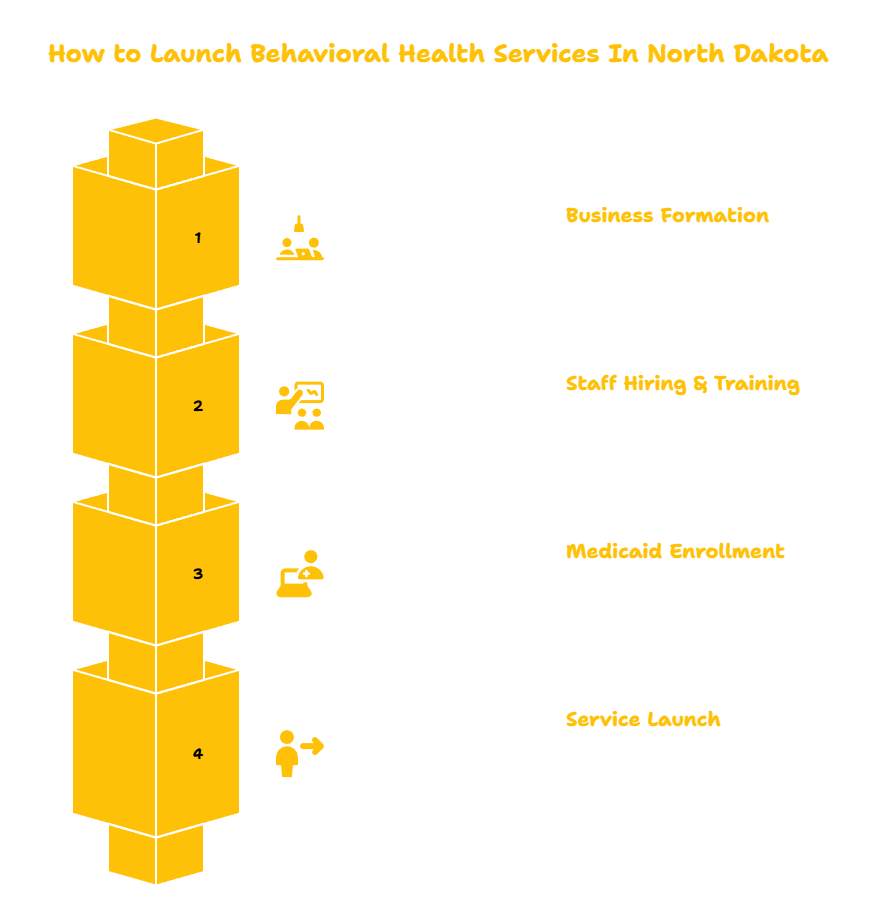
The timeline varies by agency, but generally follows this structure: 1–2 months for business formation, 2–3 months for hiring and credentialing, 60–90 days for Medicaid enrollment and readiness reviews, and 30–45 days to finalize billing setup.
What must be included in a Behavioral Health Policy & Procedure Manual?
Manuals must include clinical care protocols, crisis management guidelines, staff background check policies, HIPAA compliance procedures, grievance handling, emergency response plans, and strict documentation standards for Medicaid billing and care tracking.
Key Takeaway
Launching a Behavioral Health Services agency in North Dakota is a complex process that demands adherence to state-specific clinical and administrative regulations. By aligning business operations with the requirements of the NDDHS and the North Dakota Behavioral Health Division, providers can ensure long-term stability and success in delivering essential care to vulnerable populations. Success hinges on robust policy development, qualified staffing, and strict adherence to Medicaid billing and documentation standards.
WAIVER CONSULTING GROUP’S START-UP ASSISTANCE SERVICE — NORTH DAKOTA BEHAVIORAL HEALTH SERVICES PROVIDER
WCG supports agencies in launching Medicaid-compliant Behavioral Health Services in North Dakota, offering:
- Business registration, Medicaid enrollment, and licensing assistance
- Policy manual development for clinical care and crisis management
- Staff credentialing, training program templates, and compliance documentation
- Medicaid billing setup and audit-prepared financial management
- Branding, website development, and client outreach strategies
- Quality assurance systems for behavioral care and compliance monitoring
- Collaboration with healthcare providers, community organizations, and behavioral health networks
Last verified: 05/20/2024. This article is intended for informational purposes only and does not constitute legal or professional medical advice. Always consult with the North Dakota Department of Human Services or a qualified consultant when navigating complex Medicaid regulations.