BEHAVIORAL HEALTH SERVICES PROVIDER IN NEW YORK
By Fatumata Kaba · 2025-09-04 · 5 min read
Becoming a Behavioral Health Services provider in New York requires a rigorous commitment to clinical standards, regulatory compliance, and person-centered care models as defined by state Medicaid Home and Community-Based Services (HCBS) waivers. Agencies looking to enter this space must navigate a complex oversight framework involving the Department of Health (NYSDOH), the Office of Mental Health (OMH), and the Office for People With Developmental Disabilities (OPWDD) to ensure that therapeutic interventions meet the strict quality and safety requirements necessitated by Medicaid funding.
Understanding the Regulatory Landscape for Behavioral Health Providers
In New York, the provision of Medicaid-funded behavioral health services is governed by a multi-layered regulatory environment. Because these services are designed to address mental health conditions, substance use disorders, and developmental behavioral challenges, oversight is split between federal directives and state-specific implementation. The Centers for Medicare & Medicaid Services (CMS) sets the overarching federal standards for quality and participant safety, while the NYSDOH administers the waiver funding and coordinates the enrollment process through the eMedNY system.
Beyond the initial enrollment, providers must maintain ongoing compliance with the specific agency that oversees their service population. The Office of Mental Health (OMH) ensures that clinical programs meet the benchmarks for mental health stability and therapy efficacy. Simultaneously, the Office for People With Developmental Disabilities (OPWDD) provides specialized oversight for providers serving individuals with intellectual or developmental disabilities. Understanding these governing agencies is the first step toward operational legitimacy in the New York HCBS waiver landscape.
Core Service Offerings and Therapeutic Scope
Behavioral health providers act as a vital bridge between clinical diagnosis and daily community living. The services approved under these waivers are not merely administrative; they are therapeutic interventions meant to foster independence and emotional regulation. Providers must be prepared to offer a robust suite of services, ranging from individual counseling and group therapy to trauma-informed care and crisis intervention. This versatility ensures that an agency can meet the diverse needs of participants who may be dealing with anything from acute mental health crises to long-term behavioral support requirements.
- Individual Counseling: Tailored one-on-one sessions addressing specific mental health challenges.
- Group Therapy: Structured sessions facilitating peer support and communal skill-building.
- Substance Use Counseling: Specialized support frameworks for individuals navigating addiction and recovery.
- Crisis Intervention: Rapid response capabilities to stabilize participants during acute mental health emergencies.
- Case Management: Holistic coordination of care between clinical teams, social services, and community resources.
- Behavioral Interventions: Data-driven strategies designed to mitigate disruptive behaviors and enhance functioning.
- Psychoeducation: Educational resources for participants and their families regarding mental health management.
- Medication Management: Close monitoring of psychiatric prescriptions for efficacy and side-effect profiles.
- Social Skills Training: Developing interpersonal competencies to improve community integration.
- Trauma-Informed Care: Therapeutic approaches built on sensitivity to the participant's history and past trauma.
Navigating the Provider Enrollment and Readiness Process
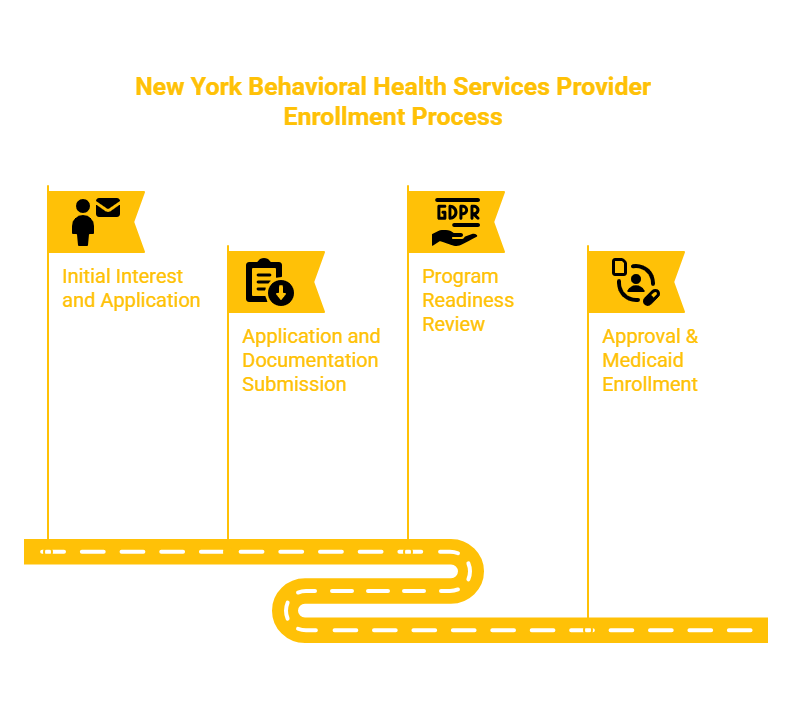
The path to becoming an approved provider begins with the formalization of the business entity and the attainment of necessary identifiers, such as the Federal Employer Identification Number (EIN) and a Type 2 National Provider Identifier (NPI). Once these business foundations are established, the agency must initiate the enrollment application through the eMedNY portal. This process is not a simple registration; it is an extensive review of the agency's structural and clinical readiness to serve Medicaid beneficiaries.
The Readiness Review phase is the most critical hurdle in the application process. During this period, NYSDOH and relevant oversight offices, such as OMH or OPWDD, scrutinize the agency’s internal protocols. They evaluate whether the provider has the infrastructure to maintain HIPAA-compliant records, the ability to manage medical crises, and the capacity to ensure that all staff members are properly vetted. Approval is only granted once the agency demonstrates that it can reliably uphold the high standards of care required for waiver program participation.
Staffing, Credentialing, and Clinical Supervision
The quality of a behavioral health agency is defined by its clinical staff. New York has strict mandates regarding the credentials of those providing therapeutic care. A Program Director must typically hold a master's or doctoral degree in a relevant field and possess licensure as an LCSW, LMHC, or Psychologist. These roles ensure that all therapeutic interventions are grounded in evidence-based practices and professional clinical ethics.
Beyond the Program Director, the agency must staff its various departments with appropriately qualified personnel. Substance use counselors must be certified as a CASAC or hold equivalent credentials, while behavioral support specialists must have the academic background necessary to implement behavioral strategies effectively. All staff, regardless of their role, are required to undergo comprehensive background checks, ongoing health screenings, and continuous training in topics such as trauma-informed care, HIPAA compliance, and participant rights. This commitment to professional development is essential for maintaining the licensure required to bill Medicaid for services rendered.
Documenting Compliance and Operational Policies
A successful provider agency must operate as a "paper-ready" organization. This means that every therapeutic interaction, staff training, and clinical assessment must be documented with precision to survive a Medicaid audit. The foundation of this documentation is the agency’s Policy and Procedure Manual. This document must contain explicit protocols for therapy practices, crisis intervention, staff credentialing, and emergency response guidelines. It serves as the blueprint for agency operations and the primary evidence of compliance during periodic state inspections.
Essential components of the documentation suite include:
- Articles of Incorporation and business licenses.
- Comprehensive insurance documentation, including general and professional liability.
- Staff training logs detailing trauma-informed care and HIPAA education.
- Clinical encounter notes that link directly to Medicaid billing codes.
- Grievance and incident reporting logs that adhere to patient right mandates.
Frequently Asked Questions
What is the difference between OMH and OPWDD oversight?
OMH oversight focuses on programs tailored to mental health and behavioral needs, while OPWDD is primarily responsible for programs serving individuals with intellectual and developmental disabilities. An agency may interact with one or both depending on the scope of their service population and the specific waiver under which they are enrolled.
How long does the provider enrollment process typically take?
The timeline varies based on the agency's readiness, but the entire process—from business formation to final billing setup—generally takes between 6 to 9 months. This includes 60–90 days for the official state enrollment and readiness review phase.
Are there specific waivers that include behavioral health services?
Yes, behavioral health services are authorized under several New York programs, including the OPWDD Comprehensive Waiver, the Home and Community-Based Services (HCBS) Waiver, the Nursing Home Transition and Diversion (NHTD) Waiver, the Traumatic Brain Injury (TBI) Waiver, and the Children’s Waiver.
Key Takeaway
Establishing a Behavioral Health Services agency in New York is a highly regulated endeavor that mandates a focus on clinical integrity, rigorous documentation, and strict adherence to the requirements of the NYSDOH, OMH, and OPWDD. By prioritizing staff credentialing and robust policy development early in the launch phase, providers can successfully navigate the Medicaid enrollment process and provide essential, high-quality support to vulnerable populations across the state.
Last verified: August 2024. This information is intended for educational purposes only and does not constitute legal or professional consulting advice. Requirements for Medicaid provider enrollment are subject to change by federal and state governing bodies. Prospective providers should consult the official eMedNY, NYSDOH, OMH, and OPWDD portals for the most current regulatory guidance and application updates.