BEHAVIORAL HEALTH SERVICES PROVIDER IN KENTUCKY
By Fatumata Kaba · 2025-07-25 · 5 min read
Behavioral health services in Kentucky provide essential support for Medicaid members managing mental health disorders, substance use disorders (SUD), and co-occurring conditions through evidence-based, person-centered interventions. By navigating the regulatory requirements set by the Cabinet for Health and Family Services (CHFS) and the Department for Behavioral Health, Developmental and Intellectual Disabilities (DBHDID), provider agencies can establish community-based programs that facilitate stability and long-term recovery.
Navigating the Regulatory Landscape and Oversight Agencies
Launching a behavioral health practice in Kentucky requires a thorough understanding of the multi-tiered regulatory framework governing healthcare delivery. The primary state authority is the Kentucky Cabinet for Health and Family Services (CHFS), which houses the Department for Medicaid Services (DMS). DMS is the central agency responsible for Medicaid coverage, provider enrollment, and reimbursement protocols. Concurrently, the Department for Behavioral Health, Developmental and Intellectual Disabilities (DBHDID) maintains the essential role of licensing providers and establishing the clinical standards for service delivery and quality assurance.
Beyond state-level licensing, providers must coordinate with the Centers for Medicare & Medicaid Services (CMS), which ensures federal compliance for all State Plan and Home and Community-Based Services (HCBS) waiver programs. Furthermore, the operational day-to-day interactions for most providers involve Managed Care Organizations (MCOs). These organizations handle the critical tasks of authorizing treatment plans, managing provider credentialing, overseeing utilization reviews, and processing billing for Medicaid members.
- CHFS/DMS: Manages Medicaid enrollment and state-wide reimbursement policies.
- DBHDID: Oversees clinical licensure, service standards, and quality monitoring.
- CMS: Provides the federal regulatory framework for Medicaid compliance.
- MCOs: Facilitate care coordination, authorization of services, and billing management.
Core Behavioral Health Services and Clinical Delivery
Behavioral health services are designed to address the psychological, emotional, and substance-related challenges that impede an individual's ability to function independently in the community. To receive reimbursement, all services must be deemed medically necessary and formally documented within the participant’s Individualized Treatment Plan (ITP) or Person-Centered Service Plan (PCSP). These plans serve as the blueprint for care, ensuring that interventions remain goal-oriented and measurable.
The scope of services encompasses a wide array of professional interventions, ranging from diagnostic assessments to intensive crisis stabilization. Providers offer individual, group, and family therapy to address diverse needs, alongside specialized support for substance use disorder (SUD) recovery and peer support initiatives. Additionally, programs often incorporate medication evaluation and management, performed by a psychiatrist or an Advanced Practice Registered Nurse (APRN), to support the pharmacological needs of the participant.
Establishing Your Agency: Licensing and Enrollment Requirements
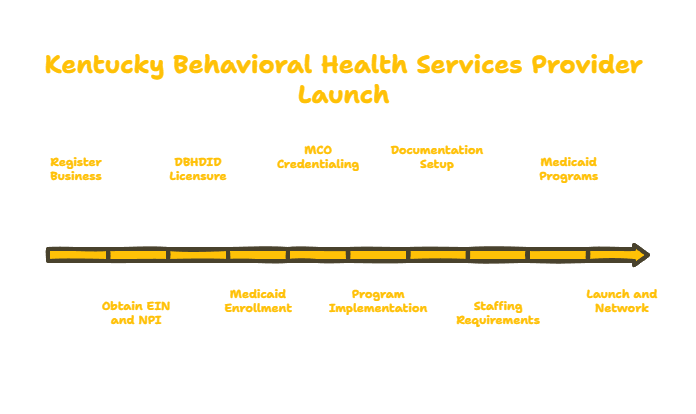
The transition from a business concept to an active Medicaid provider is a structured process that begins with formal business registration. Founders must register their organization with the Kentucky Secretary of State and obtain an IRS Employer Identification Number (EIN) and a Type 2 National Provider Identifier (NPI). These foundational steps are prerequisites for interacting with state systems and establishing tax and identity profiles.
Once registered, the entity must pursue certification from the DBHDID as a Behavioral Health Services Organization (BHSO). This process involves rigorous site readiness reviews and the submission of clinical staffing models and service descriptions. Following state certification, providers must navigate the Medicaid Partner Portal Application (MPPA) to enroll as a Medicaid provider. Successful enrollment requires maintaining comprehensive liability and malpractice insurance, as well as the development of robust internal systems for HIPAA-compliant documentation, billing, and clinical quality management.
- Register business and obtain EIN/NPI.
- Secure BHSO licensure/certification from DBHDID.
- Complete enrollment via the Medicaid Partner Portal Application (MPPA).
- Implement internal policies, procedures, and HIPAA-compliant documentation systems.
Staffing and Operational Compliance Standards
A high-functioning behavioral health organization relies on a multidisciplinary team. The clinical backbone consists of Licensed Behavioral Health Professionals, such as Licensed Clinical Social Workers (LCSW), Licensed Professional Clinical Counselors (LPCC), Licensed Marriage and Family Therapists (LMFT), or Licensed Psychologists. These professionals bear the primary responsibility for conducting therapy and clinical treatment. Supporting this effort are Behavioral Health Associates, such as case managers and peer support specialists, who provide essential community-based interventions under appropriate supervision.
Compliance and ongoing training are non-negotiable aspects of operating a Medicaid-certified practice. All staff members are required to undergo specialized training, including HIPAA and 42 CFR Part 2 protocols, crisis prevention and de-escalation techniques, and trauma-informed care. Furthermore, agencies must maintain detailed records of staff credentials and participate in annual continuing education to ensure alignment with both licensure requirements and evolving state standards of care.
Integration with HCBS Waiver Programs
Beyond standard outpatient care, behavioral health services are increasingly integrated into Kentucky’s HCBS waiver programs, which allow individuals to receive support in their homes and communities rather than in institutional settings. Key programs include the Supports for Community Living (SCL) Waiver, which offers select behavioral supports, and the Michelle P. Waiver (MPW), which provides behavioral interventions for individuals with intellectual or developmental disabilities. Additionally, the Acquired Brain Injury (ABI and ABI-LTC) waivers include specific neurobehavioral supports tailored to that population.
These services can be delivered in a variety of settings, including outpatient clinics, the participant’s home, community locations like schools or workplaces, and via authorized telehealth platforms. Providing care across these settings requires a flexible, mobile workforce and an administrative infrastructure capable of handling the documentation requirements unique to each waiver’s specific service definitions and billing codes.
Frequently Asked Questions
What is the typical timeline to launch a Behavioral Health Services Organization in Kentucky?
The timeline generally spans several months. Licensure and initial staff onboarding typically require 2–3 months, followed by 60–90 days for Medicaid enrollment and MCO credentialing. Setting up documentation and quality compliance systems usually takes an additional 30–45 days, with program launch and referral network development occurring on an ongoing basis.
What specific documents are required for the DBHDID certification process?
Agencies must submit a comprehensive Behavioral Health Services Policy & Procedure Manual, which must include intake and assessment templates, ITP/PCSP development forms, crisis and suicide prevention protocols, participant rights policies, and procedures for HIPAA and 42 CFR Part 2 compliance. Documentation of staff credentials and supervision plans is also mandatory.
Are telehealth services permitted under Kentucky Medicaid for behavioral health?
Yes, behavioral health services may be provided via telehealth platforms, provided the delivery meets the specific guidelines and authorizations set forth by Kentucky Medicaid and the individual MCOs involved in the participant’s care plan.
Key Takeaway
Successfully operating as a behavioral health provider in Kentucky requires strict adherence to DBHDID licensure, proactive management of MCO credentialing, and the establishment of robust internal compliance systems. By integrating evidence-based care with the regulatory requirements of state programs and HCBS waivers, providers can ensure high-quality outcomes while maintaining the administrative integrity necessary for sustained participation in the Medicaid ecosystem.
Last verified: October 2023. This article is for informational purposes and does not constitute legal or professional advice. Always consult with the Kentucky Cabinet for Health and Family Services (CHFS) or qualified legal counsel to ensure your organization’s full compliance with state and federal regulations.