BEHAVIORAL HEALTH SERVICES PROVIDER IN IOWA
By Fatumata Kaba · 2025-07-22 · 5 min read
Launching a behavioral health services agency in Iowa requires a rigorous understanding of both state-level licensing requirements and the complex landscape of Medicaid reimbursement. By integrating services within the Iowa Department of Health and Human Services (HHS) framework, providers play a critical role in supporting mental wellness, recovery, and community participation for individuals across the state.
To succeed as a Medicaid-approved behavioral health provider, organizations must navigate the intersection of the Iowa Medicaid State Plan, Home and Community-Based Services (HCBS) waiver programs, and Habilitation Services. This guide provides an authoritative roadmap for healthcare administrators, clinical directors, and agency founders seeking to establish and scale compliant, high-quality behavioral health operations in Iowa.
Who are the Governing Agencies for Iowa Behavioral Health Providers?
The delivery of behavioral health services in Iowa is regulated through a tripartite structure involving state-level oversight, managed care coordination, and federal accountability. At the state level, the Iowa Department of Health and Human Services (HHS), specifically the Division of Behavioral Health and Iowa Medicaid Enterprise (IME), serves as the primary authority. These agencies manage provider licensure, service delivery standards, and Medicaid reimbursement policies to ensure that care remains accessible and medically necessary.
Because Iowa operates a managed care model, providers must also work closely with Managed Care Organizations (MCOs). MCOs function as the primary administrators for service authorizations, provider credentialing, and claims processing. While the state sets the policy, the MCOs act as the gatekeepers for day-to-day operations and care planning. Additionally, the Centers for Medicare & Medicaid Services (CMS) provides the overarching federal framework, ensuring that Iowa’s behavioral health landscape meets national standards for quality, safety, and fiscal responsibility.
What Scope of Services Can an Iowa Provider Offer?
Behavioral health providers in Iowa serve a diverse population, including individuals with mental health conditions, emotional disturbances, and co-occurring developmental disorders. To meet these needs, approved providers deliver a broad spectrum of clinical and community-based interventions. These services must always align with a participant’s Individualized Treatment Plan (ITP) or Individualized Service Plan (ISP), ensuring that the care delivered is tailored to the specific clinical goals of the individual.
Providers frequently deliver the following essential services to support participant recovery and functional independence:
- Diagnostic assessments and comprehensive mental health evaluations
- Individual, group, and family therapy sessions
- Medication management and psychiatric evaluation services
- Behavioral Health Intervention Services (BHIS)
- Mobile crisis response and stabilization services
- Substance use treatment, including outpatient and intensive outpatient options
- Peer support services and recovery coaching
- Behavioral support planning and ongoing implementation under HCBS waivers
- Trauma-informed care and specialized dual-diagnosis treatment
What are the Mandatory Licensing and Enrollment Prerequisites?
The transition from a business concept to an operational Medicaid-enrolled entity involves several distinct legal and regulatory steps. First, the agency must be formally established with the Iowa Secretary of State and registered with the IRS to obtain an Employer Identification Number (EIN). Simultaneously, the entity must secure a Type 2 National Provider Identifier (NPI), which is essential for billing and organizational identification in all Medicaid-related transactions.
Beyond legal registration, clinical compliance is paramount. An agency must obtain the specific Mental Health or Behavioral Health Agency license required by Iowa HHS. Providers are also required to maintain comprehensive liability, professional, and malpractice insurance coverage to protect both the agency and its clients. Finally, the organization must develop robust internal policies covering HIPAA privacy, clinical care protocols, risk management, emergency response, and client rights before submitting enrollment applications via the Iowa Medicaid Portal Access (IMPA).
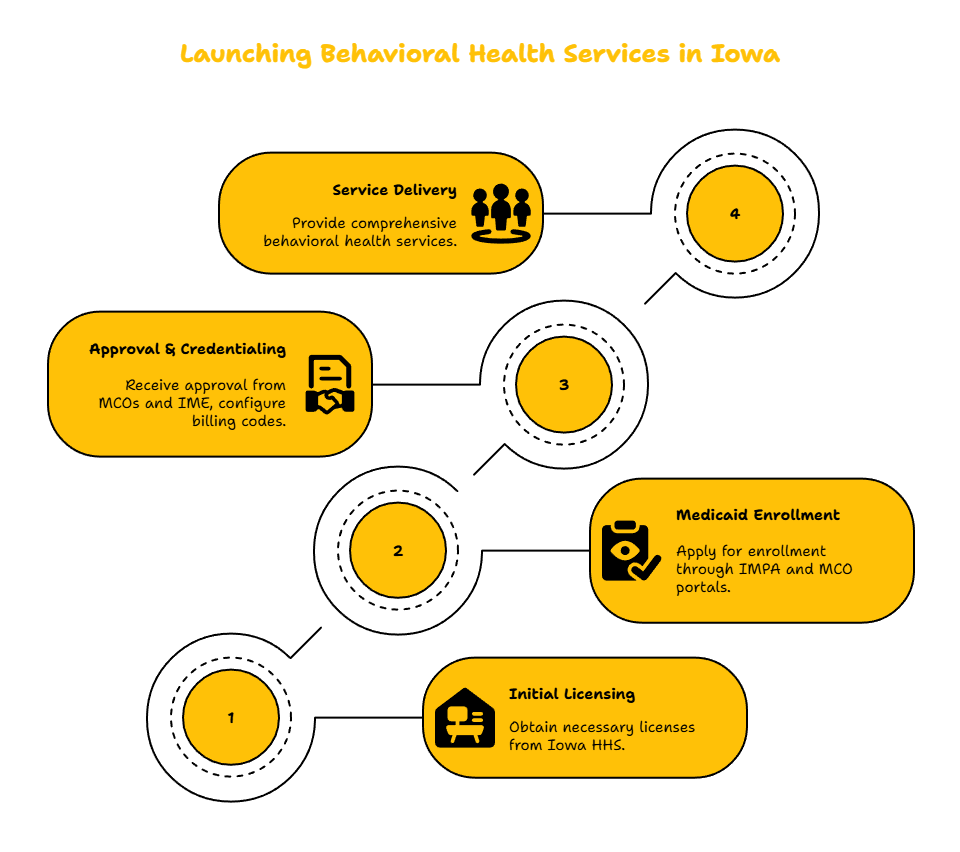
How is the Provider Enrollment Process Structured?
The Iowa enrollment process follows a tiered approach, starting with the state and moving toward MCO-specific credentialing. Initially, the provider must submit a formal license application to Iowa HHS. This phase often includes facility inspections or comprehensive organizational reviews to confirm that the physical environment and administrative structures meet state mandates. Once licensed, the entity initiates the Medicaid enrollment process through the IMPA portal.
After the initial state-level enrollment, the provider must undergo credentialing with the active Iowa MCOs. This is a critical step, as the MCOs manage the actual reimbursement for the majority of Medicaid-covered behavioral health services. During this phase, providers must submit detailed clinical staffing plans, evidence of valid licenses for all practitioners, and proof of comprehensive insurance. Once both the IME and the MCOs provide formal approval, the agency can begin configuring their internal billing systems with the appropriate procedure codes for therapy, assessments, crisis interventions, and psychiatric services.
What are the Staffing and Documentation Requirements?
The quality of a behavioral health agency is defined by its clinical staff. Iowa mandates that behavioral health services be delivered by professionals who meet strict licensure, credentialing, and background check requirements. A clinical director or supervisor must be a licensed independent professional, such as a Licensed Independent Social Worker (LISW), Licensed Mental Health Counselor (LMHC), Psychologist (PhD), or Psychiatrist (MD/DO). These supervisors are responsible for oversight, clinical audit readiness, and ensuring that all interventions remain within the staff's scope of practice.
Documentation is the backbone of Medicaid compliance and audit readiness. An agency must maintain a comprehensive Policy & Procedure Manual that details every aspect of the client journey. Key documentation areas include:
- Intake, assessment, and individualized treatment planning protocols
- Detailed crisis intervention, suicide prevention, and safety planning procedures
- Standardized service delivery and clinical progress note documentation
- HIPAA compliance, patient rights, and formal grievance procedures
- Clinical supervision logs, staff credentialing records, and mandatory training files
- Internal Medicaid billing compliance and regular audit-readiness reviews
Frequently Asked Questions
What waivers allow for behavioral health services in Iowa?
Behavioral health services are covered under the Medicaid State Plan and the Habilitation Services program. Additionally, specific services are authorized under the Intellectual Disability (ID) Waiver, Brain Injury (BI) Waiver, Health and Disability (HD) Waiver, and the Children’s Mental Health (CMH) Waiver.
How long does the launch process generally take?
The timeline varies by agency readiness, but typically involves 1–2 months for business formation and licensing, 2–3 months for clinical hiring and credentialing, 60–90 days for Medicaid/MCO enrollment, and 30–45 days for final billing system configuration.
What ongoing training is required for staff?
All clinical staff must complete mandatory training in HIPAA and confidentiality, trauma-informed care, crisis de-escalation, and abuse prevention. Additionally, staff must participate in ongoing emergency preparedness training, annual professional development, and regular performance evaluations.
Key Takeaway
Successful entry into the Iowa behavioral health market requires a disciplined approach to regulatory compliance, meticulous documentation, and strategic coordination with both the Iowa HHS and the state’s Managed Care Organizations. By prioritizing a robust clinical infrastructure and maintaining audit-ready systems from day one, providers can build sustainable, high-impact services that support the diverse mental health needs of the Iowa population.
Last verified: September 2023. Disclaimer: This article is intended for informational purposes and does not constitute legal or professional advice. Always consult the latest state regulations and official guidance from Iowa HHS and relevant Managed Care Organizations to ensure full compliance with current Medicaid policy.