BEHAVIORAL HEALTH SERVICES PROVIDER IN HAWAII
By Fatumata Kaba · 2025-07-16 · 5 min read
Becoming a behavioral health services provider in Hawaii requires navigating a rigorous regulatory landscape governed by both state and federal authorities to ensure the delivery of high-quality, person-centered care. Agencies must integrate into the state’s Medicaid framework by aligning service models—ranging from psychotherapy to crisis intervention—with the requirements of the Department of Human Services (DHS) and the Department of Health (DOH) to support emotional well-being and recovery.
Understanding the Regulatory Hierarchy and Governing Agencies
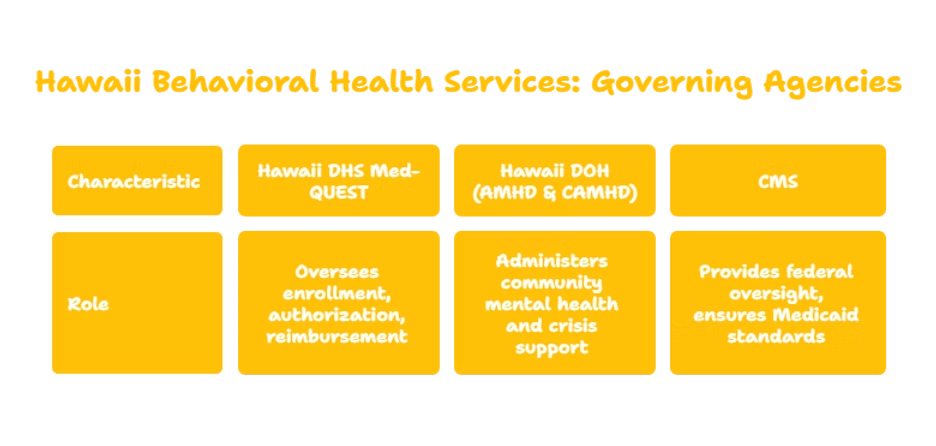
The behavioral health ecosystem in Hawaii is anchored by three primary entities that dictate operational standards, reimbursement protocols, and participant protections. Understanding the role of each is critical for any organization seeking to serve individuals through Medicaid-funded programs.
The Hawaii Department of Human Services (DHS) Med-QUEST Division serves as the primary gateway for providers. It oversees the formal enrollment process, ensuring that agencies meet the financial and administrative criteria to bill Medicaid for services rendered. Simultaneously, the Hawaii Department of Health (DOH)—specifically the Adult Mental Health Division (AMHD) and the Child & Adolescent Mental Health Division (CAMHD)—manages the clinical delivery of services and specialized crisis intervention supports, ensuring that care aligns with state public health objectives.
At the federal level, the Centers for Medicare & Medicaid Services (CMS) provides overarching guidance. CMS ensures that Hawaii’s Medicaid State Plan and Home and Community-Based Services (HCBS) waiver programs maintain compliance with federal mandates, such as the HCBS Settings Rule, which requires that services promote integration into the community. Failure to adhere to these federal standards can result in disallowance of federal financial participation, making administrative compliance a top priority for provider leadership.
Core Components of Behavioral Health Service Delivery
Behavioral health services in Hawaii are designed to be multifaceted, addressing the diverse needs of individuals dealing with mental health conditions, behavioral challenges, or emotional disorders. Providers are expected to offer a continuum of care that spans from preventative therapy to intensive stabilization.
Approved providers generally focus on evidence-based practices that foster resilience and self-management. This includes individual, group, and family psychotherapy, as well as psychiatric evaluations and medication management. For many participants, community-based rehabilitative services (CBRS) and skills training for emotional regulation and interpersonal communication are essential to maintaining stability in their home environments.
- Psychotherapy (individual, group, or family sessions)
- Psychiatric evaluation and medication management
- Behavioral intervention and crisis de-escalation
- Skills training for emotional regulation, coping strategies, and interpersonal communication
- Community-based rehabilitative services (CBRS)
- Peer support services (where authorized)
- Mobile crisis intervention and stabilization (for urgent needs)
Navigating Licensing and Medicaid Provider Enrollment
The transition from a business concept to an active Medicaid provider is a highly structured process that demands strict attention to documentation. The initial phase involves establishing the legal identity of the organization through the Hawaii Department of Commerce and Consumer Affairs (DCCA), followed by securing an IRS Employer Identification Number (EIN) and a National Provider Identifier (NPI) Type 2.
Once the legal foundation is set, the agency must undergo the Med-QUEST enrollment process. This process requires the submission of professional licensure verifications for all clinical staff, proof of comprehensive liability and malpractice insurance, and a robust set of operational policies. The DHS conducts a rigorous Program Readiness Review to ensure that the provider’s clinical staffing, documentation systems, and participant rights protections meet the state's stringent requirements for mental health service delivery.
Establishing Essential Documentation and Policies
A compliant provider agency must maintain a comprehensive Policy and Procedure Manual that serves as the blueprint for daily operations. This document must satisfy both Medicaid billing requirements and the clinical standards set by the Hawaii DOH. Essential sections must cover participant intake, standardized assessment tools, and diagnostic criteria, ensuring that every service provided is medically necessary.
Furthermore, policies must strictly enforce HIPAA compliance, confidentiality, and participant rights. Given the nature of behavioral health, the manual must also include detailed incident reporting procedures, suicide prevention protocols, and emergency response plans. Staffing records, including credentialing verifications and background checks, must be meticulously maintained to survive periodic state audits and quality assurance reviews.
Staffing Requirements and Clinical Supervision
Success in behavioral health services is entirely dependent on the quality and credentials of the clinical team. Hawaii mandates specific qualifications for various roles, requiring that all staff members hold active state licensure in their respective disciplines. This includes licensed psychologists, LCSWs, LPCs, LMFTs, psychiatrists, and APRNs.
Beyond initial hiring, agencies are required to foster a culture of continuous development. Staff must undergo recurring training in HIPAA confidentiality, client rights, abuse prevention, and specialized crisis de-escalation techniques. The Clinical Director or Program Manager is responsible for ensuring that all clinicians maintain their continuing education requirements and that clinical supervision is documented according to Medicaid standards.
Frequently Asked Questions
What is the primary difference between state plan services and HCBS waiver services?
The Medicaid State Plan provides core medical and mental health services to all eligible participants, whereas HCBS waiver programs are designed to provide targeted support to individuals with specific needs—such as those with intellectual or developmental disabilities—to remain in their homes and communities rather than in institutional settings.
How long does the full enrollment process typically take?
The timeline varies based on the completeness of the application, but generally, the process takes approximately 6 to 9 months. This encompasses the 1–2 months for business formation, 2–4 months for program development, and 90–135 days for Medicaid enrollment and system setup.
Is a facility license required for all behavioral health providers?
Not all providers require a facility license; however, if your agency operates a physical site where services are delivered, it must be licensed through the Hawaii Department of Health. Mobile-only services or telehealth-based practices may have different requirements that must be verified through Med-QUEST.
Key Takeaway
Establishing a behavioral health services agency in Hawaii requires a strategic approach that prioritizes regulatory compliance alongside clinical excellence. By aligning business operations with the specific mandates of the Med-QUEST Division and the Hawaii Department of Health, and by maintaining a rigorous focus on documentation, staffing, and participant rights, providers can successfully build a sustainable model that meets the critical needs of the community.
Last verified: September 2023. Disclaimer: This guide is for informational purposes and does not constitute legal or professional consulting advice. Requirements and state policies may change; always consult directly with the Hawaii Department of Human Services (DHS) Med-QUEST Division and the Hawaii Department of Health (DOH) for the most current regulations and application procedures.