BEHAVIORAL HEALTH SERVICES PROVIDER IN DELAWARE
By Fatumata Kaba · 2025-07-07 · 5 min read
Providing behavioral health services in Delaware is a critical endeavor that supports individuals with intellectual and developmental disabilities (IDD) in managing complex emotional and psychological challenges. By delivering specialized interventions such as Positive Behavior Support Plans (PBSPs) and individualized therapy, provider agencies play a vital role in fostering community integration, enhancing self-regulation, and ensuring the long-term well-being of participants within the Delaware Lifespan Waiver framework.
How Are Behavioral Health Services Governed in Delaware?
The delivery of behavioral health services is a highly regulated process overseen by multiple layers of state and federal authority. The primary entity responsible for the administration of these services is the Delaware Division of Developmental Disabilities Services (DDDS). DDDS is tasked with authorizing behavioral health supports under the Lifespan Waiver and continuously monitoring service delivery to ensure that every provider remains in strict compliance with state quality standards.
Beyond state-level administration, the Delaware Division of Medicaid and Medical Assistance (DMMA) serves as the fiscal backbone of the program, overseeing Medicaid reimbursement and maintaining program integrity across all waiver services. At the federal level, the Centers for Medicare & Medicaid Services (CMS) sets the overarching clinical and person-centered standards that Delaware must follow, ensuring that every behavioral intervention is designed to respect the autonomy and unique needs of the individual receiving care.
What Are the Core Components of Behavioral Health Service Delivery?
Behavioral health services are designed to address behavioral challenges that impede a person’s daily functioning, safety, or ability to thrive in their community. These services are not one-size-fits-all; they must be meticulously aligned with the participant’s Individual Service Plan (ISP). Providers are expected to utilize evidence-based practices to assist individuals in achieving specific behavioral goals that promote greater independence.
To successfully deliver these services, authorized providers must be prepared to offer a robust suite of clinical interventions. Approved activities include:
- Conducting Functional Behavioral Assessments (FBA) to identify the root causes of behavioral issues.
- Developing and implementing comprehensive Positive Behavior Support Plans (PBSPs).
- Providing individual and group therapy sessions tailored to the developmental needs of the participant.
- Offering caregiver training and behavioral consultation to build support systems in the home.
- Creating crisis prevention and intervention plans to ensure safety during periods of heightened behavioral dysregulation.
- Maintaining rigorous documentation of behavioral goals, data tracking, and ongoing plan outcomes.
What Are the Essential Requirements for Provider Enrollment?
Becoming an approved Behavioral Health Services provider requires a methodical approach to business formation and clinical credentialing. Before applying for program participation, an agency must be registered with the Delaware Division of Corporations and possess a valid EIN from the IRS. Furthermore, obtaining a Type 2 NPI is a mandatory prerequisite for billing and identification purposes in the Medicaid system.
Agencies must ensure they employ or contract with licensed behavioral health professionals—such as BCBAs, LCSWs, LPCMHs, or psychologists—who meet state licensing requirements. Once the business foundation is laid, the agency must apply for behavioral health service approval through DDDS and complete the enrollment process with Delaware Medicaid (DMAP). Throughout this process, maintaining professional liability insurance and robust, HIPAA-compliant digital infrastructure is essential for protecting both the agency and the participants it serves.
How Should Agencies Navigate the Enrollment and Documentation Process?
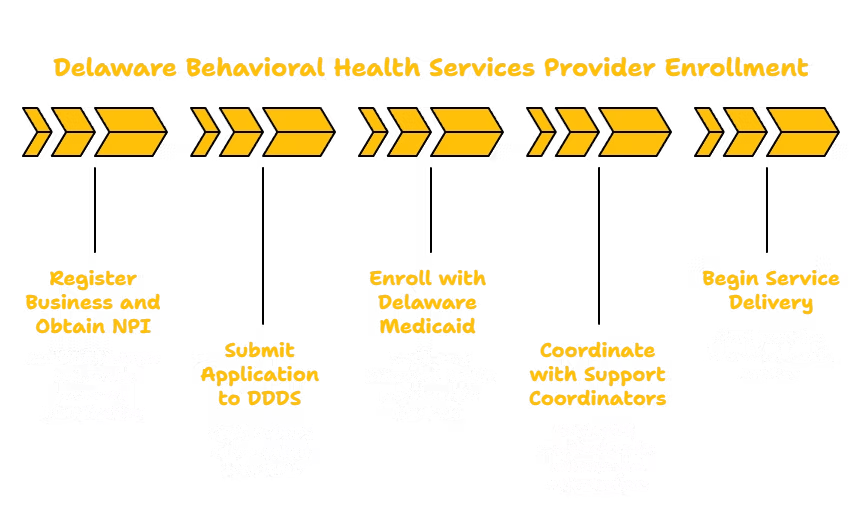
The provider enrollment process is a sequential journey that demands attention to detail. Agencies begin by registering the business and obtaining an NPI, followed by a formal application submission to DDDS. This application must include clinical licenses, staff resumes, detailed service protocols, and samples of proposed documentation. Once approved by DDDS, the agency must finalize enrollment with DMAP to ensure that claims for services can be processed.
Documentation is the cornerstone of audit compliance and quality assurance. Agencies are required to maintain a comprehensive policy and procedure manual that covers everything from intake to crisis response. Essential documentation includes:
- Articles of Incorporation and business registration records.
- Professional licensure verification for all clinical staff.
- A detailed policy and procedure manual, including behavioral assessment protocols and data collection tools.
- Specific procedures for crisis response, de-escalation, and incident reporting.
- HIPAA and participant confidentiality compliance documentation.
- Staff supervision logs and evidence of ongoing training.
What Are the Staffing and Training Expectations?
Staffing requirements are rigorous to ensure the safety and effectiveness of behavioral supports. A licensed clinician, such as a BCBA, psychologist, LCSW, or LPCMH, must oversee the clinical direction of services. These professionals are responsible for the clinical integrity of the behavior plans and must maintain current Delaware licensure, along with necessary background checks and compliance training.
Behavioral Support Technicians or implementation specialists may provide direct support, provided they are under the direct supervision of a licensed clinician. All staff, regardless of their role, must undergo comprehensive training to ensure they understand their obligations to the participants and the state. Required training modules include:
- HIPAA regulations and participant documentation protocols.
- Crisis prevention and the principles of positive behavior support.
- Mandated reporting requirements and abuse prevention strategies.
- ISP integration and accurate goal documentation.
- Continuous tracking of CEUs and adherence to supervision requirements.
Frequently Asked Questions
What is the typical timeline to launch a behavioral health practice in Delaware?
The timeline generally follows a phased approach: business formation takes 1–2 weeks, while the DDDS application and the Medicaid (DMAP) enrollment process each typically require 30–60 days. Clinical onboarding and referral coordination remain ongoing efforts once the agency is fully operational.
Do I need to be a licensed clinician to start a behavioral health provider agency?
While the business owner does not necessarily have to be a clinician, the agency must employ or contract with licensed behavioral health professionals—such as a BCBA, psychologist, LCSW, or LPCMH—to perform the clinical duties and hold the necessary credentials to meet DDDS and Medicaid standards.
How are referrals handled once an agency is approved?
After receiving DDDS approval and completing the DMAP enrollment, agencies should proactively coordinate with Support Coordinators and case managers. These individuals are responsible for managing participant care and will refer eligible individuals based on the requirements outlined in their Individual Service Plan (ISP).
Key Takeaway
Establishing a behavioral health services provider agency in Delaware requires a commitment to regulatory compliance, clinical excellence, and systematic documentation. By aligning business operations with the guidelines established by DDDS and the Delaware Lifespan Waiver, providers can ensure they are well-positioned to offer high-quality, sustainable care that supports the health and stability of the IDD community.
Last verified: 2024. This content is for informational purposes only and does not constitute legal or clinical advice. Consult with the Delaware Division of Developmental Disabilities Services (DDDS) and the Division of Medicaid and Medical Assistance (DMMA) for the most current regulatory updates and specific application requirements.