BEHAVIORAL HEALTH SERVICES PROVIDER IN COLORADO
By Fatumata Kaba · 2025-07-06 · 5 min read
DELIVERING MENTAL HEALTH AND BEHAVIORAL SUPPORT TO PROMOTE STABILITY, WELL-BEING, AND COMMUNITY PARTICIPATION
Establishing a behavioral health services agency in Colorado requires navigating a multifaceted regulatory landscape overseen by the Department of Health Care Policy and Financing (HCPF) and the Behavioral Health Administration (BHA). By obtaining proper licensure and securing enrollment as a Medicaid provider, practitioners can deliver essential therapeutic and behavioral supports to individuals with intellectual and developmental disabilities (IDD) and mental health needs through the state’s Home and Community-Based Services (HCBS) waiver programs.
What Are the Primary Governing Bodies for Colorado Behavioral Health Providers?
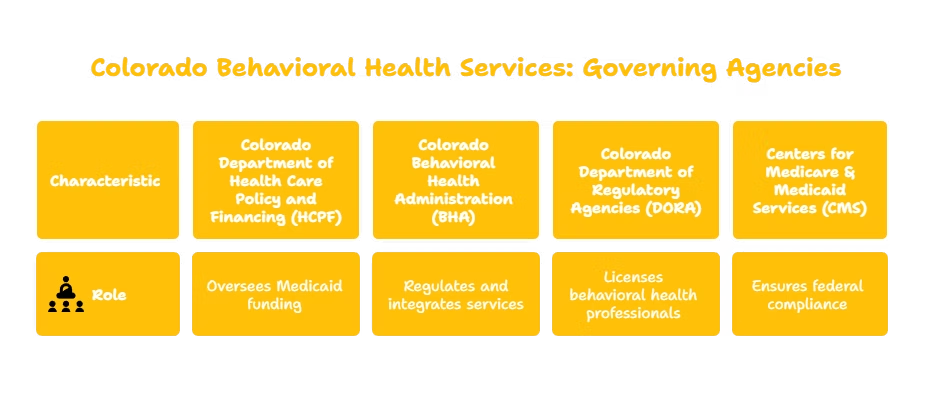
The Colorado behavioral health landscape is shaped by several key agencies that establish standards for service delivery, fiscal oversight, and professional conduct. The Colorado Department of Health Care Policy and Financing (HCPF) serves as the primary administrator for Medicaid funding, managing both the state plan services and the various HCBS waivers that provide long-term care alternatives for vulnerable populations.
In addition to HCPF, the Behavioral Health Administration (BHA) plays a critical role in regulating providers and ensuring the integration of services across the state’s diverse systems. The Colorado Department of Regulatory Agencies (DORA) is responsible for the licensing of individual practitioners, including LPCs, LCSWs, and psychologists. Finally, the Centers for Medicare & Medicaid Services (CMS) provides the federal framework, ensuring that all state-level activities remain in compliance with national Medicaid mandates and HCBS requirements.
Which Services Are Provided Through Behavioral Health Programs?
Behavioral health services are designed to be individualized, focusing on assessment, intervention, and ongoing monitoring to support emotional, cognitive, and behavioral stability. These services are often integrated into an individual’s broader support network, including their family, caregivers, and residential staff. The objective is to foster independence and community participation while minimizing the impact of challenging behaviors or co-occurring mental health conditions.
Approved providers often deliver a spectrum of specialized supports including:
- Functional behavioral assessments (FBA) to identify the root causes of behavioral challenges.
- Development and implementation of person-centered Behavior Support Plans (BSP).
- Individual or group therapy sessions utilizing CBT, DBT, or trauma-informed care models.
- Skill development training and proactive behavior stabilization techniques.
- Caregiver coaching and intensive staff training to ensure consistency in care delivery.
- Crisis de-escalation strategies and the formulation of intervention planning.
- Rigorous documentation of behavioral goals, measurable outcomes, and performance data.
How Do Providers Meet Licensing and Enrollment Prerequisites?
Before an agency can begin billing for services, it must establish a formal business entity and meet the professional qualification requirements set by the state. This process begins with registering the business with the Colorado Secretary of State and obtaining both an Employer Identification Number (EIN) from the IRS and a Type 2 National Provider Identifier (NPI). These foundational steps allow an entity to operate as a legitimate business within the healthcare sector.
Following business formation, the agency must enroll as a Medicaid behavioral health provider via the Gainwell Technologies Provider Portal. Crucially, any professional providing clinical care must hold an active license or certification through DORA, such as being a Licensed Professional Counselor (LPC), Licensed Clinical Social Worker (LCSW), Licensed Psychologist, or a Board Certified Behavior Analyst (BCBA). For those intending to operate within the HCBS waiver system, additional provider approval must be secured through HCPF to ensure the agency is authorized to bill for specific waiver-funded services.
What Are the Essential Requirements for Staffing and Documentation?
Maintaining high standards of clinical oversight and administrative accountability is a primary requirement for all behavioral health agencies. All clinicians must maintain their DORA licensure and demonstrate experience working with individuals with IDD or complex behavioral health needs. Where behavioral technicians or paraprofessionals are employed, they must operate under the direct supervision of a licensed clinician and be equipped with appropriate training in crisis management and mandated reporting.
Documentation is a cornerstone of compliance, and agencies are expected to maintain comprehensive, HIPAA-compliant systems. Required documentation includes:
- Proof of business registration, EIN, and NPI confirmation.
- Current DORA licenses and Medicaid provider ID documentation.
- Detailed policy and procedure manuals covering intake, consent, and confidentiality.
- Standardized templates for behavioral assessments, behavior support plans, and progress notes.
- Robust protocols for emergency responses, incident reporting, and the protection of client rights.
- Audit-ready logs for staff credentialing, continuing education units (CEUs), and clinical supervision.
Which Medicaid Waivers Cover Behavioral Health Services?
Reimbursement for behavioral health services is available through both the standard Colorado Medicaid State Plan and specific HCBS waivers designed for target populations. These waivers are essential for funding services that allow individuals to remain in their homes or community-based settings rather than in institutional environments. Providers must ensure their documentation is strictly aligned with the Individual Service Plan (ISP) for each participant to ensure service authorization and claim approval.
Key programs that facilitate the reimbursement of behavioral health interventions include:
- Colorado Medicaid State Plan for outpatient behavioral health services.
- Children’s Extensive Support (CES) waiver for minors with complex behavioral needs.
- Supported Living Services (SLS) waiver for adults seeking independence in the community.
- Developmental Disabilities (DD) waiver for comprehensive, high-acuity behavioral support.
- Community Mental Health Supports (CMHS) waiver.
Frequently Asked Questions
What is the typical timeline to launch a behavioral health practice?
The timeline varies based on the scope of operations. Business formation generally takes 1–2 weeks, while obtaining professional licensure and credentialing takes 2–4 weeks. Medicaid enrollment via the Gainwell portal can take 30–60 days, with waiver enrollment and referral networking occurring on an ongoing, long-term basis.
How does a new provider secure referrals?
Once enrolled as a Medicaid provider, it is essential to network with local Case Management Agencies (CMAs) and Regional Centers. These entities manage the caseloads for individuals on HCBS waivers and serve as the primary conduit for connecting providers with participants who need behavioral health support.
Are there ongoing training requirements for staff?
Yes. All staff members must undergo regular training in HIPAA compliance, positive behavior supports, person-centered planning, and trauma-informed care. Additionally, clinicians are responsible for maintaining their annual CEUs as required by their respective professional boards to keep their DORA licenses in good standing.
Key Takeaway
Successfully operating a behavioral health agency in Colorado requires a dual focus on clinical excellence and strict regulatory compliance. By aligning professional credentials with HCPF and BHA requirements, and maintaining meticulous documentation, agencies can provide the critical stability and support necessary for individuals with complex needs to thrive in their communities.
Last verified: October 2023. Disclaimer: This information is for educational purposes only and does not constitute legal or professional advice. Always consult with state agencies and legal counsel to ensure compliance with current Colorado regulations and Medicaid policies.