BEHAVIORAL HEALTH SERVICES PROVIDER IN ARIZONA
By Fatumata Kaba · 2025-07-02 · 5 min read
SUPPORTING INDIVIDUALS WITH MENTAL HEALTH AND BEHAVIORAL NEEDS THROUGH INTEGRATED, COMMUNITY-BASED INTERVENTIONS
Establishing a Behavioral Health Services agency in Arizona requires a deep understanding of the state’s integrated Medicaid system, governed by the Arizona Health Care Cost Containment System (AHCCCS) and the Department of Economic Security (DES). Providers play a critical role in delivering evidence-based, community-based interventions to individuals with developmental disabilities, chronic conditions, and mental health diagnoses, ensuring they receive care in the least restrictive environment possible.
Navigating the Regulatory Landscape and Governing Agencies
Success in the Arizona behavioral health sector begins with a clear understanding of the roles played by state and federal oversight bodies. These agencies ensure that services meet both clinical and safety standards, particularly for those receiving support through the Arizona Long Term Care System (ALTCS) and the Division of Developmental Disabilities (DDD) under Home and Community-Based Services (HCBS) waivers.
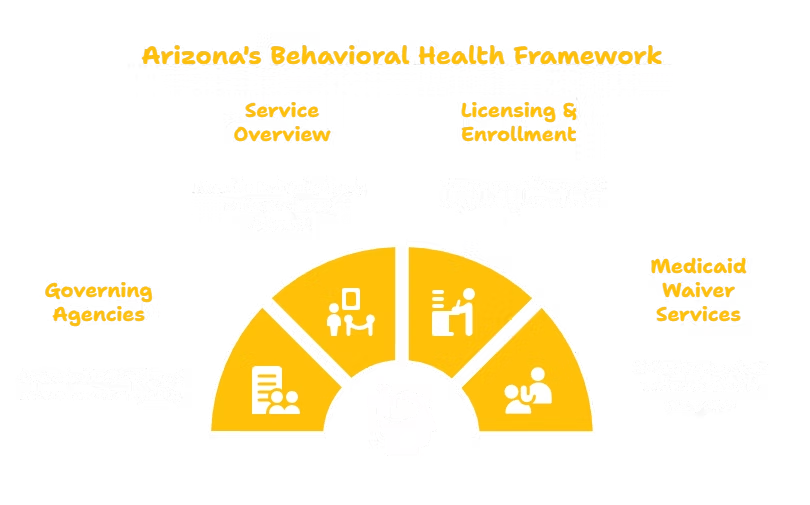
The regulatory framework is primarily managed by four distinct entities. The Arizona Health Care Cost Containment System (AHCCCS) acts as the state’s Medicaid agency, overseeing service reimbursements and quality standards. The Arizona Department of Economic Security (DES) – Division of Developmental Disabilities (DDD) manages the Qualified Vendor contracts necessary to provide specialized support to individuals with developmental disabilities. The Arizona Department of Health Services (ADHS) – Division of Licensing Services is responsible for the actual facility licensing, while the federal Centers for Medicare & Medicaid Services (CMS) sets the overarching guidelines for community integration and quality of care.
Establishing Your Service Delivery Framework
Behavioral health services in Arizona are designed to be highly individualized, focusing on emotional regulation, psychological well-being, and social integration. Whether delivered in a home, clinic, school, or community setting, these services must be evidence-based and tailored to the specific needs of the member. Developing a robust service model is the first step in creating a sustainable agency.
Approved providers often offer a diverse range of interventions, ranging from preventative counseling to intensive crisis stabilization. Effective agencies must ensure that their service delivery is not only clinically sound but also well-coordinated with the broader care team, including support coordinators and case managers.
- Behavioral assessments and treatment planning
- Counseling and psychotherapy (individual, group, or family)
- Positive behavior support interventions
- Crisis intervention and stabilization
- Skill-building in emotional regulation, communication, and coping
- Psychiatric evaluations and medication management (if licensed for clinical services)
- Documentation and coordination with care teams and case managers
Step-by-Step Licensing and Provider Enrollment
The journey toward becoming a Medicaid-enrolled behavioral health provider involves a sequenced process of business registration, facility licensing, and credentialing. Founders must first ensure their business is registered with the Arizona Corporation Commission and obtain the necessary federal identifiers, specifically an EIN from the IRS and a Type 2 NPI. Following these business formalities, the provider must engage directly with the state’s licensing and enrollment systems.
The process is divided into three distinct phases. First, obtaining an Outpatient Behavioral Health Facility License through the ADHS is mandatory, which involves submitting detailed staffing plans, clinical supervision protocols, and undergoing a facility survey. Second, registration with AHCCCS as a behavioral health provider is required to handle billing and reimbursement. Finally, if the agency intends to serve DDD members, it must apply through the Qualified Vendor Application and Directory System (QVADS), which requires a submission of service descriptions, specific policy templates, and credentialing information.
Building a Robust Policy and Procedure Manual
Administrative compliance is the cornerstone of a successful audit and long-term operational viability. A comprehensive Policy and Procedure manual serves as the operational blueprint for the agency. It must clearly define how the agency handles the intake process, ensures member privacy under HIPAA, and maintains clinical records that justify the services billed to Medicaid.
Beyond standard clinical documentation, the manual must address safety and risk management. This includes robust incident reporting procedures, de-escalation protocols for crisis situations, and clearly defined client rights. When establishing these policies, providers should focus on creating repeatable, scalable systems for staff training, credentialing, and ongoing supervision, as these areas are frequently audited by state oversight agencies.
- Clinical intake, risk screening, and service planning
- Behavioral support plans and data collection tools
- Emergency response and de-escalation protocols
- Client rights, informed consent, and privacy practices (HIPAA)
- Documentation, billing, and progress note templates
- Staff credentialing, supervision, and continuing education logs
- Crisis management and incident reporting procedures
- Cultural competency and trauma-informed care policies
Staffing, Credentialing, and Professional Requirements
The quality of behavioral health services is intrinsically linked to the qualifications and training of the staff. Agencies must recruit licensed professionals, such as LCSWs, LPCs, LMFTs, or Psychologists, to serve as Clinical Directors or Behavioral Health Supervisors. These supervisors are responsible for overseeing the clinical direction of the agency and ensuring that all interventions meet the standards established by ADHS.
All staff, including Behavioral Health Technicians and counselors, must adhere to strict training requirements. This includes mandatory education on crisis intervention, confidentiality, abuse reporting, and specialized training such as "Article 9" for those working with DDD members. Maintaining these records is a continuous responsibility, as the agency must be able to demonstrate that every staff member is up to date on their clinical and regulatory requirements at any given time.
Frequently Asked Questions
What is the typical timeline for launching a behavioral health agency?
The launch timeline varies based on the scope of services. Generally, business formation takes 1–2 weeks, followed by 60–90 days for ADHS licensing and inspection. If applying to be a DDD Qualified Vendor, the QVADS application process usually adds 45–60 days, and AHCCCS Medicaid enrollment takes an additional 45–60 days.
Is an ADHS license sufficient to bill all Medicaid programs?
No. While an ADHS Outpatient Behavioral Health Facility license is a prerequisite for operating, you must also complete the AHCCCS enrollment process to be recognized as a Medicaid provider. If you intend to serve the DDD population, you must also be approved through the QVADS portal as a Qualified Vendor.
What are the essential insurance requirements for new providers?
Providers are required to maintain both professional malpractice insurance and general liability insurance. These policies protect the agency, its staff, and the members served, and proof of these coverages is a standard requirement during the licensing and credentialing process.
Key Takeaway
Launching a behavioral health services agency in Arizona is a complex endeavor that requires precise navigation of AHCCCS, DDD, and ADHS requirements. By focusing on rigorous policy development, credentialed staffing, and a disciplined approach to the multi-step licensing and enrollment process, founders can establish a compliant and impactful agency dedicated to improving member outcomes within the HCBS system.
Last verified: October 2023. This content is for informational purposes only and does not constitute legal or professional licensing advice. Please consult with the respective Arizona state agencies or a qualified consultant to ensure compliance with current regulations and statutes.