Behavioral Health, Built to Bill: The Order That Gets You Paid
By Fatumata Kaba · 2026-06-27 · 5 min read
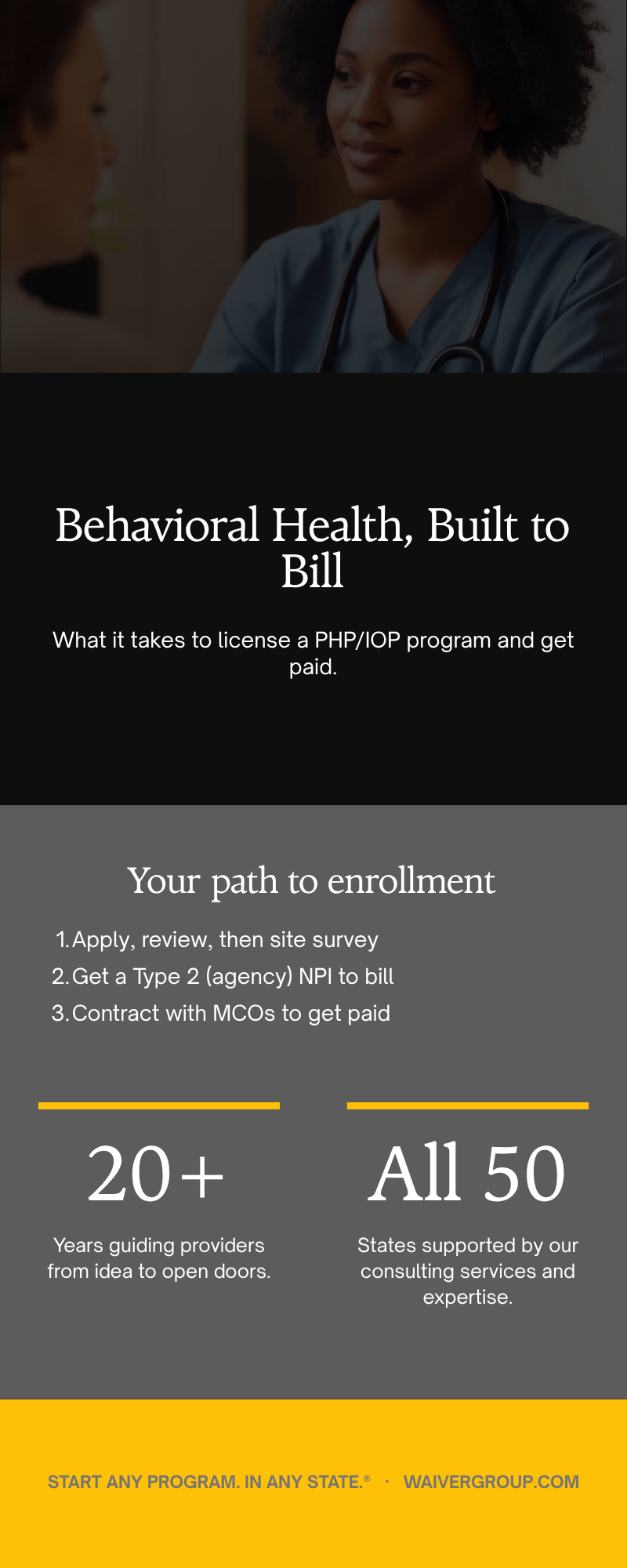
Opening a behavioral health program is not a single decision; it is a rigid sequence of regulatory and financial milestones where the order of operations dictates your agency’s ability to generate revenue. To successfully offer partial hospitalization (PHP) or intensive outpatient services (IOP) and achieve Medicaid reimbursement, providers must navigate a three-tier progression: phased licensing, agency-level credentials, and managed care organization (MCO) contracting.
Understanding the Sequence: Why Order Matters in Medicaid Billing
The behavioral health landscape is heavily regulated to ensure patient safety and fiscal integrity. Many new agency founders mistake the process for a parallel effort, assuming they can build a facility, hire staff, and apply for contracts simultaneously. However, Medicaid systems function through a series of "gates," where each subsequent step requires proof of the previous authorization.
If an agency attempts to contract with a managed care plan before securing a state license, the application will be summarily denied. Similarly, if an agency achieves licensure but fails to secure the correct National Provider Identifier (NPI) taxonomy or Medicaid enrollment, services rendered during that interim period are generally non-reimbursable. Understanding that these steps are hierarchical is the primary strategy for ensuring your program is "built to bill" from day one.
Step 1: Mastering Phased Licensing Requirements
Your state’s behavioral health authority or department of health manages facility oversight through a structured, multi-stage review process. This is the foundation of your program’s legal standing. The process typically begins with an initial application, which forces an agency to demonstrate the viability of their business model and the soundness of their physical space.
Following the application, state surveyors conduct a comprehensive review of your policies and procedures. This manual must reflect compliance with state administrative codes regarding clinical documentation, risk management, and staffing ratios. Finally, the process culminates in an on-site operational survey, where inspectors verify that your facility matches the documentation you submitted. It is critical to build your operations around these three phases from the start rather than retrofitting your policies after the fact.
Step 2: Securing Agency-Level Credentials for Medicaid Enrollment
While a license grants you the legal authority to operate, credentialing is the mechanism that grants you the technical authority to bill. Before a single claim can be submitted to the Medicaid state agency, your entity must be enrolled as an authorized provider. This stage is where many administrative delays occur due to mismatched identifiers or taxonomy codes.
Your agency must obtain a Type 2 NPI, which is specifically for organizational entities rather than individual practitioners. You must then ensure your taxonomy code—the classification that describes your specific behavioral health service—aligns perfectly with the service codes your state allows for Medicaid reimbursement. Without this specific administrative alignment, the state’s automated payment processing system will reject claims as "invalid provider type."
Step 3: Negotiating Managed Care Contracts
In most states, Medicaid behavioral health funding is carved into managed care. Enrollment with the state Medicaid program is merely the "master" record; the actual reimbursement flows through individual managed care plans operating in your specific region. You can only bill the plans with which you are actively contracted and credentialed.
Because MCOs operate independently of the state Medicaid agency, they maintain their own credentialing departments. This process is frequently the most time-consuming phase of program development, as each plan requires its own verification of your professional staff, facility capacity, and billing protocols. Initiating this process early is essential, as the turnaround times for MCO paneling can span several months.
- Identify the primary MCOs serving the Medicaid population in your target region.
- Prepare a credentialing "packet" including your state license, NPI, and W-9.
- Verify if the MCO requires site visits or additional accreditation (such as CARF or Joint Commission) as a prerequisite to contracting.
Step 4: Managing the Documentation-to-Payment Lifecycle
Once you are licensed, enrolled, and contracted, the focus shifts to the clinical-administrative intersection: documentation. Medicaid reimbursement is contingent upon clinical notes that map directly to the billing codes you use. If your behavioral health program provides group therapy or individual counseling, your Electronic Health Record (EHR) must reflect the medical necessity required by the specific MCOs in your network.
Providers should conduct internal audits on a monthly basis to ensure that clinical services are documented in accordance with the contracts they have signed. An MCO may perform a post-payment audit, and if the clinical documentation does not support the billing code, the plan will initiate a "clawback" of funds. Building a system that audits documentation against billing requirements is just as important as the initial credentialing process.
Frequently Asked Questions
Can I begin MCO credentialing before the state license is officially issued?
Generally, no. Managed care organizations require a copy of your active state license or a letter of verification from the state behavioral health authority as a core component of their credentialing application. Without this proof of licensure, the MCO will not move forward with the contracting process.
Is a Type 2 NPI mandatory for all behavioral health agencies?
Yes. A Type 2 NPI is essential for organizational providers, including clinics and agencies. It distinguishes your facility from individual practitioners (who use Type 1 NPIs) and allows the state and MCOs to link revenue generated by your program to your specific business entity.
Why does managed care credentialing take longer than state Medicaid enrollment?
State Medicaid enrollment is a standardized administrative process performed by a single government entity. In contrast, MCO credentialing involves multiple private entities, each with unique provider manuals, independent software portals, and individual verification timelines that must be managed on a contract-by-contract basis.
Strategic Implementation for Long-Term Viability
The transition from a startup to a functioning, reimbursable behavioral health provider is not about speed; it is about the structural integrity of your administrative foundation. By respecting the sequence—licensing, credentialing, and contracting—you mitigate the risk of "dead time," where your facility is physically ready but financially dormant. Start with the state requirements, transition to Medicaid system enrollment, and treat MCO contracting as a long-lead, prioritized business activity.
Key takeaway: A behavioral health program reaches billing through three separate gates — phased licensing, agency credentials, and managed care contracts. Build them in order, and start MCO credentialing first.
Last verified: 2024. The information provided here is for general informational purposes only and does not constitute legal or professional advice. Requirements for Medicaid waivers and behavioral health licensing vary significantly by state and jurisdiction. Providers should consult directly with their state’s Department of Health and their regional MCO partners to verify specific program requirements. Start Any Program. In Any State.® For further assistance, contact Waiver Consulting Group at waivergroup.com/videoappointment, call 302.888.9172, or email [email protected].