BEHAVIOR SUPPORT SERVICES PROVIDER IN WEST VIRGINIA
By Fatumata Kaba · 2026-04-14 · 5 min read
Behavior Support Services in West Virginia are specialized clinical interventions designed to assist individuals with intellectual or developmental disabilities, behavioral health needs, or complex emotional challenges. These services utilize evidence-based strategies—including Functional Behavior Assessments (FBA) and the creation of comprehensive Behavior Support Plans (BSP)—to help participants develop adaptive coping skills, manage environmental triggers, and reduce disruptive or harmful behaviors to promote long-term stability and independence.
As these services are primarily funded through Medicaid waiver programs, providers must maintain rigorous adherence to the regulatory frameworks established by the West Virginia Department of Health and Human Resources (WVDHHR) and the Bureau for Medical Services (BMS). Achieving provider status requires a systematic approach to clinical licensing, Medicaid enrollment via Gainwell Technologies, and the establishment of robust, compliant administrative protocols that satisfy both state standards and clinical best practices.
What Are the Core Regulatory Agencies and Oversight Bodies?
Success as a Behavior Support Services provider in West Virginia depends on a clear understanding of the roles played by the state’s primary oversight agencies. Each entity serves a specific function, ranging from policy setting and clinical licensure to financial reimbursement and quality assurance, ensuring that all services delivered are person-centered, ethical, and within the scope of the participant's Individualized Service Plan (ISP).
The WVDHHR acts as the primary architect of service guidelines, while the Bureau for Medical Services (BMS) manages the fiscal and compliance components of Medicaid provider enrollment. Acentra Health serves as the critical gatekeeper for service delivery, responsible for the review and authorization of behavior support requests to ensure they align with the needs identified in the Person-Centered Service Plan (PCSP). Furthermore, the WV Behavior Analyst Licensure Board provides the essential regulatory framework for professional standards, ensuring that all clinicians practicing in the state meet strict ethical and educational requirements.
How Do Providers Structure Behavior Support Programs?
The delivery of Behavior Support Services is fundamentally rooted in clinical assessment and data-driven intervention. A provider's primary task is to conduct thorough Functional Behavior Assessments to identify the underlying causes of challenging behaviors. Once the assessment is complete, providers develop and implement Behavior Support Plans that are tailored to the individual’s unique cognitive, physical, and emotional profile, focusing on positive, non-aversive reinforcement strategies.
- Conducting Functional Behavior Assessments (FBA) to determine behavioral motivations.
- Developing and implementing personalized Behavior Support Plans (BSP).
- Providing ongoing training for staff and caregivers on behavior management strategies.
- Facilitating crisis prevention, de-escalation support, and emergency response planning.
- Collaborating with the interdisciplinary team to ensure consistency in service delivery and monitoring progress.
What Are the Essential Steps for Provider Enrollment?
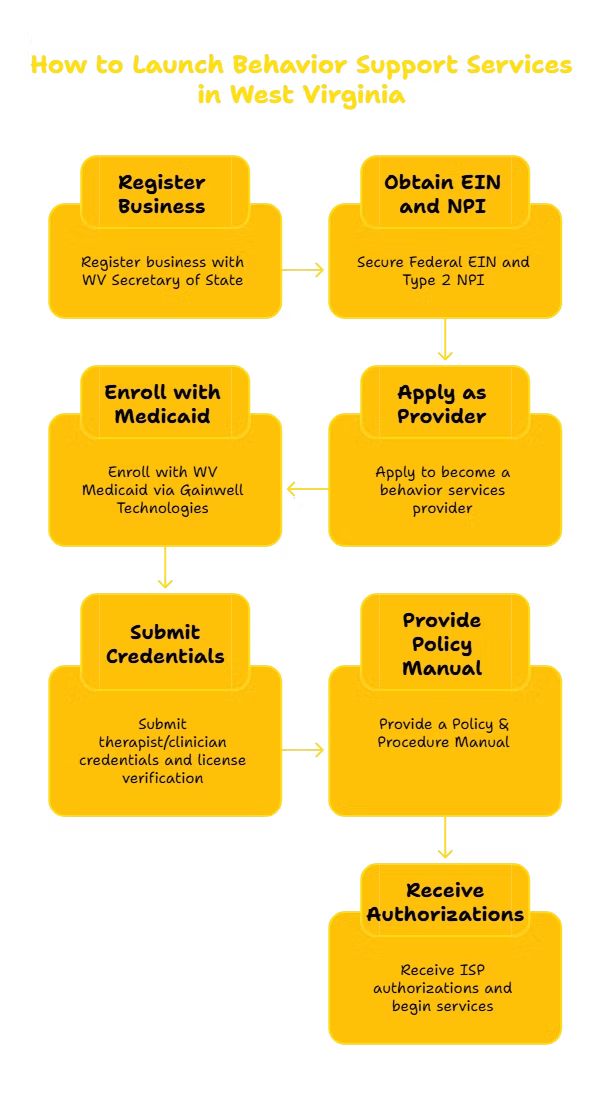
Launching a service agency requires a sequential, detail-oriented approach to state and federal requirements. The process begins with standard business formation—registering the entity with the West Virginia Secretary of State and obtaining a Federal Employer Identification Number (EIN) and a Type 2 National Provider Identifier (NPI). These foundational steps allow a provider to apply for formal participation in the I/DD Waiver or CSEDW programs.
Once registered, the provider must navigate the Medicaid enrollment process through Gainwell Technologies. This phase necessitates the submission of comprehensive clinical credentials, including the licenses of all BCBAs or LBAs associated with the agency. Additionally, the agency must present a detailed Policy & Procedure Manual that reflects established protocols for assessment, clinical intervention, incident reporting, and HIPAA compliance, all of which must be approved prior to receiving service authorizations for participants.
What Documentation Is Required for Ongoing Compliance?
High-quality documentation is the cornerstone of a successful audit and is essential for maintaining eligibility as a Medicaid provider. Administrators must establish an internal system for maintaining records that track the entire lifecycle of a participant’s service, from initial assessment through to ongoing progress monitoring. This includes clear documentation of the FBA process, consent forms for interventions, and detailed logs of all staff and caregiver training sessions.
Providers must maintain organized records for incident tracking and crisis debriefing, ensuring that every significant behavioral event is documented according to state standards. Because Behavior Support Services often involve interdisciplinary collaboration, the agency should utilize standardized templates for sharing updates with the participant's case manager and family members. Accurate billing documentation, which must align precisely with the service authorizations received through Acentra Health, is vital to ensure continuous reimbursement and program integrity.
What Are the Staffing and Credentialing Mandates?
West Virginia enforces strict staffing requirements to ensure that individuals with behavioral needs receive care from highly qualified professionals. All lead clinicians must be Licensed Behavior Analysts (LBA) or Board Certified Behavior Analysts (BCBA) who hold an active license in the state of West Virginia. These professionals are responsible for the clinical oversight of the program, including the supervision of any behavior support technicians working under their direction.
Beyond licensure, the agency is responsible for ensuring that every staff member completes the necessary background checks through WV CARES. Comprehensive training is mandatory for all personnel, covering critical areas such as HIPAA privacy regulations, client rights, and ethics in behavioral practice. Furthermore, staff must be proficient in positive behavior support models and proven de-escalation techniques, such as MANDT or CPI, to maintain a safe and supportive environment for all participants.
Frequently Asked Questions
How long does the provider enrollment process typically take?
The timeline varies based on the completeness of your initial application and the speed of credentialing, but typically takes several months. Business registration takes approximately 2–3 weeks, Medicaid enrollment and licensing documentation usually span 1–2 months, and developing your policy manual and credentialing staff can take an additional 30–45 days.
Which Medicaid waivers cover these services?
Behavior Support Services are primarily funded through the Intellectual/Developmental Disabilities (I/DD) Waiver and the Children with Serious Emotional Disorder Waiver (CSEDW). In limited cases, the Traumatic Brain Injury Waiver (TBIW) may provide coverage, and state-plan Medicaid may fund behavioral health services for youth under EPSDT.
What is the role of Acentra Health in the service process?
Acentra Health acts as the utilization review agent for the state. They are responsible for reviewing and approving your service requests to ensure they are medically necessary and consistent with the participant’s Individualized Service Plan. Providers must work closely with them to ensure that all submitted authorizations are supported by clinical data.
Key Takeaway
Launching a Behavior Support Services program in West Virginia requires a meticulous focus on clinical compliance, staff credentialing, and administrative documentation. By strictly adhering to the guidelines provided by WVDHHR, BMS, and Acentra Health, and by maintaining a robust Policy & Procedure Manual, providers can successfully deliver essential behavioral health supports that foster independence and stability for the individuals they serve.
Last verified: May 2024. The information provided in this article is for educational purposes only and does not constitute legal or professional medical advice. Regulatory requirements are subject to change; providers should consult directly with the West Virginia Department of Health and Human Resources (WVDHHR) and the Bureau for Medical Services (BMS) for the most current program updates and policy guidance.