BEHAVIOR SUPPORT SERVICES PROVIDER IN SOUTH CAROLINA
By Fatumata Kaba · 2025-10-13 · 6 min read
Becoming a Behavior Support Services provider in South Carolina is a strategic move for agencies looking to deliver high-impact, individualized care to individuals with intellectual or developmental disabilities (IDD) and behavioral health needs. By securing approval from the South Carolina Department of Disabilities and Special Needs (DDSN) and enrolling with the South Carolina Department of Health and Human Services (SCDHHS), providers gain the regulatory standing to deliver essential, Medicaid-reimbursable services that foster community inclusion and personal growth.
Understanding the Regulatory Landscape for South Carolina Behavior Support
The delivery of behavior support services in South Carolina is governed by a tripartite structure involving federal, state-level, and agency-specific oversight. At the federal level, the Centers for Medicare & Medicaid Services (CMS) sets the overarching standards for Home and Community-Based Services (HCBS), mandating that all interventions remain person-centered, promote participant autonomy, and adhere to strict quality assurance protocols. These requirements ensure that services are not merely custodial but are instead designed to meaningfully improve the quality of life for the individual.
At the state level, the SCDHHS manages the financial infrastructure, specifically Medicaid reimbursement and eligibility verification for the state’s various waiver programs. The DDSN acts as the primary oversight authority for clinical operations. This agency is responsible for the vetting of providers, the approval of behavior support programs, and the continuous monitoring of Individual Service Plans (ISPs). Success in this sector requires maintaining rigorous compliance with both the financial reporting mandates of SCDHHS and the clinical standards set by DDSN.
Core Components of High-Quality Behavior Support Services
Effective behavior support goes beyond simple intervention; it requires a systemic approach to skill-building and proactive environmental modification. Approved providers are tasked with conducting thorough Functional Behavior Assessments (FBA) to identify the "why" behind maladaptive behaviors. These assessments serve as the data-driven foundation for creating Behavior Support Plans (BSPs) that are tailored to the individual’s unique cognitive, emotional, and social profile.
Beyond the initial planning phases, providers must maintain a robust operational framework to support ongoing needs. This includes direct 1:1 behavioral support in natural environments, consistent caregiver training to ensure the maintenance of skills outside of clinical sessions, and continuous data collection. Documenting progress is essential, as Medicaid reimbursement depends heavily on the agency's ability to demonstrate that the services provided are medically necessary and consistent with the approved ISP.
- Functional Behavior Assessments (FBA): In-depth evaluations to identify triggers and patterns in behavior.
- Behavior Support Plans (BSPs): Individualized, proactive plans based on FBA outcomes.
- Ongoing Monitoring and Adjustment: Regular review of BSPs, data collection, and plan modifications.
- Direct Behavioral Support: 1:1 services in the home or community focused on skill-building and de-escalation.
- Caregiver Training: Instruction for family members and staff on how to implement behavior plans.
- Data Collection and Documentation: Session notes, behavior data sheets, progress summaries, and Medicaid-compliant records.
Navigating the Provider Enrollment and Approval Pathway
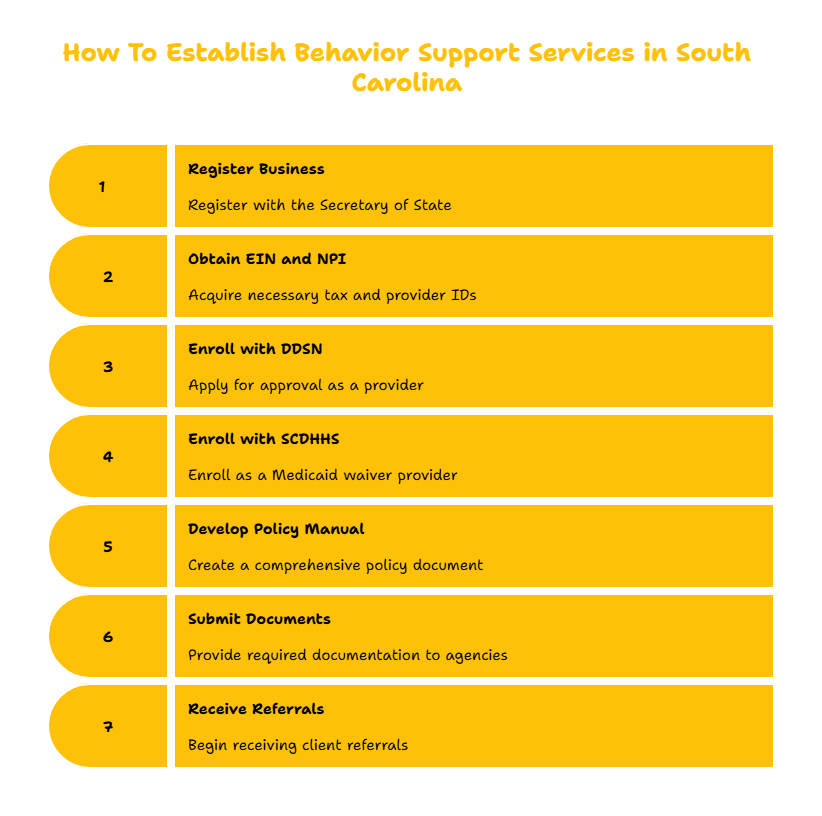
The path to becoming a recognized provider involves a structured sequence of administrative tasks. Before engaging with state agencies, a founder must first establish a formal business entity with the South Carolina Secretary of State, secure an Employer Identification Number (EIN), and obtain a Type 2 National Provider Identifier (NPI). These are the foundational credentials required to enter the state's provider network.
Once the business is legally established, the provider must navigate the dual-track application process. First, an application must be submitted to the DDSN to gain approval as a specialized behavior support provider. Concurrently, the agency must enroll in the Medicaid program through the SCDHHS provider portal. This process necessitates the submission of comprehensive internal documentation, including a detailed Policy & Procedure Manual that covers clinical protocols, staff training requirements, and protocols for participant rights and incident reporting.
Staffing, Training, and Clinical Supervision Standards
The quality of a behavior support program rests entirely on the credentials and ongoing training of its staff. The Behavior Support Professional or Specialist is typically required to hold a Master’s degree in psychology, behavior analysis, education, or a closely related field, and must often hold specific certifications, such as being a Board Certified Behavior Analyst (BCBA) or a licensed psychologist. These professionals lead the clinical charge, ensuring that all interventions are ethically sound and evidence-based.
Support staff, such as behavior technicians, play a critical role in carrying out the day-to-day implementation of BSPs. Regardless of their role, all personnel must undergo comprehensive training regarding HIPAA compliance, the prevention of abuse and neglect, and techniques for positive behavior support and de-escalation. Agencies are also required to implement systems for annual competency checks and continuing education, ensuring that staff stay current with evolving clinical best practices and state-specific regulatory changes.
Selecting the Appropriate Medicaid Waiver Programs
Behavior support services are funded through specific Medicaid HCBS waivers, each designed to serve a unique population. Agencies should familiarize themselves with these programs to better understand their target service population. The ID/RD Waiver serves individuals with intellectual or related developmental disabilities, while the Community Supports Waiver is often utilized for those who require less intensive, yet consistent, behavior support. The HASCI Waiver is specifically reserved for individuals with head or spinal cord injuries.
Furthermore, providers may be involved in supporting children through EPSDT or TEFRA mechanisms. Because each waiver has unique clinical criteria and billing rules, agencies must maintain clear, categorized records for every participant. Understanding these nuances allows for smoother service delivery and ensures that the agency is equipped to meet the diverse needs of the participants referred to them by case managers.
Frequently Asked Questions
What is the typical timeline for launching a behavior support agency?
The entire launch process generally spans 5 to 8 months. Business registration and initial policy development typically require 1–2 months, followed by 2–3 months for the DDSN and SCDHHS approval cycles. Finalizing staff credentials and setting up the referral network can take an additional 1–2 months.
What specific documentation must be included in a Policy & Procedure Manual?
A compliant manual must include protocols for functional behavior assessments, standardized BSP templates, data collection forms, and clear policies on staff supervision and continuing education. It must also detail procedures for ensuring participant rights, emergency intervention protocols, and Medicaid-ready billing and audit tools.
Are providers required to maintain specific insurance coverage?
Yes, all providers must maintain proof of professional liability and general liability insurance. These documents must be kept current and provided to state agencies upon request as part of the initial enrollment and subsequent renewal or audit processes.
Key Takeaways for Prospective Providers
Success as a Behavior Support Services provider in South Carolina hinges on three pillars: meticulous administrative compliance, the employment of highly qualified clinical staff, and the consistent application of person-centered care models. By aligning agency policies with the requirements of DDSN and SCDHHS from day one, administrators can build a stable, scalable, and effective organization that successfully navigates the complexities of the Medicaid waiver system.
Waiver Consulting Group’s Start-Up Assistance Service provides comprehensive support for professionals and agencies launching behavior support programs in compliance with Medicaid and DDSN guidelines. Our services cover Medicaid enrollment, DDSN provider setup, the development of Policy & Procedure Manuals, FBA and BSP templates, staff credentialing systems, and quality assurance tools.
Last verified: October 2023. This information is for educational purposes only and does not constitute legal or financial advice. Always verify current requirements directly through the South Carolina Department of Disabilities and Special Needs (DDSN) and the South Carolina Department of Health and Human Services (SCDHHS) websites.