Becoming a Medicaid Respite Provider in Michigan: Enrollment and Codes
By Fatumata Kaba · 2026-07-10 · 5 min read
Becoming a Medicaid respite provider in Michigan requires a structured approach that bridges state-level systems with regional administration. The process centers on navigating the CHAMPS enrollment portal and securing direct contracts with your specific Prepaid Inpatient Health Plan (PIHP) and Community Mental Health Services Program (CMHSP) service areas.
Understanding the Michigan Medicaid Respite Landscape
In Michigan, respite services are designed to provide temporary relief to primary caregivers of individuals with intellectual or developmental disabilities, serious emotional disturbances, or serious mental illness. Because Michigan administers these services through a managed care model, the state does not contract with every provider directly for every service. Instead, the Michigan Department of Health and Human Services (MDHHS) delegates the management of these services to regional PIHPs and local CMHSPs.
To operate as a provider, you must understand that your authority to deliver services is granted at the regional level. While CHAMPS serves as the primary gateway for Medicaid enrollment, the authorization to bill for specific respite services relies upon the contracts established between your agency and the local CMHSP or PIHP. This dual-layered structure ensures that services are tailored to the specific needs of the local populations served by these regional entities.
Navigating the CHAMPS Enrollment Portal
The Community Health Automated Medicaid Processing System, commonly known as CHAMPS, is the definitive portal for all Medicaid provider enrollments in Michigan. Before an agency can provide respite services or receive reimbursement, it must successfully register and be approved within this system. The enrollment process is rigorous and requires detailed disclosures regarding your business entity, ownership, and operational capacity.
During the CHAMPS enrollment process, ensure that your provider taxonomy accurately reflects the services you intend to deliver. Mismatched taxonomies can lead to billing rejections or the denial of claims once your contracts are active. Maintain current records in the portal at all times, as the regional entities (PIHPs and CMHSPs) will verify your status through the information contained in the CHAMPS database before approving you for their provider network.
Contracting with PIHPs and CMHSPs
Once you are enrolled in CHAMPS, the next critical step is establishing a contract with the PIHP or CMHSP in your target service area. Unlike state-level enrollment, which is a singular process, contracting is a localized endeavor. Each PIHP and CMHSP maintains its own provider network and credentialing requirements, meaning you may need to navigate separate application processes for every region in which you intend to operate.
These entities are responsible for managing the Medicaid budget and ensuring that providers meet the quality standards mandated by the state. During the contracting phase, expect the regional entity to review your internal policies, staff training records, and evidence of insurance. Being proactive in your outreach to the Provider Network Department at your local CMHSP is the most effective way to understand their specific submission timelines and local requirements.
Matching Qualifications to Billing Codes
Your ability to bill for respite services is directly tied to the qualifications of the staff you deploy. Michigan utilizes specific Healthcare Common Procedure Coding System (HCPCS) codes to distinguish between levels of care, ranging from unskilled assistance to complex nursing interventions. You must ensure that your agency has the infrastructure to track and verify staff certifications for the codes you select.
Documentation is the cornerstone of compliance. For every service provided, your records must clearly demonstrate that the staff member met the qualification requirements associated with the billed code. The following list outlines the spectrum of common respite delivery models:
- S5150: Unskilled respite services provided by trained, non-licensed staff to support activities of daily living.
- T1005: Respite services delivered by a Registered Nurse (RN) or Licensed Practical Nurse (LPN) to address medical needs.
- Modifier usage: Proper application of RN or LPN modifiers is essential for billing T1005; failing to include these specific modifiers often results in immediate claims denials.
Documenting Business and Operational Standards
Beyond clinical qualifications, your agency must prove its operational legitimacy to secure contracts. PIHPs and CMHSPs are held accountable for the performance and reliability of the providers within their networks. Consequently, they conduct thorough due diligence on all applicants to ensure they are prepared to handle the administrative burdens of Medicaid billing.
Prepare your business documentation well in advance of your contracting meetings. This typically includes, but is not limited to: proof of business registration with the State of Michigan, comprehensive professional liability insurance, and detailed staff training curricula. Furthermore, be prepared to demonstrate that your agency maintains a consistent system for background checks and personnel file management, as these are mandatory components of the state's provider requirements.
Frequently Asked Questions
Can I bill the state directly for respite services?
No. In Michigan, respite services are managed by the regional PIHPs and local CMHSPs. While you must enroll with the state via CHAMPS to be a Medicaid provider, the actual payment and authorization for services occur through the contracts you hold with your local regional entities.
Do I need different certifications for different respite codes?
Yes. The qualifications required to bill for a code are specific to the nature of the service. For example, unskilled respite (S5150) requires different training documentation than nurse-delivered respite (T1005). Your agency must maintain records verifying that every staff member possesses the credentials required for the specific code they are billing.
What if I want to provide services in multiple regions?
Because provider network management is decentralized, you will likely need to contract separately with each PIHP or CMHSP in every region where you intend to deliver services. Each entity may have its own unique credentialing processes and provider manual requirements that you must satisfy in addition to the state-level CHAMPS enrollment.
Key takeaway
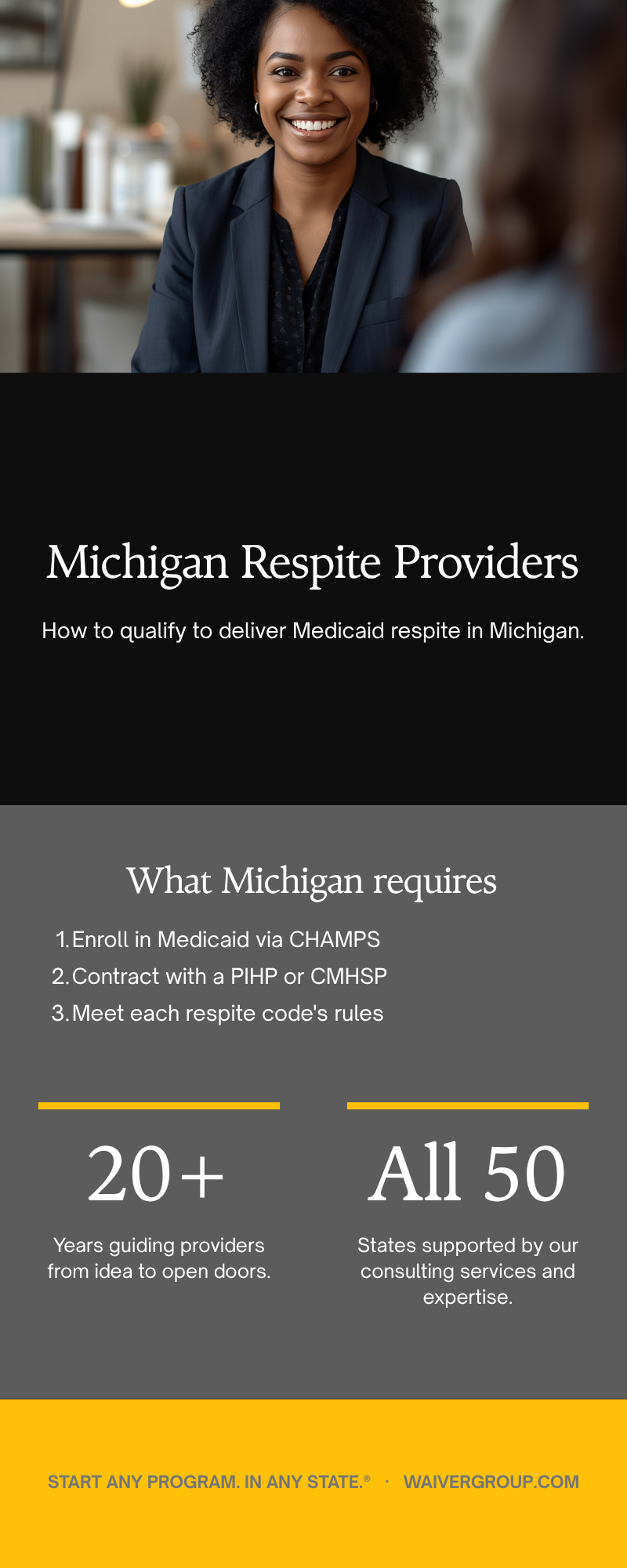
Enroll in Medicaid through CHAMPS, contract with your regional PIHP and local CMHSP, and match your qualifications to the respite codes you plan to bill. By aligning your internal credentialing with the specific codes and regional requirements, you establish a defensible and compliant foundation for your respite agency.
Start Any Program. In Any State.®
20+ years clearing the path in all 50 states — we've done this before, and we'll do it for you. Book a video consultation at waivergroup.com/videoappointment · 302.888.9172 · [email protected]