ATTENDANT & COMPANION CARE SERVICES PROVIDER IN SOUTH CAROLINA
By Fatumata Kaba · 2025-10-13 · 6 min read
Attendant and Companion Care Services in South Carolina are essential non-medical programs designed to provide daily living support, emotional companionship, and safety supervision to Medicaid waiver participants. By facilitating these services, provider agencies enable individuals with disabilities, aging adults, and those with specific health needs to maintain their independence and reside safely within their own homes rather than in institutional settings.
Understanding the Role of Attendant and Companion Care in South Carolina
In the South Carolina Medicaid landscape, Attendant and Companion Care are distinct but complementary services authorized under various Home and Community-Based Services (HCBS) waivers. These services are vital for participants who do not require skilled medical nursing but do need consistent assistance with the activities of daily living (ADLs) or protective oversight to ensure their well-being and community integration.
The core objective of these programs is to foster a person-centered environment where the participant’s autonomy is prioritized. By providing support with tasks such as mobility, grooming, and social engagement, providers act as a bridge that allows participants to remain active members of their local communities while receiving the necessary care to prevent accidents and health declines.
Regulatory Oversight and Governing Agencies
Navigating the South Carolina Medicaid system requires a clear understanding of the governing hierarchy. The South Carolina Department of Health and Human Services (SCDHHS) serves as the primary agency overseeing Medicaid reimbursement and ensuring that all service delivery meets federal and state compliance standards. Providers must align their operations with the requirements set forth by this department to remain in good standing.
For services targeting individuals with intellectual or developmental disabilities (IDD), the South Carolina Department of Disabilities and Special Needs (DDSN) acts as the authorizing body. Additionally, all programs must adhere to the federal person-centered planning and community-based service requirements mandated by the Centers for Medicare & Medicaid Services (CMS). Coordination between these entities ensures that care is standardized, effective, and compliant with both state and federal law.
Establishing Your Provider Business
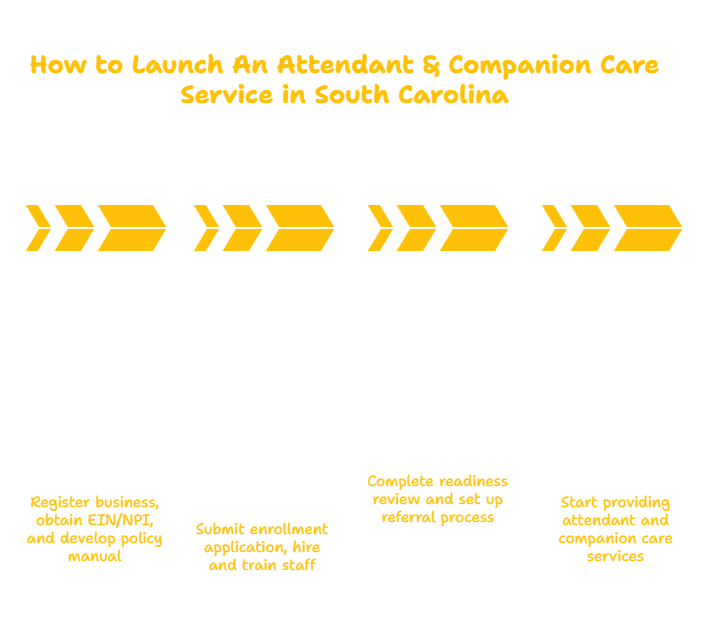
Launching a provider agency begins with formal business formation. Entrepreneurs must register their entity with the South Carolina Secretary of State and secure necessary foundational identifiers, including an Employer Identification Number (EIN) and a Type 2 National Provider Identifier (NPI). These are the prerequisites for any administrative interaction with Medicaid agencies.
Beyond legal registration, providers must develop a robust operational framework. This includes drafting a comprehensive Companion and Attendant Care Services Policy & Procedure Manual, which acts as the roadmap for your agency’s daily operations. Securing appropriate liability and workers' compensation insurance is also a critical step in protecting the agency, the staff, and the participants from unforeseen risks.
- Register business entity with the South Carolina Secretary of State
- Obtain federal EIN and Type 2 NPI
- Develop a comprehensive Policy & Procedure Manual
- Secure liability and workers’ compensation insurance
- Enroll as an authorized provider with SCDHHS or DDSN
The Provider Enrollment and Readiness Process
The enrollment journey is a multi-step process designed to ensure that the applicant is prepared to provide safe and effective care. Once the business is established, the agency must submit a formal enrollment application through SCDHHS or DDSN, depending on the specific waiver population they intend to serve. This application includes the submission of staff qualification documentation, service delivery plans, and proof of administrative readiness.
Following the document submission, agencies typically undergo a provider readiness review. This review is an assessment by state officials to verify that the agency has the systems in place to handle referrals, document care, and manage billing appropriately. Once successful, the agency is added to the list of approved providers and can begin accepting referrals from waiver case managers.
Essential Documentation and Operational Compliance
Maintaining meticulous records is the backbone of any successful Medicaid provider agency. From the initial intake of a participant to the final billing of a shift, every action must be documented to satisfy audit requirements. This includes accurate timesheets, daily activity logs, incident reports, and ongoing service plans that reflect the participant’s evolving needs.
Your Policy and Procedure Manual must address critical operational areas, including HIPAA compliance to protect participant health information, emergency response protocols for when a participant is in distress, and clear procedures for reporting suspected abuse or neglect. These documents are not merely administrative requirements; they serve as a safeguard for both the provider and the participant.
Staffing, Training, and Professional Development
The quality of your agency is directly tied to the competency of your direct care staff. Whether the individual is serving as an Attendant or a Companion, they must meet the specific credentialing requirements set by the state. This generally includes passing rigorous background checks and obtaining CPR and First Aid certifications to ensure they are prepared for medical emergencies.
Beyond initial hiring requirements, ongoing professional development is mandatory. Staff must receive continuous training in areas such as infection control, documentation standards, and the nuances of working with diverse populations. Program supervisors are responsible for the oversight of these staff members, ensuring that every interaction follows the participant's plan of care and that documentation remains current and accurate.
- Verified high school diploma or GED
- Completed state-mandated background checks
- Mandatory CPR and First Aid certifications
- Ongoing HIPAA and abuse/neglect prevention training
- Annual competency reviews and performance evaluations
Waiver Programs and Scope of Services
Attendant and Companion Care services are integrated into several key South Carolina Medicaid waivers. These include the Community Supports Waiver, the ID/RD Waiver, the HASCI Waiver for those with head and spinal cord injuries, and the Community Long Term Care (CLTC) program for aging adults. Additionally, some participants utilize self-directed waiver models, allowing them to participate in the selection and management of their care providers.
Regardless of the specific waiver, the scope of work remains focused on non-medical support. This encompasses assistance with daily activities—such as dressing, grooming, and mobility—as well as safety monitoring and providing the social stimulation necessary for emotional well-being. Providers must ensure that the services delivered strictly align with the authorized service plan for each specific participant.
Frequently Asked Questions
What is the difference between Attendant Care and Companion Care?
Attendant Care generally involves hands-on assistance with activities of daily living (ADLs) like bathing, grooming, and mobility. Companion Care focuses primarily on social interaction, community engagement, safety supervision, and light non-medical tasks that promote the participant's emotional well-being.
Can a provider start delivering services immediately upon business registration?
No. A provider must complete the formal enrollment process with SCDHHS or DDSN and pass a provider readiness review before they can be authorized to provide services and receive Medicaid reimbursement.
What are the primary training requirements for direct care staff?
All direct care staff must be trained in HIPAA and confidentiality, abuse and neglect prevention and reporting, infection control, emergency response, and proper documentation procedures. These trainings must be completed during onboarding and updated annually.
Key Takeaway: Successfully launching an Attendant and Companion Care agency in South Carolina requires a disciplined approach to business formation, regulatory compliance, and staff training. By strictly adhering to the guidelines set by SCDHHS and DDSN, providers can build a sustainable organization that consistently delivers high-quality, person-centered care to Medicaid waiver participants.
Last verified: 2024. This article is for informational purposes only and does not constitute legal or professional medical advice. Always consult with the South Carolina Department of Health and Human Services (SCDHHS) or the South Carolina Department of Disabilities and Special Needs (DDSN) for the most current regulations and program requirements.