ASSISTIVE TECHNOLOGY SERVICES PROVIDER IN WYOMING
By Fatumata Kaba · 2026-04-14 · 5 min read
Becoming an Assistive Technology (AT) services provider in Wyoming involves navigating the state's Medicaid requirements to deliver essential tools that enhance the independence, communication, and safety of participants. By partnering with the Developmental Disabilities Division (DDD) and Medicaid Provider Services, organizations can offer devices and services—ranging from smart home systems to specialized mobility aids—that are critical to the function of individuals enrolled in Home and Community-Based Services (HCBS) waivers. This guide outlines the regulatory, operational, and clinical standards necessary for agencies to successfully provide these life-changing technologies.
How Do AT Services Empower Wyoming Medicaid Participants?
Assistive Technology services provide the vital infrastructure for individuals with disabilities or chronic conditions to live securely in their homes rather than in institutional settings. By integrating customized technology solutions, providers help participants bridge the gap between their functional limitations and their personal goals. These services encompass not just the hardware itself, but the professional expertise required to assess, install, and train participants on how to use their new tools effectively.
Covered devices and supports are diverse and highly personalized, ensuring that each participant receives exactly what they need to thrive. Whether a participant requires a speech-output device to communicate or an environmental control unit to manage their living space independently, the goal is always to promote self-sufficiency. Key categories of support include:
- Communication devices, such as AAC systems and speech output tools.
- Mobility aids, including smart canes and voice-controlled interface devices.
- Environmental control units, such as smart home systems and remote door openers.
- Adaptive switches and specialized technology for recreation or learning.
- Sensory regulation and behavioral support devices.
- Visual and auditory alert systems for safety and independence.
- Medication dispensers and remote health monitoring tools.
- Professional services including device setup, customization, and user training.
What Are the Governing Agencies and Regulatory Requirements?
The Wyoming Department of Health serves as the primary regulatory body for AT services. The Developmental Disabilities Division (DDD) and the Division of Healthcare Financing define the scope of covered items and establish the clinical eligibility criteria that participants must meet. Because AT services are generally authorized through an Individualized Plan of Care (IPC), providers must work closely with Case Management Agencies and Public Health Nursing (PHN) to ensure that each device meets the test of functional necessity.
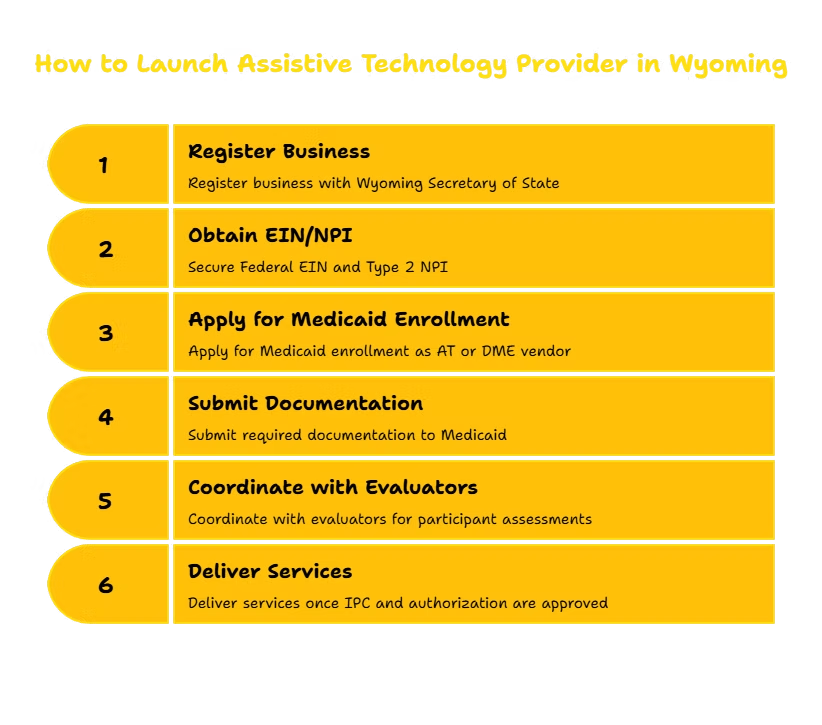
Before launching services, agencies must establish a solid administrative foundation. This begins with registering the business with the Wyoming Secretary of State and obtaining a Federal EIN and Type 2 NPI. Providers must then navigate the formal Medicaid enrollment process, ensuring that all policies and procedures are documented. Because many AT devices are considered Durable Medical Equipment (DME), adherence to both state-specific Medicaid guidelines and federal standards for equipment safety is mandatory.
How Do You Structure Your Agency for Clinical Compliance?
Successful AT providers do not operate in a vacuum; they function as part of a multidisciplinary team. A critical component of this structure is the partnership with licensed professionals, such as Occupational Therapists (OTs), Physical Therapists (PTs), Speech-Language Pathologists (SLPs), or certified Assistive Technology Professionals (ATPs). These individuals are responsible for conducting the functional evaluations that justify the medical necessity of the technology, which is a core requirement for Medicaid reimbursement.
Beyond clinical evaluators, the agency itself must maintain robust internal documentation. An Assistive Technology Services Policy & Procedure Manual is not merely a suggestion; it is a vital tool for compliance. This manual must detail the workflow for everything from the initial assessment to the final delivery and training. Furthermore, agencies must ensure all staff are thoroughly vetted, which includes background checks and rigorous training on HIPAA, participant rights, and the specific maintenance requirements for the equipment they provide.
What Is the Required Workflow for Medicaid Enrollment?
The enrollment timeline follows a systematic progression designed to ensure that providers are fully prepared to support vulnerable populations. The process generally begins with the formal registration of the business and the acquisition of the necessary tax and provider identifiers. Once these basics are in place, the agency submits an application for Wyoming Medicaid provider enrollment specifically as an AT or DME vendor.
During the application phase, providers must be prepared to submit comprehensive documentation, including detailed service manuals, fee schedules, and clear warranty policies. Once the state approves the provider, the agency enters the active phase of operations: coordinating with case managers and evaluators. Because services are tied to the participant's IPC, the provider must be adept at facilitating the authorization process, ensuring that every piece of equipment delivered is explicitly covered and justified.
Which Medicaid Programs Support Assistive Technology?
AT services are accessed through several distinct Wyoming Medicaid programs, each tailored to specific demographics. The Comprehensive Waiver and the Supports Waiver, both managed by the DDD, are the primary vehicles for individuals with intellectual and developmental disabilities. For older adults and individuals with physical disabilities, the Community Choices Waiver (CCW) provides the necessary coverage to support aging in place.
Additional support pathways exist for younger populations and those with complex needs. Early and Periodic Screening, Diagnostic, and Treatment (EPSDT) services cover medically necessary technology for individuals under age 21. Furthermore, the Katie Beckett Program serves as a vital resource, offering AT support for children with significant medical needs who may not otherwise meet traditional Medicaid eligibility criteria. Regardless of the program, the consistent rule is that all equipment must be medically necessary, cost-effective, and fully authorized within the participant’s care plan.
Frequently Asked Questions
What is the primary role of an Assistive Technology Professional (ATP) in the waiver process?
An ATP, or other licensed therapist like an OT or PT, conducts the functional evaluation of the participant. They identify which specific devices will meet the participant’s needs and write the recommendation report that serves as the clinical justification for the Medicaid authorization request.
Can an agency provide AT services without a physical storefront in Wyoming?
While the business must be registered with the Wyoming Secretary of State and have a valid NPI for billing, the delivery of AT services is often mobile. Providers must, however, have a documented system for equipment storage, maintenance, and safe delivery as outlined in their approved Policy & Procedure Manual.
What should be included in an Assistive Technology Services Policy & Procedure Manual?
The manual must detail equipment recommendation and assessment workflows, service delivery protocols, device setup procedures, warranty/repair/return policies, HIPAA compliance, and staff training requirements. It should also include templates for justification letters and incident reporting.
Key Takeaway
Establishing an Assistive Technology agency in Wyoming requires a blend of administrative precision, clinical collaboration, and strict adherence to Medicaid HCBS waiver standards. By maintaining high-quality documentation, securing professional partnerships with qualified evaluators, and focusing on the clear functional necessity of every device, providers can effectively support participant independence while ensuring long-term operational success.
Last verified: 2024. This information is for educational purposes only and does not constitute legal or professional medical advice. Always consult with the Wyoming Department of Health and current state Medicaid provider manuals for the most recent updates to regulations and policy requirements.