ASSISTIVE TECHNOLOGY SERVICES PROVIDER IN WISCONSIN
By Fatumata Kaba · 2026-04-14 · 5 min read
Becoming an Assistive Technology (AT) services provider in Wisconsin involves navigating a highly structured Medicaid waiver landscape to bridge the gap between innovation and individual functional needs. By securing enrollment through ForwardHealth and aligning operations with the specific requirements of programs like IRIS, Family Care, and the Children’s Long-Term Support (CLTS) Waiver, businesses can provide essential tools that promote independence, safety, and community integration for individuals with disabilities.
What is the Scope of Assistive Technology Services in Wisconsin?
Assistive Technology encompasses a broad spectrum of devices and services designed to help individuals with disabilities overcome physical or cognitive barriers. In the Wisconsin Medicaid context, this service is defined not just by the hardware itself, but by the comprehensive support structure surrounding it, including professional evaluations, precise customization, expert installation, and ongoing user training.
To be eligible for funding, these solutions must be directly tied to a functional necessity identified within a participant’s Individualized Service Plan (ISP) or Plan of Care. Providers are tasked with ensuring that each device is cost-effective and directly contributes to a participant’s goal of increased independence, enhanced safety, or improved communication within their home and community environment.
Which Agencies Govern AT Services and How Do They Interact?
The Wisconsin Department of Health Services (DHS) serves as the primary governing authority, establishing the policy framework that dictates how AT is delivered and monitored across all state Medicaid waiver programs. Working in tandem, ForwardHealth functions as the operational backbone, managing the critical tasks of provider enrollment, service authorization, and the processing of payments for approved AT devices and services.
On the ground, IRIS Consultant Agencies and Managed Care Organizations (MCOs) act as the gatekeepers for funding, reviewing individual assessments and service plans to determine if a specific AT intervention meets the threshold for medical or functional necessity. Additionally, the Wisconsin Assistive Technology Program (WisTech) acts as a valuable resource, offering guidance, device demonstrations, and loan programs that assist both providers and participants in identifying the most effective technology for their unique circumstances.
What Are the Essential Prerequisites for Provider Approval?
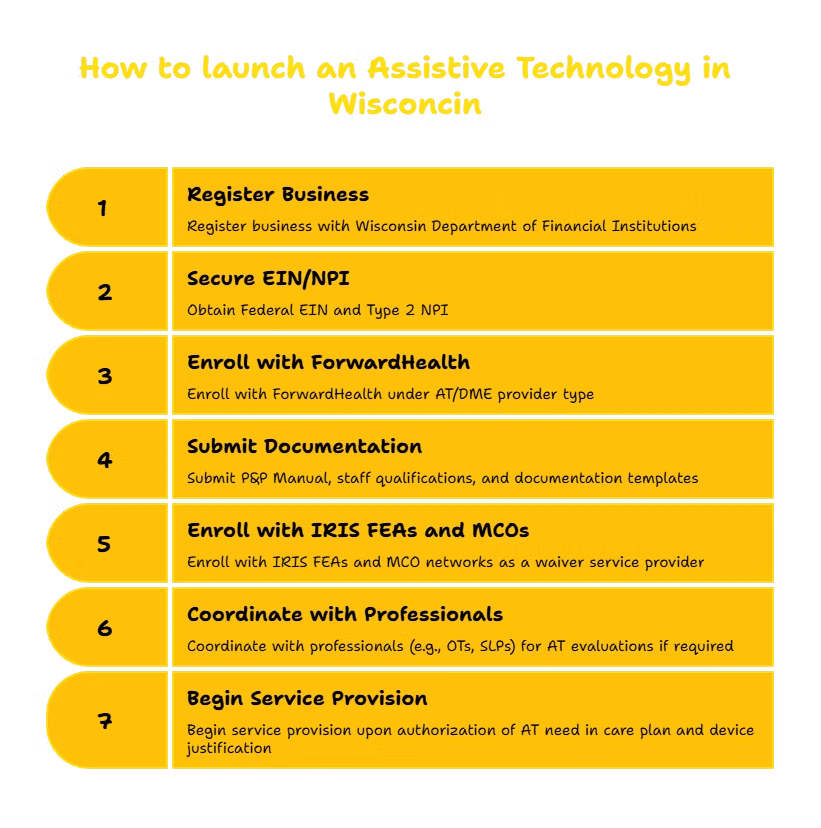
Prospective providers must establish a solid administrative foundation before attempting to secure contracts with IRIS or MCO networks. This begins with formal business registration through the Wisconsin Department of Financial Institutions (DFI) and the acquisition of a Federal EIN and a Type 2 NPI. These identifiers are mandatory for any entity seeking to engage in billing for professional health services.
Following registration, an applicant must undergo the ForwardHealth enrollment process specifically for the AT or Durable Medical Equipment (DME) categories. This requires the development of a robust Assistive Technology Policy & Procedure Manual, which must detail how the business maintains safety standards, manages warranties, and ensures client confidentiality. Furthermore, providers should cultivate relationships with qualified professionals, such as Occupational Therapists, Speech Pathologists, or ATP-certified specialists, to fulfill the evaluation requirements mandated by the state.
How Should Providers Structure Their Operational Documentation?
A comprehensive Policy & Procedure Manual is the cornerstone of regulatory compliance and audit readiness. This document must clearly articulate the full lifecycle of an AT intervention, starting from the initial evaluation and recommendation process through to the final setup and user training. It must explicitly outline how the provider handles device repairs, maintenance, and the delicate logistics of returns or warranty exchanges.
Providers must also create standardized documentation templates to ensure consistency and compliance. Essential templates include:
- Justification of need forms that link the AT to specific functional deficits.
- Comprehensive AT delivery and training checklists.
- Evaluation summaries that document the participant's reaction to the technology.
- Follow-up assessment forms to track the effectiveness of the AT over time.
What Are the Staffing and Competency Requirements?
The success of an AT program hinges on the expertise of its staff. Technical personnel responsible for installation, customization, and device programming must possess documented experience with equipment functionality and a thorough understanding of Medicaid waiver requirements. Prior to interacting with participants, these staff members must undergo rigorous onboarding, including background check clearance, and training in participant-centered instruction, HIPAA compliance, and abuse/neglect reporting.
For high-cost or highly complex equipment, the involvement of a licensed professional—such as an Occupational Therapist, Physical Therapist, Speech-Language Pathologist, or an Assistive Technology Professional (ATP) certified individual—is often required. These professionals are responsible for conducting clinical assessments and providing the professional recommendations that underpin the authorization of the device. All staff must be well-versed in equipment safety, troubleshooting, and the ethical standards required when working in diverse community settings.
Frequently Asked Questions
What is the typical timeline to launch an AT business in Wisconsin?
The launch process generally follows a three-phase timeline. Initial business registration and policy manual development typically take 2–3 weeks. Securing partnerships with clinicians and enrolling in the necessary categories takes 30–45 days. Finally, completing the full ForwardHealth and waiver program enrollment usually requires 2–3 months of processing time before services can officially commence.
Does the CLTS Waiver cover all types of assistive technology?
The Children’s Long-Term Support (CLTS) Waiver covers a wide range of AT and related supports for eligible children, provided the equipment is necessary to achieve care plan goals and is cost-effective. The specific authorization depends on the child's identified needs and the professional justification provided during the evaluation process.
Are there specific requirements for managing AT repairs and warranties?
Yes. Providers are required to maintain clear policies on repair, maintenance, and warranty tracking. These protocols must be documented in the provider’s manual and should cover the procedures for notifying the participant or their guardian when equipment requires servicing, ensuring that the participant’s safety and access are not compromised during the repair period.
Waiver Consulting Group’s Start-Up Assistance Service — Wisconsin Assistive Technology Provider
WCG assists device vendors, AT consultants, and community agencies in navigating the complex regulatory requirements to become authorized providers across Wisconsin’s waiver programs. Our services include:
- ForwardHealth enrollment assistance under AT and DME categories.
- Development of comprehensive AT Policy & Procedure Manuals.
- Creation of standardized evaluation and recommendation form templates.
- Drafting of vendor-client agreements and warranty documentation.
- Establishment of staff credentialing and specialized training protocols.
- Design of efficient setup, delivery, and user instruction workflows.
- Dedicated compliance and audit readiness support.
Key Takeaway: Successfully operating as an Assistive Technology provider in Wisconsin requires a disciplined approach to documentation, strict adherence to ForwardHealth enrollment standards, and the integration of professional clinical assessments to justify the necessity of every device. By focusing on these administrative pillars, providers can effectively scale their services while remaining fully compliant with state waiver requirements.
Last verified: October 2023. This content is provided for informational purposes only and does not constitute legal or professional advice. Requirements for Medicaid waiver programs are subject to change. Please consult official Wisconsin Department of Health Services (DHS) documentation and ForwardHealth provider manuals for the most current regulations and policy updates.