ASSISTIVE TECHNOLOGY SERVICES PROVIDER IN WASHINGTON
By Fatumata Kaba · 2026-04-06 · 6 min read
Becoming an Assistive Technology (AT) services provider in Washington requires a strategic integration of clinical expertise, regulatory compliance, and administrative infrastructure. By delivering essential tools, equipment, and training, these providers empower individuals with disabilities to enhance their independence, safety, and communication capabilities within their own homes and communities.
Operating as a Medicaid-approved provider involves navigating the requirements set forth by the Developmental Disabilities Administration (DDA) and the Health Care Authority (HCA). This guide outlines the essential steps for establishing a professional AT practice, ensuring that your organization is positioned to meet the rigorous standards necessary to serve participants effectively through Washington’s HCBS waivers.
What Are the Roles of Governing Agencies in Washington?
The landscape of Medicaid-funded assistive technology in Washington is governed by a tripartite structure of state oversight. The Developmental Disabilities Administration (DDA) serves as the primary gateway for waiver participants; they are responsible for authorizing specific AT services and ensuring that providers adhere to the state’s quality and safety standards. Without DDA authorization, services cannot be billed through the waiver program.
The Health Care Authority (HCA) maintains the broader administrative role of managing Medicaid funding through Apple Health. The HCA defines how AT is categorized within the State Plan and waiver programs, ensuring consistency in how funds are allocated. Simultaneously, the Department of Social and Health Services (DSHS) oversees the administration of the HCBS waivers and holds the direct contracts with qualified AT providers, acting as the operational link between state policy and service delivery.
How Do You Define the Scope of Assistive Technology Services?
Assistive Technology encompasses a wide spectrum of interventions, ranging from low-tech communication boards to sophisticated smart-home ecosystems. Providers are expected to supply both the physical equipment and the professional services necessary for the successful integration of that technology into a participant's daily life. This includes the initial needs assessment, device selection, customization, and long-term maintenance.
Common examples of covered AT include speech-generating communication devices, adaptive computer access tools like screen readers or switches, and environmental controls such as voice-activated lighting. Furthermore, the scope includes smart home safety devices—such as fall detectors and automated medication reminders—and custom mounting systems. Crucially, the provider’s role extends to the "soft" services of fitting, installation, and rigorous training for both the individual and their primary caregivers to ensure the technology is used safely and effectively.
- Communication devices (e.g., speech-generating devices)
- Hearing or vision aids (if not already covered under other benefits)
- Environmental controls (e.g., voice-activated lights, adaptive remotes)
- Computer access tools (adaptive keyboards, switches, screen readers)
- Mounting systems or custom adaptations
- Smart home safety devices (e.g., fall detectors, medication reminders)
What Are the Licensing and Enrollment Requirements for Providers?
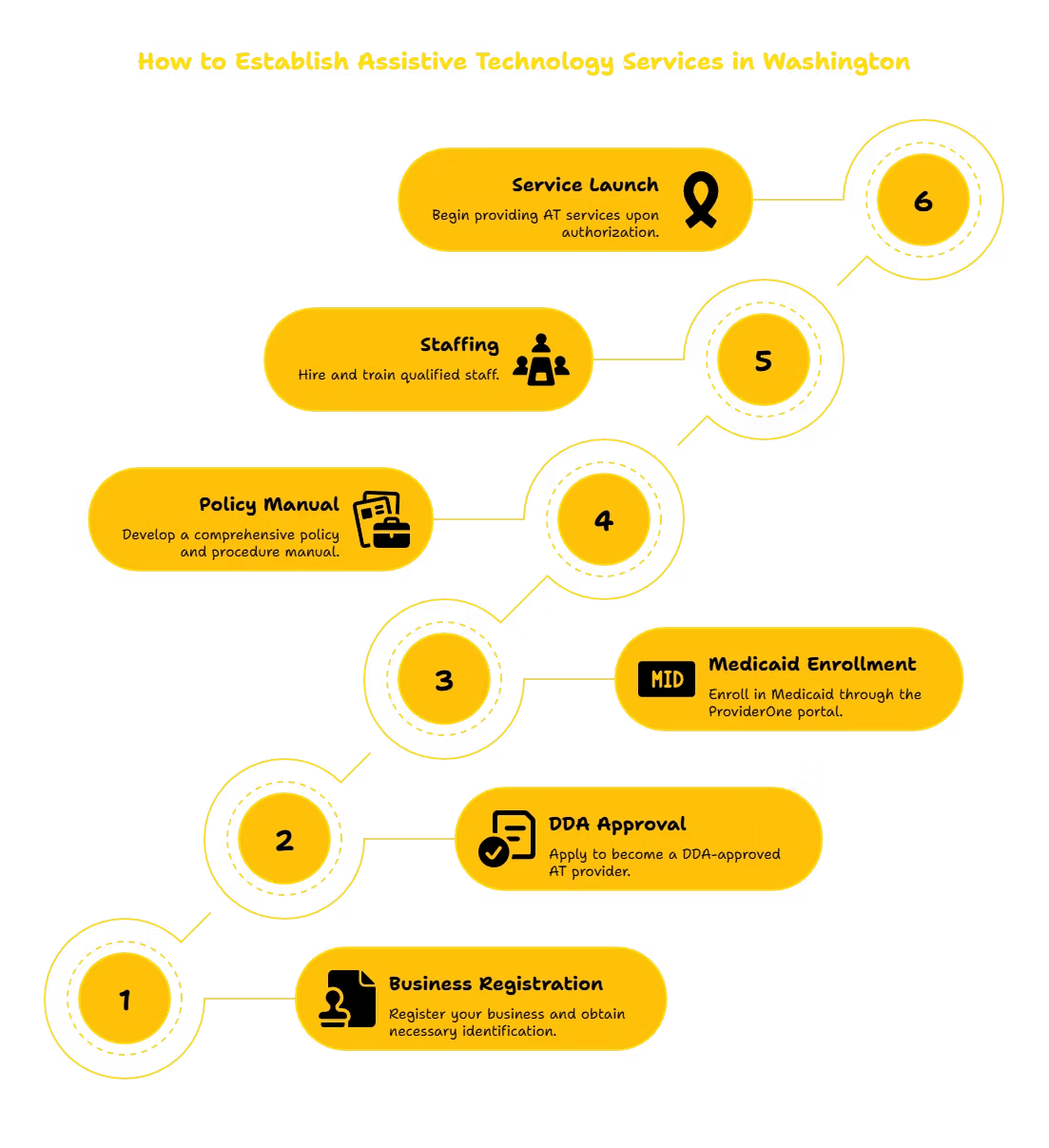
The journey toward becoming a recognized provider begins with the formal establishment of a business entity. You must register your business with the Washington Secretary of State and obtain an Employer Identification Number (EIN) and a Type 2 National Provider Identifier (NPI). These identifiers are fundamental to the Medicaid billing infrastructure and represent the formal identity of your agency in the eyes of the state.
Once the business entity is established, you must apply to become a DDA-approved Assistive Technology Provider. This is followed by enrollment in the Medicaid program through the ProviderOne portal, which serves as the central hub for billing and authorization. Additionally, if your services include the supply of durable medical equipment (DME), you must ensure you have secured the appropriate DME licensing. Developing a comprehensive Policy & Procedure Manual is a critical prerequisite, as it acts as your foundational document for compliance, staff credentialing, and clinical service delivery.
How Should You Structure Your Staffing and Clinical Competency?
Staffing requirements for AT providers are focused on specialized technical and clinical knowledge. The primary role, the Assistive Technology Specialist or Consultant, should ideally hold a RESNA ATP (Assistive Technology Professional) certification or maintain active licensure as an Occupational Therapist (OT) or Physical Therapist (PT). These professionals are responsible for the critical evaluation of client needs and the selection of appropriate technological solutions.
For technicians and installers, the focus shifts to hardware assembly, device configuration, and site safety. Regardless of the role, all staff members must undergo thorough training in HIPAA compliance, participant rights, and informed consent. Furthermore, providers must maintain rigorous documentation of ongoing technical and clinical competency evaluations. This ensures that every staff member interacting with participants is fully prepared to handle the delicate balance of technology, medical necessity, and person-centered care.
Which Medicaid Waivers and Programs Cover Assistive Technology?
Assistive Technology is a vital component of several Washington Medicaid programs, each designed to address specific needs across the disability community. The Basic Plus Waiver and the Core Waiver are the primary vehicles for individuals living in family or supported settings who require long-term AT integration to maintain independence. The Individual and Family Services (IFS) Waiver also covers AT, though it is subject to an annual budget cap that providers must monitor closely.
Beyond the primary waiver programs, the Community First Choice (CFC) program provides coverage for AT items specifically designed to promote functional independence. In some instances, school-based or vocational rehabilitation programs may co-fund assessments or devices if the technology serves a dual purpose in educational or employment settings. It is imperative that every AT request is substantiated by documentation of medical necessity and is formally included in the individual’s Person-Centered Service Plan (PCSP).
Frequently Asked Questions
Is a RESNA ATP certification required to become a provider?
While not explicitly mandated in every instance by state statute, holding a RESNA ATP certification is highly preferred and strongly recommended. It serves as professional validation of your expertise in matching technology to the specific clinical needs of waiver participants.
How long does the entire setup process typically take?
The timeline for a new provider generally spans 8 to 14 weeks. This includes 2-3 weeks for business registration, 4-6 weeks for DDA approval and Medicaid enrollment, and 2-3 weeks for internal manual development and staff onboarding. Service launch occurs only after these milestones are met and individual PCSP authorizations are in place.
What documentation is essential for billing?
To ensure successful reimbursement, you must maintain clear documentation that includes the initial evaluation, proof of medical necessity, installation logs, staff training records, and evidence that the service is explicitly listed in the participant’s PCSP. All records must be HIPAA-compliant and readily available for state audits.
Key Takeaway
Establishing an Assistive Technology service in Washington is a multi-phased process that demands strict adherence to DDA and HCA regulations. By focusing on robust policy development, specialized staff credentialing, and seamless integration with the ProviderOne portal, agencies can provide high-quality, sustainable technology solutions that significantly improve the lives of individuals with disabilities across the state.
Waiver Consulting Group’s Start-up Assistance Service provides the administrative and clinical scaffolding needed to launch a compliant AT agency. From drafting your Policy & Procedure Manual to supporting your DDA and ProviderOne enrollment, our service ensures you have the templates, client intake forms, and billing workflows necessary to operate effectively. We specialize in preparing providers for the technical and regulatory demands of the Washington Medicaid landscape.
Last verified: October 2023. This information is for educational purposes only and does not constitute legal or professional advice. Always consult with the Washington State DSHS and HCA for the most current regulatory guidance and official policy updates.