ASSISTIVE TECHNOLOGY SERVICES PROVIDER IN VIRGINIA
By Fatumata Kaba · 2026-04-08 · 6 min read
DELIVERING PERSONALIZED TECHNOLOGICAL SOLUTIONS THAT ENHANCE COMMUNICATION, MOBILITY, INDEPENDENCE, AND DAILY LIVING FOR INDIVIDUALS WITH DISABILITIES
Assistive Technology (AT) Services in Virginia enable individuals with disabilities to overcome functional barriers through the assessment, acquisition, customization, and training of specialized devices. By providing these essential tools, providers empower Medicaid waiver participants to achieve greater autonomy, ensuring they can actively participate in their homes, workplaces, schools, and the broader community.
This service is authorized under Virginia’s Community Living (CL) Waiver, the Family and Individual Supports (FIS) Waiver, and the Commonwealth Coordinated Care Plus (CCC Plus) Waiver. Oversight for these programs is maintained by the Virginia Department of Medical Assistance Services (DMAS), with service coordination managed through regional Community Services Boards (CSBs) or private Managed Care Organizations (MCOs).
How Do Governing Agencies Oversee Assistive Technology Services?
The regulatory landscape for Assistive Technology in Virginia is structured to ensure that every device provided is medically necessary and directly supports the participant’s Individual Support Plan (ISP). The Virginia Department of Medical Assistance Services (DMAS) serves as the primary authority, administering waiver coverage policies and overseeing the mandatory provider enrollment process. Without DMAS-approved enrollment, a business cannot bill for AT services under the Medicaid program.
For individuals enrolled in the Community Living (CL) and Family and Individual Supports (FIS) waivers, the local Community Services Boards (CSBs) act as the primary point of contact for service authorization. They ensure that all requested technology aligns with the goals outlined in the participant’s ISP. Conversely, for those under the CCC Plus Waiver, service authorizations are processed through Managed Care Organizations (MCOs), which manage care coordination and service approval for individuals with complex medical needs or physical disabilities.
What Are the Core Components of Assistive Technology Services?
Assistive Technology services are comprehensive, moving beyond the simple delivery of a device. The service model focuses on a lifecycle of support that begins with a professional evaluation to identify the specific needs of the participant. Once a need is established, the provider assists in the acquisition of the technology, performs necessary customizations, and delivers rigorous training to the participant and their caregivers to ensure the device is used effectively and safely.
Common examples of covered technologies that fall under this service umbrella include:
- Communication devices, such as speech-generating devices and Augmentative and Alternative Communication (AAC) systems.
- Adaptive switches and specialized software designed for computer or mobile device access.
- Environmental control units, including smart home technology and remote-access systems.
- Augmented vision or hearing tools to assist with daily living tasks.
- Adapted educational and learning devices that facilitate skill acquisition.
- Customized seating systems and ergonomic tools designed for comfort and mobility.
- Modifications to existing technologies to ensure universal accessibility.
It is vital to remember that all devices must be deemed medically necessary. Furthermore, they must be explicitly linked to established ISP goals and must not be covered under other available insurance plans or programs.
What Are the Licensing and Provider Approval Prerequisites?
Entering the Virginia Medicaid market as an AT provider requires a structured approach to administrative compliance. Before a provider can begin delivering services or seeking reimbursement, they must establish a formal business entity and meet all state-mandated documentation requirements. This includes registering the business with the Virginia State Corporation Commission (SCC) and obtaining a federal Employer Identification Number (EIN) and a Type 2 National Provider Identifier (NPI).
Additionally, providers must demonstrate that they have the internal infrastructure necessary to maintain high standards of care. This involves developing a comprehensive Assistive Technology Services Policy & Procedure Manual that covers evaluation procedures, ethical client interaction, device maintenance, and data privacy protocols. Once the infrastructure is ready, the agency must enroll as a formal Medicaid provider through the MES portal and establish active contracts with the relevant CSBs for CL/FIS waiver participants or MCOs for CCC Plus waiver participants.
How Should a Provider Manage Staffing and Documentation?
Staffing requirements are centered on expertise, as the success of the technology often depends on the quality of the assessment. Providers must hire or contract with a qualified Assistive Technology Professional (ATP), ideally holding a RESNA certification, or a licensed therapist with verifiable experience in assistive technology. These professionals are responsible for assessing the individual's needs and matching them with appropriate, evidence-based solutions. If the provider uses technicians for setup or training, those individuals must also be trained in HIPAA compliance, safety, and person-centered planning.
Documentation is the backbone of compliance and audit readiness. Every provider must maintain meticulous records, including:
- Proof of business registration (SCC), EIN, and NPI.
- A copy of the approved Medicaid provider enrollment confirmation.
- An internal Policy & Procedure Manual that details every step of the service delivery process.
- Standardized evaluation templates and clinical assessment forms.
- Documentation demonstrating the link between the device and the participant's ISP.
- Signed agreements regarding technology use, maintenance, repair schedules, and return policies.
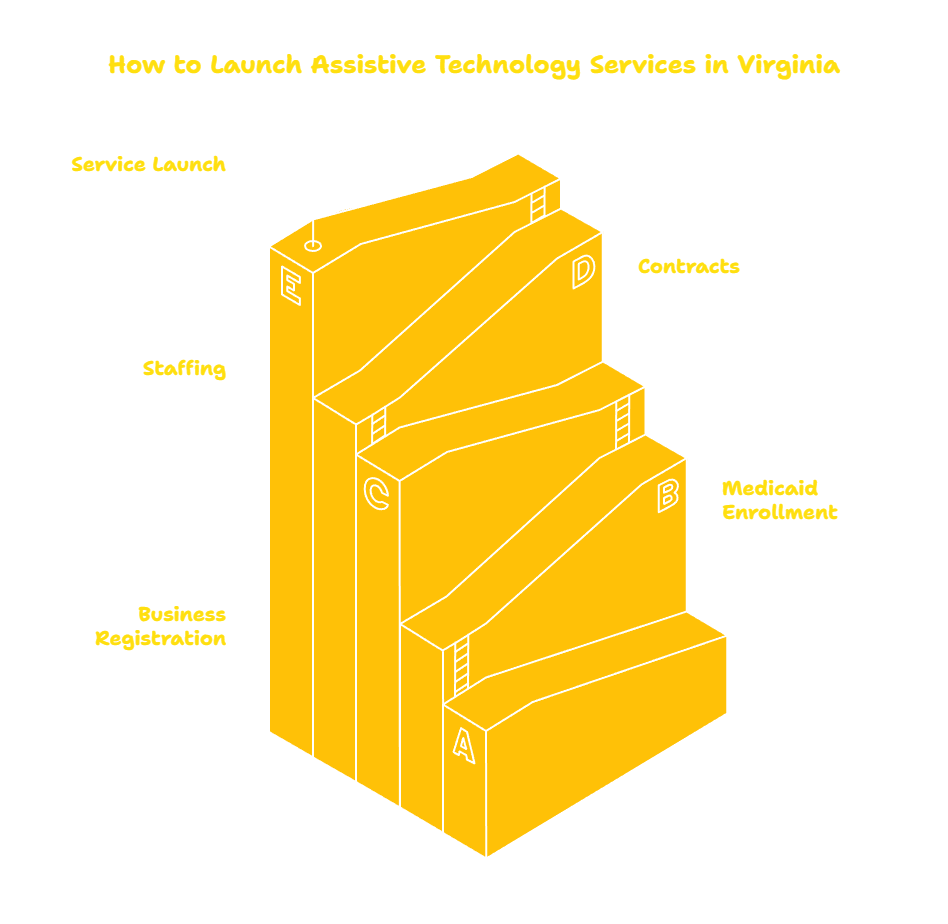
What is the Projected Timeline for Launching AT Services?
Launching as a Medicaid-approved Assistive Technology provider is a multi-phase process that typically requires several months of preparation. The initial phase involves business registration, EIN/NPI procurement, and the drafting of a robust Policy & Procedure Manual, which generally takes 2 to 3 weeks. Following this, the agency must complete the Medicaid enrollment process through the MES portal and finalize the recruitment of qualified staff, a phase that typically spans 4 to 6 weeks.
The final pre-launch stage involves securing contracts with regional CSBs or Managed Care Organizations (MCOs). This phase ensures that the provider is recognized within the referral networks, which can take an additional 3 to 5 weeks depending on the agency’s capacity to meet local contracting requirements. Once these administrative hurdles are cleared and the provider has the necessary device authorizations, they may begin service delivery for individuals listed on their respective waiver programs.
Frequently Asked Questions
Can a provider bill Medicaid for technology that is already covered by another insurance plan?
No. Assistive Technology services under the Medicaid waiver program are intended to be the payer of last resort. All devices must be medically necessary, linked to the ISP, and not covered by other insurance or alternative resources.
Is RESNA certification mandatory for all staff members?
While the RESNA ATP certification is the gold standard for Assistive Technology Professionals, providers may also utilize licensed therapists who possess demonstrable experience in AT assessments. All staff must be qualified to match technology to the specific functional needs of the participant.
Do I need to contract with both CSBs and MCOs to provide AT services?
You must contract with the entities that serve your target participants. CSBs manage authorizations for the Community Living (CL) and Family and Individual Supports (FIS) waivers, while MCOs manage authorizations for the CCC Plus waiver. Many providers contract with both to maximize their service reach.
Key Takeaway: Successfully operating as an Assistive Technology provider in Virginia requires a dual focus on administrative compliance and specialized clinical expertise. By maintaining rigorous documentation, ensuring staff possess the appropriate certifications, and establishing formal contracts with DMAS, CSBs, and MCOs, providers can sustainably offer the technology solutions necessary for participant independence.
Last verified: May 2024. This information is intended for educational purposes and does not constitute legal or financial advice. Providers should consult the official DMAS provider manual and relevant regulatory agencies for the most current policy updates.