ASSISTIVE TECHNOLOGY SERVICES PROVIDER IN UTAH
By Fatumata Kaba · 2026-03-31 · 5 min read
Becoming an Assistive Technology (AT) services provider in Utah involves meeting specific regulatory standards set by the Utah Department of Health and Human Services (DHHS) and the Division of Services for People with Disabilities (DSPD). Providers play a vital role in the 1915(c) Medicaid Home and Community-Based Services (HCBS) ecosystem by delivering personalized equipment, training, and maintenance that enable individuals with disabilities to achieve greater independence in their homes and communities.
This guide outlines the critical steps for agency founders and administrators to navigate the enrollment process, understand the scope of covered services, and maintain the compliance standards required to operate under various Utah Medicaid waivers.
What is the Scope of Assistive Technology Services in Utah?
Assistive Technology services encompass a broad range of supports designed to increase, maintain, or improve the functional capabilities of individuals with disabilities. Under the DSPD framework, these services are not merely about the provision of hardware; they include the comprehensive process of assessment, acquisition, customization, training, and ongoing maintenance. By integrating these tools into an Individual Support Plan (ISP), providers help participants overcome barriers to communication, mobility, and safety.
To be considered a reimbursable service, the AT must be medically necessary and directly aligned with the goals outlined in the participant's ISP. When providing these services, agencies should focus on items that effectively reduce the need for human assistance or provide a significant enhancement to the individual's quality of life. Common categories of service include:
- Communication devices, including speech-generating technology.
- Smart home automation, such as voice-controlled lighting, environmental controls, and smart locks.
- Cognitive supports, including electronic organizers and specialized memory aids.
- Mobility and sensory equipment designed for specific visual, hearing, or physical limitations.
- Remote monitoring systems and safety alerts to support independent living.
How Do Agencies Navigate Governing Agencies and Oversight?
The regulatory landscape for AT providers is defined by a tiered oversight structure. At the state level, the Utah Department of Health and Human Services (DHHS), specifically the Division of Services for People with Disabilities (DSPD), is the primary authority. The DSPD reviews all requests for assistive technology, authorizes services within the ISP, and maintains the certification and compliance standards for all enrolled providers.
Federal oversight is provided by the Centers for Medicare & Medicaid Services (CMS). CMS establishes the overarching standards for HCBS waiver implementation and ensures that funding for assistive technology remains consistent with federal Medicaid requirements. Maintaining a strong understanding of both state-level expectations and federal mandates is essential for any provider looking to sustain long-term operations in Utah’s Medicaid landscape.
What Are the Prerequisites for Provider Enrollment?
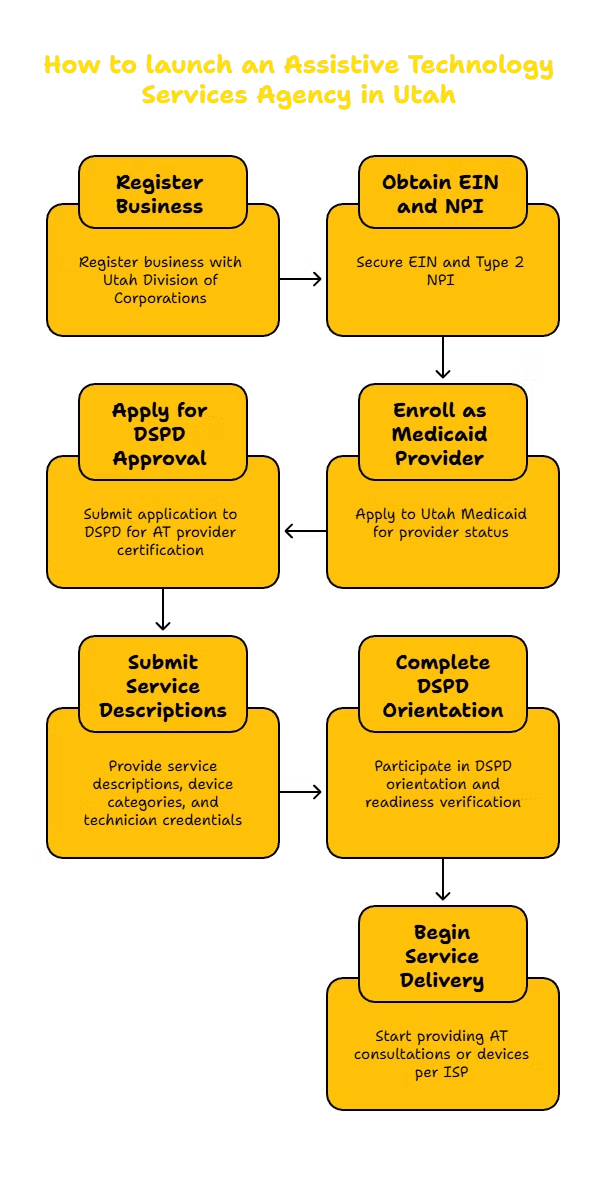
Before an agency can accept referrals, it must satisfy several foundational business and operational requirements. The process begins with standard business registration through the Utah Division of Corporations. Once the business entity is established, the provider must obtain a Federal Employer Identification Number (EIN) and a Type 2 National Provider Identifier (NPI). These are required for all billing and identification processes within the state’s healthcare network.
Beyond basic registration, providers must demonstrate readiness to handle specialized equipment and client needs. This involves enrolling as an official Medicaid provider and successfully navigating the specific DSPD certification process for Assistive Technology. Agencies must also maintain appropriate levels of liability insurance and develop a robust Assistive Technology Services Policy & Procedure Manual that covers everything from equipment handling to emergency protocols.
How to Complete the Utah Provider Enrollment Process
The path to authorization is a multi-step sequence that requires careful attention to detail. Initially, agencies must submit their Medicaid provider application and simultaneously apply for DSPD approval as an authorized AT provider. This application requires the submission of service descriptions, detailed categories of the equipment the agency intends to provide, and the verified credentials of all staff members who will be performing the consultations or installations.
Following the submission of these materials, the provider will undergo a readiness verification process, which may include a review of the agency's operational policies and staff training records. After completing the DSPD orientation, the agency is formally recognized, allowing them to begin accepting referrals and delivering services as authorized under the participant's ISP. Throughout this period, maintaining clear, auditable records is a core requirement for ongoing approval.
What Are the Staffing and Documentation Requirements?
Success in this field relies on qualified personnel. The Assistive Technology Specialist or Consultant is typically expected to have professional experience with AT devices, with certifications such as the RESNA Assistive Technology Professional (ATP) or clinical backgrounds in occupational or physical therapy being highly preferred. Technicians responsible for the setup and configuration of hardware must possess technical aptitude and a thorough understanding of the equipment’s functionality.
Documentation is the backbone of compliance. Every agency must maintain a comprehensive Policy & Procedure Manual that details the process for evaluating participant needs, ensuring alignment with the ISP, and managing the entire equipment lifecycle. This manual must explicitly cover delivery protocols, staff credentials, infection control measures, and clear documentation for repairs, warranties, and returns. Proper billing documentation, including signed delivery receipts and usage verification logs, is non-negotiable for Medicaid reimbursement.
Frequently Asked Questions
What waivers cover Assistive Technology in Utah?
Assistive Technology is currently covered under the Community Supports Waiver (CSW), the Acquired Brain Injury (ABI) Waiver, the Physical Disabilities Waiver (PDW), the Medically Complex Children’s Waiver (MCCW), and the New Choices Waiver (NCW) for those transitioning from nursing facilities.
What is the typical timeline for launching an AT provider agency?
The timeline varies based on operational readiness, but generally, business formation and policy development take 1–2 months, Medicaid and DSPD enrollment take 2–3 months, and staff training and equipment setup take an additional 30–60 days.
What are the essential requirements for staff training?
All staff must complete training in HIPAA and client confidentiality, Abuse, Neglect, and Exploitation Prevention (ANEP), DSPD ISP alignment, documentation practices, manufacturer-specific device setup, and participant-centered education techniques.
Key Takeaway
Launching a Medicaid-approved assistive technology agency in Utah requires a structured approach to business registration, DSPD certification, and rigorous adherence to documentation standards. By focusing on compliant service delivery and professional staff development, providers can successfully support participants within the CSW, ABI, PDW, MCCW, and NCW waiver programs to foster greater independence.
Last verified: November 2024. This content is for informational purposes only and does not constitute legal or professional advice. Always consult the latest Utah DHHS and DSPD provider manuals and official state documentation for the most current regulatory requirements.