ASSISTIVE TECHNOLOGY SERVICES PROVIDER IN TEXAS
By Fatumata Kaba · 2026-03-30 · 5 min read
ENABLING INDEPENDENCE THROUGH SPECIALIZED DEVICES AND TRAINING THAT ENHANCE FUNCTIONAL ABILITY FOR INDIVIDUALS WITH DISABILITIES
Becoming an Assistive Technology (AT) Services provider in Texas requires navigating a structured regulatory environment governed by the Texas Health and Human Services Commission (HHSC) and federal guidelines established by the Centers for Medicare & Medicaid Services (CMS). By providing specialized devices, software, and training, agencies play a critical role in the 1915(c) Medicaid Waiver ecosystem, enabling participants to perform essential daily tasks and achieve greater personal independence.
What is the Role of AT Services within Texas Medicaid Waiver Programs?
Assistive Technology Services are defined as any item, piece of equipment, software, or product system—whether acquired commercially, modified, or customized—that is used to increase, maintain, or improve the functional capabilities of individuals with disabilities. These services are not merely about the hardware; they include the professional assessment, selection, acquisition, installation, and ongoing training necessary to ensure the technology effectively meets the participant's specific needs identified in their Person-Directed Plan (PDP) or Individual Plan of Care (IPC).
The scope of these services is broad, designed to bridge the gap between a participant's current functional ability and their independence goals. Common examples include adaptive communication devices for non-verbal participants, modified hardware for computer access, environmental control units for mobility, and specialized software to assist with cognitive task management or medication adherence. Success in this field relies on a collaborative approach, ensuring that every device provided is medically necessary, clinically appropriate, and directly linked to the goals outlined by the participant’s multidisciplinary care team.
How Do Agencies Gain Authorization and Enroll as Providers?
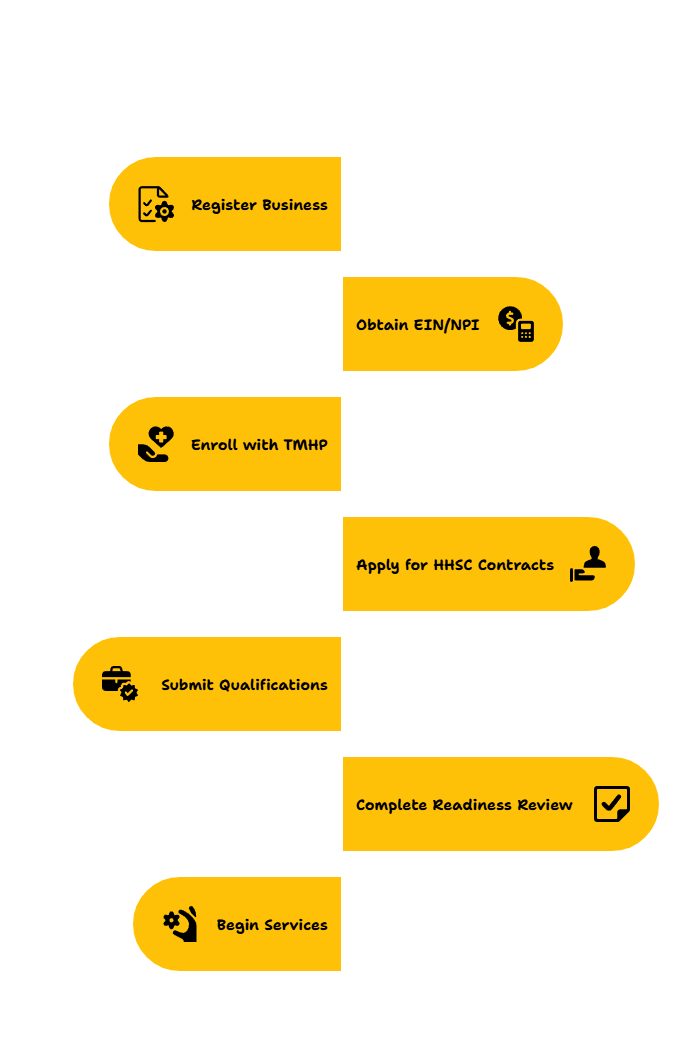
Provider enrollment is a multi-step, sequential process managed primarily through the Texas Medicaid & Healthcare Partnership (TMHP). Before beginning operations, an agency must be registered as a legal business entity with the Texas Secretary of State and secure all necessary federal identifiers, including an Employer Identification Number (EIN) and a Type 2 National Provider Identifier (NPI). This foundational administrative layer is essential for system recognition and future claims processing.
Once registered, providers must navigate the specific contracting processes for the waiver programs they intend to serve, such as CLASS, DBMD, or HCS. The enrollment process involves submitting documentation of staff qualifications, detailed device procurement protocols, and evidence of the agency’s ability to handle delivery and maintenance. Following these submissions, the agency undergoes a readiness review by the HHSC, which evaluates the provider’s operational capacity before granting the authorization to begin accepting service requests.
What are the Core Licensing and Operational Requirements?
Maintaining compliance is the central focus of an Assistive Technology provider. Agencies must possess a comprehensive Policy & Procedure Manual that details every stage of the service lifecycle, from the initial professional assessment to the final delivery and training phases. This manual serves as the operational blueprint and is essential for both internal quality control and external audits conducted by state regulators.
Operational documentation must be robust to meet audit standards. This includes, but is not limited to, the following requirements:
- Detailed assessment and recommendation documentation signed by qualified professionals.
- Specific protocols for equipment procurement, sanitation, and delivery.
- Training logs demonstrating that the participant or caregiver has been instructed on device usage.
- Established maintenance and repair logs for equipment under warranty or service agreements.
- Strict adherence to HIPAA and participant confidentiality protocols in all data handling.
Which Staffing Roles are Required to Deliver AT Services?
Successful delivery of Assistive Technology requires a combination of technical knowledge and clinical insight. While the specific requirements can vary based on the waiver program, agencies generally utilize a mix of licensed therapists—such as Occupational Therapists (OTs), Speech-Language Pathologists (SLPs), or Physical Therapists—and certified AT specialists. These individuals are responsible for evaluating the participant's functional limitations and recommending technology that provides the highest therapeutic value.
Beyond clinical recommendations, agencies require staff dedicated to service coordination and training. Service coordinators ensure that devices are delivered correctly and that the participant understands how to integrate the technology into their daily routine. All personnel involved in the provision of AT services must complete mandatory training on HIPAA compliance, abuse and neglect prevention, and the specific operation of the equipment they are tasked with installing and supporting.
Which Medicaid Waiver Programs Include AT Services?
Assistive Technology is a reimbursable service across several key Texas Medicaid HCBS waiver programs, though the specific availability of certain items may depend on the unique scope of each program. The Community Living Assistance and Support Services (CLASS) and Deaf Blind with Multiple Disabilities (DBMD) programs have well-established frameworks for AT integration. Other programs, such as Home and Community-based Services (HCS) and Texas Home Living (TxHmL), provide coverage for specific adaptive items that fall under their individual service definitions.
The Youth Empowerment Services (YES) Waiver may also incorporate AT based on the specific goals set forth in a youth’s plan of care. Because each waiver program maintains distinct rules regarding device eligibility and service limits, providers must regularly consult the current program handbooks and the HHSC provider bulletins to ensure that billing codes and service definitions are accurately applied to each individual participant’s authorization.
Frequently Asked Questions
What is the typical timeline for an agency to begin providing services?
The timeline varies based on the agency's existing infrastructure, but generally follows a phased approach: 1–2 months for business formation and policy development, 2–3 months for TMHP and HHSC contracting, and 30–45 days for internal staff training and systems setup, totaling approximately 5–7 months before the agency is ready for active service authorizations.
Do all AT devices require a therapist’s recommendation?
Yes, for most programs, a licensed therapist (such as an OT, PT, or SLP) or a specialized professional must perform an evaluation and provide a recommendation. This assessment is required to ensure that the technology is medically necessary and appropriately matched to the functional goals outlined in the participant’s Individual Plan of Care (IPC).
What agencies are involved in the oversight of these services?
The Texas Health and Human Services Commission (HHSC) serves as the primary state agency responsible for overseeing the waiver programs and approving service plans. The Texas Medicaid & Healthcare Partnership (TMHP) handles the administrative and billing enrollment, while the federal Centers for Medicare & Medicaid Services (CMS) provides the overarching regulatory framework for all Medicaid-funded services.
Key Takeaway: Establishing a successful Assistive Technology provider agency in Texas requires rigorous adherence to HHSC and TMHP protocols, a well-documented policy framework, and a commitment to maintaining high standards for both clinical assessment and ongoing technical support. By focusing on compliant documentation and qualified staffing, providers can effectively navigate the waiver system to improve functional outcomes for individuals with disabilities.
Last verified: May 2024. This information is for educational purposes only and does not constitute legal or professional advice. Always refer to the official Texas Health and Human Services Commission (HHSC) and Texas Medicaid & Healthcare Partnership (TMHP) provider manuals for the most current program requirements and regulatory updates.