ASSISTIVE TECHNOLOGY SERVICES PROVIDER IN TENNESSEE
By Fatumata Kaba · 2025-10-22 · 5 min read
Assistive Technology (AT) services in Tennessee serve as a vital bridge to independence for individuals with disabilities, providing the tools and training necessary to navigate daily life with greater autonomy. By integrating specialized devices and environmental modifications into a participant’s Individual Support Plan (ISP), providers enable TennCare members to pursue educational, vocational, and personal goals within their own communities.
Operating as an AT service provider in the Tennessee Medicaid ecosystem requires a clear understanding of regulatory pathways, including TennCare’s State Plan, the Employment and Community First (ECF) CHOICES program, 1915(c) Waivers, and the Katie Beckett Program. Because these services must be medically necessary and functionally appropriate, providers must demonstrate not only technical proficiency with devices but also a rigorous commitment to the documentation and compliance standards set by the Tennessee Department of Intellectual and Developmental Disabilities (DIDD) and the Centers for Medicare & Medicaid Services (CMS).
What Are the Governing Agencies and Regulatory Frameworks?
The provision of Assistive Technology in Tennessee is governed by a multi-tiered regulatory structure that ensures quality of care and financial accountability. At the federal level, the Centers for Medicare & Medicaid Services (CMS) provides the overarching framework by approving state waivers and establishing the baseline requirements for Medicaid-reimbursed AT services. This federal guidance ensures that the technology delivered is not merely convenient but truly essential for the participant’s health and functional progression.
In Tennessee, the state oversight is bifurcated between the Division of TennCare and the Department of Intellectual and Developmental Disabilities (DIDD). TennCare serves as the primary authority for authorization and reimbursement, managing the fiscal integrity of the program across State Plan services. Simultaneously, the DIDD plays a pivotal role in the certification of AT service providers, specifically those operating under the ECF CHOICES waiver and other specialized 1915(c) programs. Providers must maintain ongoing compliance with both entities to retain their enrollment status and continue receiving service authorizations.
What Services and Devices Are Eligible for Reimbursement?
Assistive Technology services encompass a broad lifecycle of support, ranging from the initial assessment and acquisition to delivery, customization, and long-term maintenance. Services are only eligible for reimbursement when they are directly tied to an objective within the participant’s Individual Support Plan (ISP). Consequently, providers must be prepared to document how a specific device or modification will improve the participant’s ability to perform activities of daily living or participate in their community.
Covered items typically focus on overcoming physical or cognitive barriers to communication, mobility, or environmental interaction. While each authorization is assessed on a case-by-case basis, the following categories represent common areas of support for Tennessee Medicaid members:
- Communication Devices (AACs) and voice-activated technology.
- Screen readers, adaptive keyboards, mice, and computer access tools.
- Smart home automation, including controlled lighting, automated doors, and security alarms.
- Environmental Control Units (ECUs) and sophisticated mounting systems.
- Mobility or positioning aids that incorporate electronic or technical components.
- Comprehensive participant and caregiver training regarding device safety, troubleshooting, and daily use.
How Do You Meet Licensing and Provider Approval Requirements?
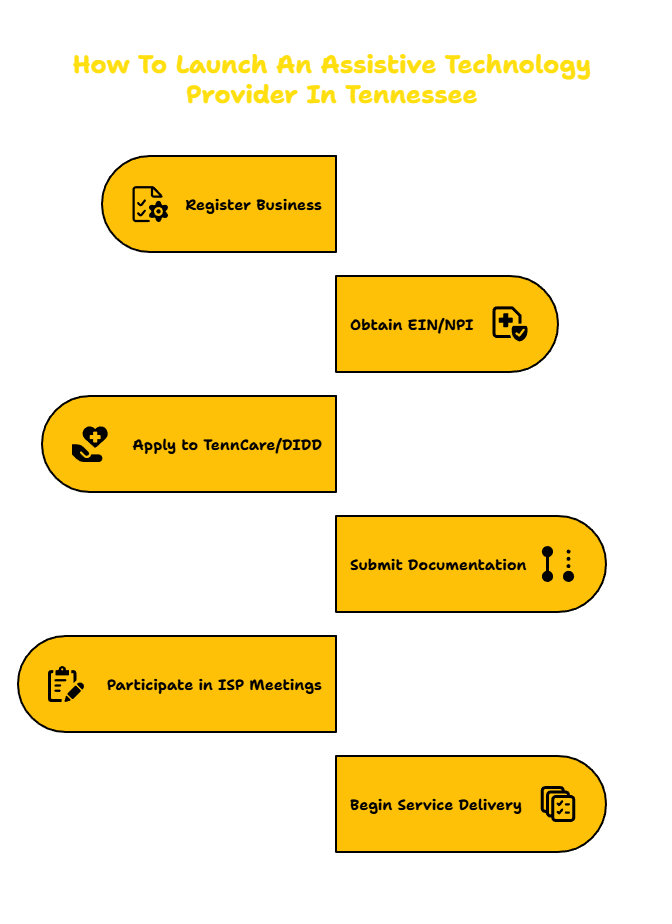
Establishing an AT service business in Tennessee involves a methodical approach to corporate and clinical readiness. Before a provider can be authorized to receive referrals, they must first satisfy the fundamental business requirements, which include registering the legal entity with the Tennessee Secretary of State and obtaining both a Federal Employer Identification Number (EIN) and a Type 2 National Provider Identifier (NPI). These foundational steps provide the administrative framework necessary to engage with state billing systems.
Once the business entity is established, prospective providers must seek enrollment with TennCare or the DIDD. This process necessitates the development of a comprehensive Assistive Technology Policy & Procedure Manual. This manual serves as a roadmap for operations, detailing the agency’s protocols for assessments, coordination with interdisciplinary care teams, installation procedures, and rigorous HIPAA compliance. Furthermore, if the agency intends to provide physical devices directly, they must ensure they hold the necessary vendor certifications or have established formal partnerships with authorized Durable Medical Equipment (DME) suppliers.
What Are the Essential Staffing and Competency Standards?
The quality of AT services is heavily dependent on the expertise of the staff facilitating the technology implementation. An Assistive Technology Specialist is generally expected to possess a background in rehabilitation, therapy, or special education, with professional certification such as an Assistive Technology Professional (ATP) credential being highly preferred. This specialist is responsible for the high-level assessment and recommendation phase, ensuring that the technology matches the functional needs of the individual.
In addition to specialists, agencies often employ AT trainers or device technicians to handle the hands-on delivery, setup, and education of the participant and their caregivers. Regardless of the specific job title, all personnel must undergo training in person-centered planning, documentation accuracy, and safety protocols. Because AT services often interface with other clinical support services, staff should also be prepared to work closely with Speech-Language Pathologists or Occupational Therapists who may be involved in the participant’s care, ensuring that device recommendations are clinically sound and holistically supported.
Frequently Asked Questions
How does the timeline to launch compare across different programs?
The launch process is generally divided into several phases: business registration and credentialing typically take 1–2 months, followed by an enrollment period of 2–3 months with TennCare or DIDD. Developing internal staff training and operational tools adds another 30–60 days, with actual service delivery beginning once the agency has received formal authorization for specific participant referrals.
What must be included in the Assistive Technology Policy & Procedure Manual?
Your manual must clearly outline assessment and recommendation protocols, coordination with the participant’s care team, and step-by-step procedures for delivery, installation, and maintenance. It must also include specific plans for caregiver training, safety and risk management protocols, HIPAA compliance policies, and templates for billing and warranty tracking.
Is there a difference between ECF CHOICES and State Plan DME for assistive tech?
Yes, while both provide assistive equipment, they operate under different authorities. ECF CHOICES provides AT as part of the broader, waiver-based individualized support plan to promote long-term independence in the community. State Plan Durable Medical Equipment (DME) focuses more narrowly on medically necessary, standardized equipment that meets specific clinical criteria for durable devices under the state's baseline Medicaid benefit.
Key Takeaway
Building a successful Assistive Technology service agency in Tennessee requires a rigorous focus on clinical compliance, precise documentation, and the ability to navigate the intersection of TennCare and DIDD regulations. By aligning your operational protocols with the specific requirements of the ECF CHOICES, Katie Beckett, and 1915(c) waiver programs, your agency can ensure both the fiscal viability of the business and the delivery of high-quality, life-changing technology solutions for the individuals you serve.
Last verified: October 2023. Disclaimer: This information is for educational purposes only and does not constitute legal or professional medical advice. Always consult with the official TennCare, DIDD, or CMS provider manuals for the most current rules and regulations.