ASSISTIVE TECHNOLOGY SERVICES PROVIDER IN SOUTH DAKOTA
By Fatumata Kaba · 2025-10-15 · 5 min read
ENHANCING FUNCTIONAL INDEPENDENCE THROUGH PERSONALIZED DEVICES, TOOLS, AND SUPPORTIVE TECHNOLOGY SOLUTIONS
Assistive Technology (AT) services in South Dakota are essential supports designed to bridge the gap between functional limitations and personal independence for individuals with disabilities. By providing the assessment, acquisition, customization, and training necessary to utilize specialized devices, these services enable participants to perform daily tasks, communicate effectively, and engage more deeply with their communities.
What Are Assistive Technology Services and Who Governs Them?
Assistive Technology services encompass a broad spectrum of solutions ranging from simple low-tech adaptations to complex, high-tech electronic systems. These services are authorized under various programs, including the CHOICES Waiver, Family Support 360 Waiver, and Medically Fragile Waiver, as well as through State Plan Medicaid or school-based support systems. The primary objective is to facilitate greater autonomy in home, school, and community environments.
The regulatory landscape is managed by several key entities to ensure quality and compliance. The South Dakota Department of Human Services (DHS), specifically the Division of Developmental Disabilities (DDD), serves as the primary oversight body for waiver-funded AT services and monitors provider compliance. Simultaneously, the South Dakota Department of Social Services (DSS) Medical Services Division manages the complex billing landscape for AT devices and services. Finally, the Centers for Medicare & Medicaid Services (CMS) establishes the federal framework for documentation, medical necessity, and service utilization.
What Scope of Services Should an AT Provider Offer?
A comprehensive AT service model goes beyond the mere procurement of equipment; it requires a holistic approach to the participant’s functional needs. Providers must be prepared to offer a full lifecycle of support, starting from the initial identification of a functional barrier to the long-term maintenance of the chosen solution. This includes professional assessment, customization of off-the-shelf products, and the physical installation of equipment.
Equally important is the instructional component of these services. Providers are expected to deliver robust training to both the participant and their primary caregivers to ensure the technology is used safely and effectively. The scope of services typically includes:
- Comprehensive Assistive Technology assessments
- Device selection, acquisition, and personalization
- Professional equipment setup and installation
- Structured training for participants and caregivers
- Ongoing maintenance, troubleshooting, and repair support
- Coordination with interdisciplinary teams, including therapists and case managers
- Rigorous documentation to support medical necessity and ensure accurate Medicaid billing
What Are the Licensing and Provider Approval Requirements in South Dakota?
Becoming an approved provider for Medicaid-funded AT services requires a structured administrative foundation. Before a provider can be authorized to deliver services under the CHOICES, Family Support 360, or Medically Fragile waivers, they must first establish their business entity with the South Dakota Secretary of State and secure a federal Employer Identification Number (EIN) and a Type 2 National Provider Identifier (NPI). This administrative setup is the bedrock upon which all subsequent compliance rests.
Beyond basic business registration, providers must create a comprehensive Assistive Technology Services Policy & Procedure Manual. This document serves as the internal regulatory guide for the organization, detailing how the provider will maintain HIPAA compliance, manage equipment inventory, and conduct participant assessments. Agencies must also demonstrate that they either employ or maintain professional partnerships with qualified staff, such as Occupational Therapists, Speech-Language Pathologists, or RESNA-certified Assistive Technology Professionals, to perform clinical evaluations and training.
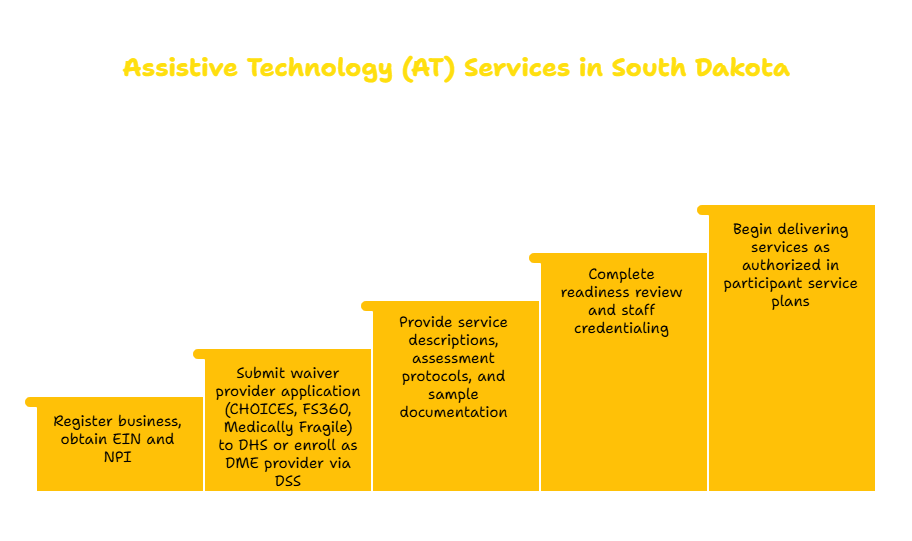
How Does the South Dakota Provider Enrollment Process Work?
The enrollment process is a sequential journey that moves from business establishment to operational readiness. Potential providers must first decide whether they are seeking enrollment as a waiver-specific provider under the DHS-DDD or as a Durable Medical Equipment (DME) provider under the DSS. This distinction determines the specific paperwork and compliance protocols required during the application phase.
Once the initial application is submitted, the agency must provide evidence of their assessment protocols and service delivery models. This stage often involves a readiness review where the state assesses the provider's ability to maintain high standards of service. Key milestones in the enrollment process include:
- Completing business registration, EIN, and NPI procurement
- Submitting waiver-specific provider applications to DHS or DSS
- Defining service descriptions and developing standardized assessment protocols
- Completing state-mandated readiness reviews and verifying staff credentials
- Initiating service delivery upon receiving the first authorization for a participant’s service plan
What Are the Core Documentation and Staffing Standards?
Compliance in the Medicaid space is defined by the quality of documentation. A provider’s records must provide a clear audit trail that justifies why a specific piece of technology is medically necessary for an individual. This includes maintaining detailed device evaluation templates, training logs that track caregiver competency, and meticulous equipment maintenance records. Failure to maintain these records in accordance with state guidelines can lead to billing denials or recoupments.
Staffing requirements are equally stringent. The individual performing the AT assessment must possess the appropriate professional background—typically an OT, PT, SLP, or a certified ATP. Installation technicians, while not always requiring clinical credentials, must undergo rigorous background checks and receive specific training on participant safety. All personnel, regardless of their role, must be fluent in HIPAA requirements and Medicaid billing standards to ensure the agency operates within legal boundaries.
Frequently Asked Questions
What waivers in South Dakota cover Assistive Technology?
AT services are covered under the CHOICES Waiver, the Family Support 360 Waiver, and the Medically Fragile Waiver. Additionally, devices may be accessed through State Plan Medicaid or through Early Intervention (Birth–3) programs.
What is the recommended timeline to launch an AT program?
On average, the process takes approximately 4–6 months. This includes 1–2 months for business registration, 2–3 months for Medicaid enrollment and documentation preparation, and 1 month for setting up device catalogs and assessment tools.
Do staff members need specific certifications to provide AT services?
Yes. Clinical assessments should be conducted by professionals such as Occupational Therapists, Physical Therapists, Speech-Language Pathologists, or RESNA-certified Assistive Technology Professionals. All staff must complete training in HIPAA, participant safety, and Medicaid billing.
Waiver Consulting Group provides comprehensive assistance for organizations looking to launch or scale AT programs. This includes the development of Policy & Procedure Manuals, creation of compliant assessment and training templates, and guidance on navigating the South Dakota Medicaid provider enrollment process. By centralizing the operational components of an AT program, agencies can focus on delivering high-quality, life-enhancing technology to the individuals who need it most.
Key takeaway: Successfully operating as an Assistive Technology provider in South Dakota requires a rigorous focus on administrative compliance, a well-defined clinical assessment protocol, and a commitment to maintaining detailed documentation for every piece of equipment provided under the state’s Medicaid waiver programs.
Last verified: October 2023. Disclaimer: This information is for educational purposes and does not constitute legal or professional advice. Always verify current state requirements with the South Dakota Department of Human Services (DHS) and the South Dakota Department of Social Services (DSS).