ASSISTIVE TECHNOLOGY SERVICES PROVIDER IN SOUTH CAROLINA
By Fatumata Kaba · 2025-10-13 · 5 min read
Enabling independence and accessibility through customized tools and equipment for individuals with disabilities is the core mission of Assistive Technology (AT) services in South Carolina. These Medicaid-funded services provide the essential devices, training, and ongoing support necessary for participants to navigate their daily environments with greater autonomy. By partnering with the South Carolina Department of Health and Human Services (SCDHHS) and the Department of Disabilities and Special Needs (DDSN), providers play a critical role in delivering person-centered solutions authorized under state Home and Community-Based Services (HCBS) Waivers.
What Are the Governing Frameworks for AT Services in South Carolina?
The provision of Assistive Technology is strictly regulated to ensure that every device provided is medically necessary and promotes the individual's ability to live independently in their community. The South Carolina Department of Health and Human Services (SCDHHS) serves as the primary authority for authorizing and reimbursing Medicaid claims, ensuring that all services align with state Medicaid policy.
At the implementation level, the South Carolina Department of Disabilities and Special Needs (DDSN) oversees the coordination of services for individuals with intellectual, developmental, or related disabilities. Furthermore, the Centers for Medicare & Medicaid Services (CMS) sets the overarching federal guidelines for HCBS waivers, mandating that all AT services be delivered within a person-centered framework. Compliance with these three entities is the cornerstone of any successful AT provider operation.
How Do Providers Deliver Comprehensive Assistive Technology Services?
Assistive Technology Services are defined by a holistic approach that moves beyond simple equipment delivery. Effective programs incorporate a full cycle of support, beginning with rigorous assessments to determine exactly which tools best fit an individual's unique physical, cognitive, and environmental needs. Once a device is identified, the provider is responsible for procurement, customization, and precise installation to ensure compatibility with the participant’s living space.
Beyond the hardware, service delivery requires extensive training and coaching. Participants, their caregivers, and their support staff must be fully trained on the safe, effective operation of the equipment. Furthermore, long-term success relies on consistent maintenance and repair services to ensure equipment longevity. Providers must maintain meticulous documentation, including service logs, device usage notes, and HIPAA-compliant billing records, to satisfy state oversight requirements.
- Communication devices, such as high-tech speech-generating systems.
- Adaptive switches and environmental control units for smart home integration.
- Mobility aids, including powered wheelchairs and specialized gait trainers.
- Sensory support tools designed for individuals with hearing or vision impairments.
- Adaptive computer hardware and specialized software interfaces.
What Are the Essential Requirements for Provider Enrollment?
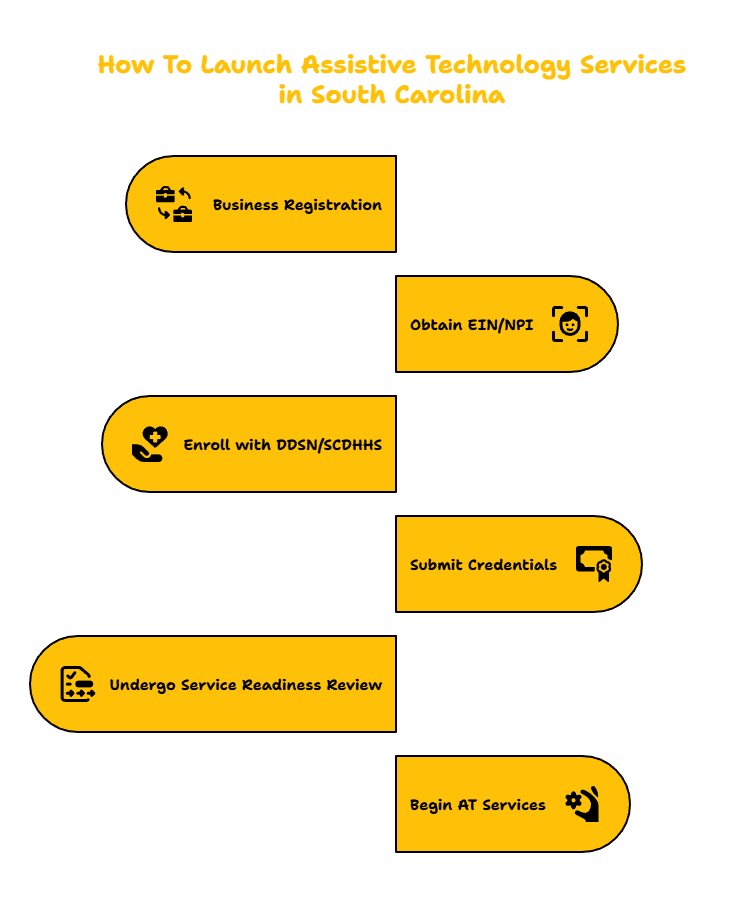
Entering the South Carolina market as an AT provider requires a structured commitment to business and clinical excellence. Before initiating the enrollment process, an organization must be properly registered with the South Carolina Secretary of State and possess a valid EIN and Type 2 National Provider Identifier (NPI). These foundational steps allow the agency to interface correctly with Medicaid billing systems.
Professional staffing is another critical prerequisite. Agencies must employ qualified professionals, such as Assistive Technology Professionals (ATP) certified by RESNA, or licensed clinicians like occupational or physical therapists when necessary. Additionally, the business must maintain comprehensive insurance coverage, including product liability, general business liability, and workers' compensation. Finally, every provider must develop an internal Policy & Procedure Manual that clearly defines their protocols for procurement, equipment safety, and Medicaid documentation.
What Is the Step-by-Step Pathway to Provider Approval?
The enrollment journey is a multi-phase process requiring diligence and attention to detail. The initial phase involves foundational business registration and the establishment of an internal administrative structure. Once the business is established, the prospective provider must formally apply for enrollment with DDSN and/or SCDHHS, specifically designating the Assistive Technology service category. This phase requires the submission of professional credentials, organizational policies, and sample device request protocols.
After the application is submitted, the agency must undergo a service readiness review and credentialing process. This evaluation ensures that the provider has the operational capacity to fulfill its obligations to Medicaid participants. Once the provider is fully credentialed and active, they can begin receiving referrals through case managers or Individual Support Plans (ISPs). This timeline generally spans several months, as agencies must navigate both business setup and state-level verification.
Which Medicaid Waiver Programs Support AT Services?
In South Carolina, AT services are facilitated through several specific waiver programs, each designed to meet the needs of distinct populations. The ID/RD Waiver supports individuals in their daily functioning to minimize the need for 24-hour human assistance, while the HASCI Waiver provides targeted technology for those managing brain or spinal cord injuries. The Community Supports Waiver offers a pathway for those requiring more focused, limited AT interventions.
Additionally, Community Long Term Care (CLTC) services assist individuals in maintaining independence while reducing the risk of institutionalization. For younger participants, EPSDT, TEFRA, and various State Plan services provide paths for children under the age of 21 to receive medically necessary assistive devices through doctor referrals and Medicaid coverage. Understanding which waiver a participant is enrolled in is essential for correct service authorization and billing.
Frequently Asked Questions
What qualifications must my staff hold?
Staff must possess specialized credentials appropriate to their role. An Assistive Technology Professional (ATP) should hold certification from RESNA. Clinical staff, such as occupational or physical therapists, must maintain active, valid South Carolina state licensure. All staff, regardless of their clinical role, must complete training in HIPAA confidentiality, participant safety, and Medicaid-specific documentation.
How long does the provider enrollment process typically take?
The timeline varies based on the completeness of your documentation, but generally follows a 4-to-7-month trajectory. Business registration and policy creation typically take 1–2 months, followed by 2–3 months for credentialing and Medicaid enrollment, and an additional 1–2 months for finalizing vendor agreements and staff training.
What must be included in the AT Policy & Procedure Manual?
Your manual must serve as a comprehensive guide for all agency operations. It must include your specific procedures for assessment and recommendation, guidelines for equipment procurement and ongoing maintenance, templates for training and documentation, and strict policies regarding HIPAA, safety, and participant rights. It must also detail your internal workflows for Medicaid billing and authorization.
Key Takeaway for New Providers
Launching an Assistive Technology business in South Carolina requires a dual focus: maintaining strict compliance with SCDHHS and DDSN administrative requirements while ensuring high-quality, person-centered outcomes for participants. Success depends on building a robust infrastructure—backed by qualified staff, clear internal policies, and effective vendor relationships—to ensure that the devices and training provided meaningfully enhance the independence of those served within the HCBS waiver system.
Waiver Consulting Group provides expert guidance for new providers seeking to navigate the complex landscape of South Carolina's HCBS waiver programs. Our services focus on facilitating Medicaid enrollment, developing comprehensive Policy & Procedure Manuals, and establishing the administrative systems necessary to manage equipment procurement, assessment workflows, and Medicaid compliance effectively. Our Client Portal offers a wealth of resources that you can explore related to various programs and state requirements. Last verified on: 2024-05-22. Disclaimer: This information is for educational purposes only and does not constitute legal or professional advice. Always consult directly with SCDHHS or DDSN regarding current regulatory requirements and individual provider enrollment policies.