ASSISTIVE TECHNOLOGY SERVICES PROVIDER IN RHODE ISLAND
By Fatumata Kaba · 2025-10-09 · 6 min read
ENHANCING INDEPENDENCE AND ACCESSIBILITY FOR INDIVIDUALS WITH DISABILITIES THROUGH INNOVATIVE SUPPORTIVE DEVICES AND TECHNOLOGIES
Assistive Technology (AT) Services in Rhode Island function as a critical pillar of Medicaid Home and Community-Based Services (HCBS), providing the necessary tools to enhance the functional capabilities of individuals with disabilities. By offering professional evaluation, customized procurement, and ongoing technical support, AT providers empower participants to maintain independence within their homes and communities while meeting the clinical standards required by the Rhode Island Executive Office of Health and Human Services (EOHHS) and the Department of Behavioral Healthcare, Developmental Disabilities & Hospitals (BHDDH).
What Defines Assistive Technology Services in the Rhode Island Medicaid Framework?
Assistive Technology is defined as any item, piece of equipment, or product system—whether acquired commercially off-the-shelf, modified, or customized—that is used to increase, maintain, or improve the functional capabilities of individuals with disabilities. In the context of Rhode Island’s Medicaid 1115 Waiver, Developmental Disability (DD) Waivers, and Long-Term Services and Supports (LTSS) programs, these services are not merely about equipment distribution; they are about holistic clinical outcomes.
To operate effectively as an AT provider, an agency must be prepared to offer a comprehensive suite of services. This goes beyond the physical delivery of a device, requiring a systematic approach to identifying the participant's unique environment and goals. The service lifecycle typically includes:
- AT Needs Assessment: Conducted by a qualified clinician to identify specific gaps in independence or safety.
- Device Selection & Procurement: Navigating the market to secure high-quality, Medicaid-approved mobility aids, communication devices, or environmental control units.
- Device Installation & Customization: Performing the technical adjustments necessary to ensure the equipment functions optimally for the specific individual.
- Training & Support: Providing education to the individual and their primary caregivers on the safe and effective use of the technology.
- Maintenance & Repair: Offering ongoing technical support to ensure long-term device reliability and safety.
Which Regulatory Agencies Govern AT Services in Rhode Island?
Navigating the regulatory landscape is essential for maintaining compliance. Rhode Island utilizes a multi-agency approach to ensure that funding is utilized appropriately and that service delivery meets state and federal safety standards. Providers must be prepared to interface with several key entities to ensure their operations remain within the scope of their contracts.
The Rhode Island Executive Office of Health and Human Services (EOHHS) serves as the primary authority, overseeing Medicaid policy and the overarching service authorizations for assistive technology. Simultaneously, the Department of Behavioral Healthcare, Developmental Disabilities & Hospitals (BHDDH) plays a direct role in managing AT approvals specifically under DD Waivers, coordinating the funding and assessment protocols for this population. Furthermore, the Centers for Medicare & Medicaid Services (CMS) provides the federal regulatory framework under which all 1915(c) and 1115 waivers must operate, ensuring consistency and fiscal integrity across the program.
How Do Providers Successfully Navigate Enrollment and Licensure?
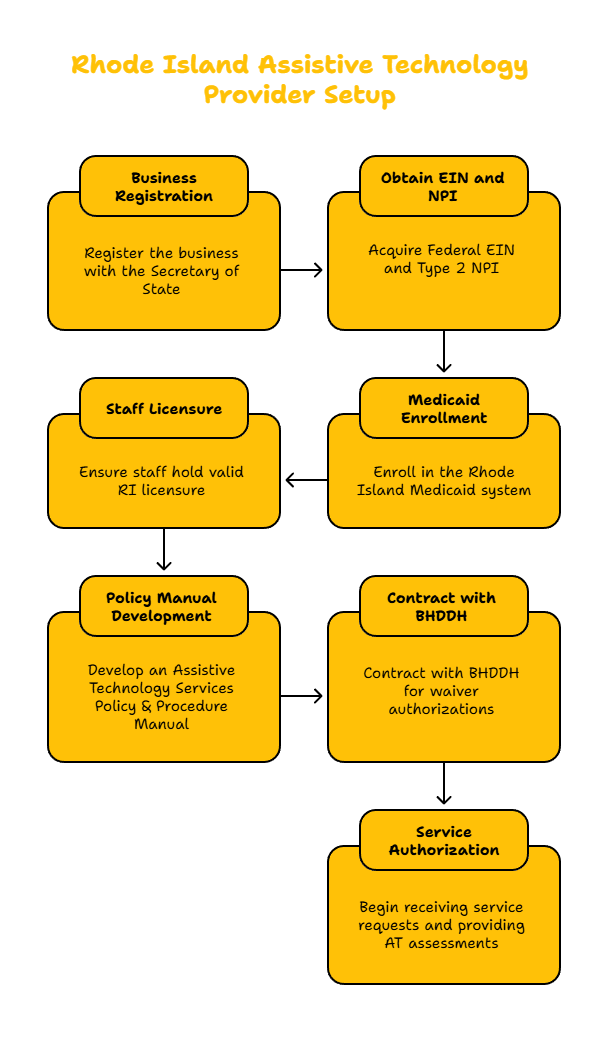
The transition from a business entity to a Medicaid-authorized AT provider is a rigorous process that requires meticulous attention to administrative detail. Prospective providers must first establish their legal footing by registering the business with the Rhode Island Secretary of State and obtaining a Federal Employer Identification Number (EIN) and a Type 2 National Provider Identifier (NPI). This foundational step is required before any application for Medicaid enrollment can be processed.
Once the business is legally established, the provider must enroll in the Rhode Island Medicaid system through the EOHHS provider portal. This process involves submitting formal service descriptions and an internal Policy & Procedure Manual. If the agency provides clinical evaluations, such as those performed by Occupational Therapists (OT), Physical Therapists (PT), or Speech Therapists, it is mandatory to verify that all staff hold active, valid Rhode Island licenses. Finally, providers must secure appropriate liability insurance and, depending on the scope of their supply, demonstrate compliance as a Durable Medical Equipment (DME) vendor.
What are the Operational Requirements for Documentation and Staffing?
Operational success hinges on the strength of the agency’s Policy & Procedure Manual. This document must serve as the blueprint for the organization’s daily operations, covering everything from initial assessment workflows to the specific protocols used for device procurement and delivery. Documentation must be robust enough to withstand potential audits, including detailed service logs, equipment maintenance records, and proof of participant training.
Staffing requirements are equally stringent. Organizations should categorize roles into three primary areas: clinical evaluators, technical specialists, and administrative coordinators. Each role requires specific background qualifications. For example, therapists conducting assessments must maintain their clinical licensure, while technical staff must demonstrate expertise in disability-related hardware and software. Regardless of role, every staff member must complete mandatory training on HIPAA compliance, infection control for shared devices, and ethical documentation practices.
How are AT Services Structured within Medicaid Waiver Programs?
Assistive technology is integrated into several distinct waiver programs, each with its own set of funding rules and authorization procedures. The Global Consumer Choice Compact (1115 Waiver) is the primary vehicle for providing medically necessary devices and training under the broader HCBS umbrella. This waiver is designed to keep individuals out of institutional settings by providing them with the necessary tools to live independently.
In addition to the 1115 Waiver, BHDDH DD Waivers provide a specific pathway for individuals with developmental disabilities to receive specialized AT assessments and customization. Furthermore, LTSS Medicaid Managed Care plans provide a structured framework for adults requiring ongoing home-based support. Agencies should maintain a clear understanding of which waiver program covers their specific service offerings to ensure accurate billing and authorization compliance.
Frequently Asked Questions
What is the typical timeline for an agency to launch AT services?
The timeline varies based on operational readiness but generally spans several months. Business formation and the development of internal manuals typically take 1–2 months. Following this, Medicaid enrollment and contracting with BHDDH or Managed Care Organizations usually require 2–3 months. Staff credentialing and final training prep typically add an additional 30–60 days before the provider is ready to accept referrals.
Is a clinical license required for every employee?
No, a clinical license is only required for staff performing evaluations or therapeutic justifications, such as Occupational Therapists, Physical Therapists, or Speech-Language Pathologists. Technical staff responsible for installation and device repair require specialized training and experience with AT hardware, but they do not necessarily require clinical licensure unless stipulated by the nature of the specific equipment being installed.
Which agencies should be contacted to initiate the provider enrollment process?
The primary point of contact is the Rhode Island Executive Office of Health and Human Services (EOHHS) through the Medicaid Provider Portal. For providers specifically interested in serving the developmental disability population, the Department of Behavioral Healthcare, Developmental Disabilities & Hospitals (BHDDH) is the essential contact for waiver-specific authorizations and coordination.
Key Takeaway: Establishing a successful Assistive Technology service agency in Rhode Island requires a dual focus on rigorous administrative compliance and clinical excellence. By aligning business operations with the specific requirements of EOHHS and BHDDH, and by maintaining robust documentation and staff credentialing standards, providers can effectively bridge the gap between innovation and the essential care needs of Rhode Island’s Medicaid population.
Last verified: October 2023. This information is intended for educational purposes only and does not constitute legal or professional advice. Always refer to the latest guidance provided by the Rhode Island Executive Office of Health and Human Services (EOHHS) and the Centers for Medicare & Medicaid Services (CMS) to ensure current compliance with all Medicaid program requirements.