ASSISTIVE TECHNOLOGY SERVICES PROVIDER IN PENNSYLVANIA
By Fatumata Kaba · 2025-10-08 · 6 min read
ENHANCING INDEPENDENCE THROUGH TECHNOLOGY THAT CONNECTS INDIVIDUALS TO THEIR ENVIRONMENTS, COMMUNITIES, AND GOALS
Becoming an Assistive Technology (AT) Services provider in Pennsylvania involves navigating a complex, regulated landscape of Medicaid-funded HCBS waivers overseen by the Department of Human Services (DHS). Organizations entering this space provide essential tools, devices, and specialized training that empower individuals with disabilities to maintain or improve their functional independence at home and within their communities.
Understanding the Governing Structure of Pennsylvania AT Services
The provision of Assistive Technology in Pennsylvania is governed by a multi-tiered regulatory framework. At the federal level, the Centers for Medicare & Medicaid Services (CMS) sets the standards for Medicaid-funded supports. In Pennsylvania, these regulations are filtered through the Department of Human Services (DHS), which bifurcates oversight based on the specific population and waiver program involved.
The Office of Developmental Programs (ODP) is responsible for administering AT services for individuals with intellectual disabilities and autism under the Consolidated, Community Living, and P/FDS waivers. Simultaneously, the Office of Long-Term Living (OLTL) manages AT services for adults with physical disabilities and aging-related needs through various HCBS waivers. Furthermore, for individuals enrolled in Community HealthChoices (CHC), the Managed Care Organizations (MCOs) act as the primary authorizing bodies for the assessment, procurement, and ongoing support of assistive devices.
- Pennsylvania Department of Human Services (DHS) – Office of Developmental Programs (ODP): Administers AT services under the Consolidated, Community Living, and P/FDS waivers.
- DHS – Office of Long-Term Living (OLTL): Oversees AT for adults with physical disabilities and aging-related needs through HCBS waivers.
- Community HealthChoices (CHC) MCOs: Responsible for authorizing AT assessments, equipment purchases, and training for CHC-eligible individuals.
- Centers for Medicare & Medicaid Services (CMS): Provides federal guidance and oversight of Medicaid-funded assistive technology.
- Pennsylvania Department of State: Handles business registration and required licensure.
Defining the Scope of Assistive Technology Service Delivery
Assistive Technology encompasses more than just the delivery of hardware; it is a holistic service model designed to bridge the gap between an individual’s current functional level and their personal goals. Providers are expected to manage the entire lifecycle of the technology, from the initial identification of a need to the long-term maintenance of the device. Professionalism in documentation is the cornerstone of this service, as every intervention must be medically justified and billed according to strict Medicaid standards.
Approved providers generally manage several core service components. This includes the AT needs assessment, where a qualified professional determines the most appropriate equipment for the individual’s environment. Once the device is procured, the provider is responsible for customization, installation, and ensuring the device is correctly fitted for the user. Finally, training and education are critical; the provider must ensure that both the participant and their caregivers understand how to safely operate, troubleshoot, and maintain the equipment over time.
Establishing Your Agency: Requirements and Provider Enrollment
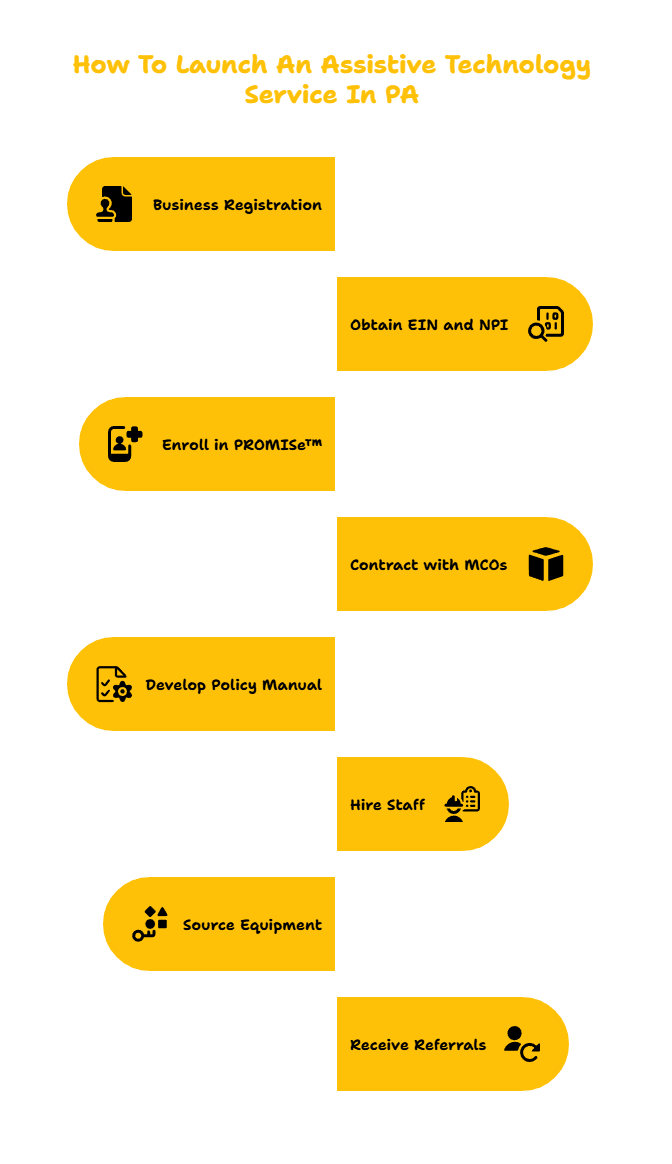
The process of becoming a Medicaid-approved provider requires a systematic approach to business development and compliance. Before a provider can bill for services, the organization must be legally recognized by the Commonwealth, registered with the Department of State, and hold the necessary EIN and Type 2 NPI. The technical backbone of this process is the PROMISe™ (Provider Reimbursement and Operations Management Information System) portal, where all enrollment and credentialing data must be accurately maintained.
Beyond basic business registration, agencies must demonstrate institutional competence. This involves developing a robust Assistive Technology Services Policy & Procedure Manual that details every operational workflow, from HIPAA-compliant intake to incident reporting. Providers must also contract directly with the appropriate MCOs if they intend to serve the CHC population, ensuring that their internal processes align with the specific authorizations and billing requirements of those managed care entities.
- Business Foundation: Register the business and obtain all necessary tax and national provider identifiers.
- Medicaid Enrollment: Enroll as a Medicaid provider in the PROMISe™ portal under the appropriate provider type.
- Credentialing: Maintain current liability and workers' compensation insurance, and ensure staff hold relevant professional certifications like the Assistive Technology Professional (ATP) from RESNA.
- Compliance Documentation: Compile a comprehensive policy manual covering privacy, safety, equipment maintenance, and documentation standards.
Structuring Staffing and Clinical Requirements
Staffing for an AT provider agency requires a blend of administrative efficiency and clinical expertise. The Program Coordinator typically serves as the central point of contact for service authorizations and referrals, ensuring that the agency remains compliant with documentation timelines. For the actual delivery of technology, the role of the Assistive Technology Specialist is paramount. While certification is not always mandatory, having an ATP-certified specialist on staff significantly strengthens an agency’s ability to conduct high-quality evaluations.
Where the scope of work involves complex medical needs, the agency may utilize licensed clinicians such as Occupational Therapists (OTs), Physical Therapists (PTs), or Speech-Language Pathologists (SLPs). Regardless of the specific role, all staff must undergo rigorous training. This includes specialized instruction on device handling, HIPAA and confidentiality protocols, and the nuances of Medicaid documentation to ensure that every billing entry is audit-ready.
Navigating Medicaid Waiver Programs and Timelines
Pennsylvania’s HCBS waiver landscape is diverse, and understanding which program covers which technology is essential for long-term sustainability. The Consolidated, Community Living, and P/FDS waivers under ODP each offer different budgetary pathways for AT, while the OLTL waivers, including the Aging, Independence, and OBRA waivers, serve specific adult populations with physical or age-related limitations. Navigating these requires a deep understanding of the individual’s Service Plan and the specific authorizations granted by their service coordinators.
Agencies should anticipate a phased timeline for startup. Initial business registration and policy development typically span one to two months, followed by the more intensive PROMISe™ enrollment and provider approval period, which can take two to three months. Once authorized, hiring and initial equipment sourcing may take an additional 30 to 60 days. Recognizing these timelines is critical for financial planning and maintaining cash flow before the first referral is ever received.
Frequently Asked Questions
What is the role of an ATP certification in Pennsylvania?
An Assistive Technology Professional (ATP) certification from RESNA signifies that the practitioner has met rigorous standards for analyzing the needs of consumers with disabilities and selecting the appropriate equipment. While not always a regulatory requirement for every task, it is highly encouraged and often preferred by oversight agencies for conducting clinical assessments and developing complex medical justifications.
How does an agency receive referrals for AT services?
Once an agency is fully enrolled in the PROMISe™ portal and holds the necessary contracts with ODP, OLTL, or specific CHC MCOs, they become eligible to receive referrals. These referrals are typically initiated by support coordinators or service coordinators who manage the participant's individual support plan (ISP). Marketing and relationship-building with these coordinators are vital to building a consistent referral pipeline.
What documentation is essential for every AT device provided?
Every piece of AT provided must be backed by a clear audit trail. This includes the initial assessment report, evidence of medical necessity, proof of procurement, and documentation of delivery or installation. Furthermore, the agency must maintain signed logs of all training sessions provided to the user or their caregiver, as well as any subsequent maintenance or repair records, ensuring compliance with Medicaid billing and record-keeping mandates.
Key Takeaway: Successful operation as a Pennsylvania Assistive Technology provider requires a disciplined adherence to state-mandated documentation, active engagement with PROMISe™ enrollment procedures, and a clear understanding of the specific requirements set forth by ODP, OLTL, and CHC MCOs to ensure service continuity for the participants served.
Last verified: 2024. The information provided is for educational purposes only and does not constitute legal or professional consulting advice. For specific guidance regarding your agency's compliance or enrollment, please consult the official Pennsylvania Department of Human Services or the appropriate managed care organization documentation.