ASSISTIVE TECHNOLOGY SERVICES PROVIDER IN OREGON
By Fatumata Kaba · 2025-10-06 · 6 min read
Enabling greater independence, accessibility, and safety for Oregonians through innovative technology solutions requires a strategic approach to provider enrollment and regulatory compliance. Assistive Technology (AT) services in Oregon are specialized Medicaid-funded supports that provide individuals with disabilities or chronic conditions access to devices, equipment, and technology-related services that increase functional independence in their daily lives. By securing status as an authorized provider under the Oregon Health Plan (Medicaid), organizations can deliver essential tools—ranging from mobility aids to complex environmental control systems—that are vital to the health and autonomy of waiver participants.
How Are Assistive Technology Services Regulated in Oregon?
The regulatory framework for Assistive Technology in Oregon is multi-layered, involving both state and federal oversight to ensure participant safety and fiscal accountability. The Oregon Department of Human Services (ODHS), specifically through Aging and People with Disabilities (APD) and Developmental Disabilities (DD) services, serves as the primary gateway for service authorization. Local service coordinators and case managers within these departments are responsible for identifying participant needs and authorizing the specific AT services required to meet those needs.
Beyond state-level authorization, the Oregon Health Authority (OHA) maintains the integrity of the Oregon Health Plan (OHP). The OHA manages the critical functions of provider enrollment, funding disbursement, and regulatory compliance. At the federal level, the Centers for Medicare & Medicaid Services (CMS) ensures that Oregon’s HCBS waivers and the K Plan (Community First Choice) remain in alignment with federal standards regarding the delivery of assistive technology. Additionally, all provider businesses must maintain valid registration with the Oregon Secretary of State (SOS) to operate legally within the state.
What Specific Services Do AT Providers Deliver?
Approved AT providers deliver a comprehensive range of supports designed to acquire, retain, or improve a participant's ability to perform daily activities. These services go beyond simple product delivery; they encompass the full lifecycle of the technology, ensuring that the device is not only provided but is also functional and effectively utilized by the participant. Providers act as essential partners in home and community-based settings by offering technical expertise that translates into real-world independence.
- Device Selection & Procurement: Identifying and ordering appropriate AT that meets the client’s documented functional needs.
- Installation & Setup: Ensuring devices are safely and properly configured in the home or community setting to prevent injury and maximize utility.
- Customization & Programming: Modifying equipment for individual preferences, such as setting up voice commands, mobility access triggers, or interface adjustments.
- Training & Coaching: Teaching individuals and their primary caregivers how to use AT effectively and safely in their daily routines.
- Repair & Maintenance: Troubleshooting technical issues, replacing faulty parts, and performing routine servicing to extend the life of the equipment.
- Environmental Accessibility Solutions: Deploying smart home devices, automated switches, alarm systems, and remote controls to enhance household safety.
What Are the Prerequisites for Provider Enrollment?
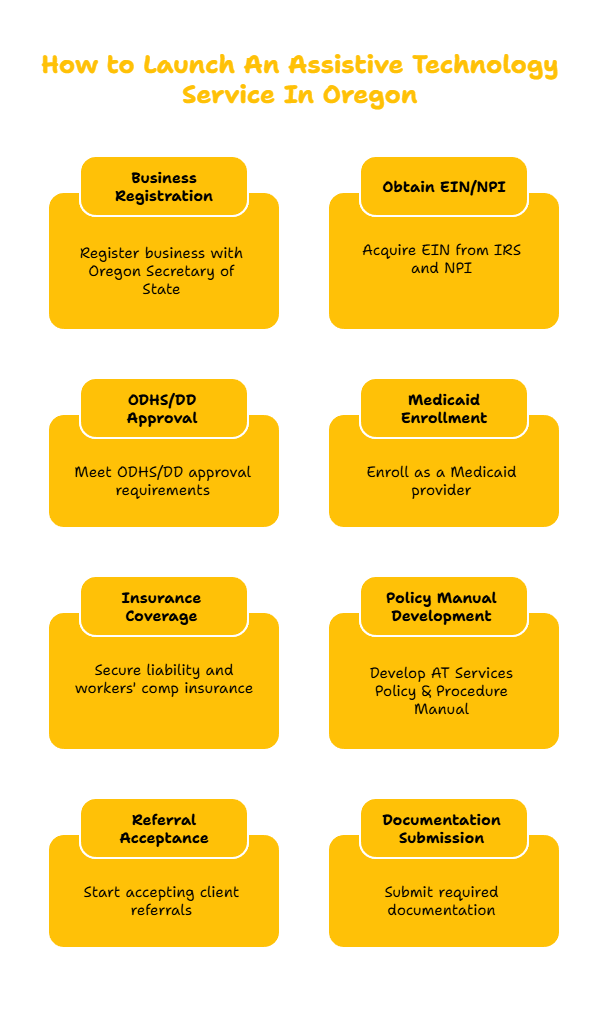
Becoming an approved Medicaid provider for AT services in Oregon is a structured process that requires significant administrative preparation. Before initiating enrollment, an agency must establish a formal business structure, register with the Oregon Secretary of State, and secure both an Employer Identification Number (EIN) from the IRS and a Type 2 National Provider Identifier (NPI). Demonstrating financial and operational readiness through appropriate insurance coverage, including general liability and workers’ compensation, is mandatory for all applicants.
Internal documentation is perhaps the most critical component of the readiness phase. Applicants must develop an Assistive Technology Services Policy & Procedure Manual that explicitly outlines how the business will meet Oregon Medicaid expectations. If the business intends to operate as a Durable Medical Equipment (DME) provider, it may also be required to obtain specialized accreditation through bodies such as CHAP or ACHC and secure necessary licensing via the Oregon Board of Pharmacy for devices that contain medical components.
How Do Agencies Manage Staffing and Training Requirements?
Success as an AT provider depends heavily on the competency and reliability of the staff. Key roles typically include an Assistive Technology Specialist or Technician, who provides the hands-on technical knowledge of devices and equipment. For organizations managing complex cases, a Program Coordinator is often necessary to ensure compliance, oversee billing cycles, and manage staff operations. In many instances, an evaluation by a licensed clinical professional—such as an Occupational Therapist (OT), Physical Therapist (PT), or Speech-Language Pathologist (SLP)—is required to determine the appropriate AT needs for a client.
All staff members must undergo rigorous training to ensure they meet quality and safety standards. This includes mandatory instruction on HIPAA compliance, client rights, and incident reporting. Furthermore, staff must be proficient in the specific equipment they install and maintain, and they should be well-versed in emergency planning and the environmental safety protocols required in participant homes. Annual credentialing updates are essential to remain in good standing with state regulators.
Which Medicaid Waiver Programs Include AT Services?
Assistive technology is a core component of the state’s commitment to supporting individuals within their own communities. Authorization for these services is primarily handled through various HCBS waiver programs and the K Plan. The K Plan (Community First Choice) provides broad access to AT for individuals who require assistance with Activities of Daily Living (ADL) or Instrumental Activities of Daily Living (IADL). Similarly, APD waivers focus on providing the environmental and mobility supports necessary for seniors and adults with physical disabilities.
For individuals with intellectual and developmental disabilities (IDD), the DD Comprehensive and Support Services Waivers are the primary vehicles for funding AT. Additionally, programs like the Children’s Waiver and Medically Fragile Services support pediatric populations, providing specialized equipment such as speech-generating devices or adapted tools that facilitate play and development. Outside of these waivers, limited AT coverage is available under the standard OHP for medically necessary durable equipment that has been properly prescribed by a medical professional.
Frequently Asked Questions
What is the typical timeline to launch an AT provider agency?
The timeline generally spans several months, beginning with a 1–2 month phase for business formation and policy manual development. Medicaid enrollment and state-specific vendor approval can take an additional 2–3 months, followed by 30–60 days for equipment sourcing and staff training. Service activation begins once formal authorizations are issued by case managers.
Are there specific documentation requirements for AT providers?
Yes. Providers must maintain robust records, including equipment logs, detailed service plans, and evidence of client training. Your internal manual must cover your assessment process, installation safety guidelines, device inventory tracking, and HIPAA-compliant billing procedures to ensure you are prepared for periodic state audits.
How does a provider start accepting client referrals?
Referrals are generated once an agency is fully enrolled as a Medicaid provider and has received vendor approval from ODHS/APD or DD. You must coordinate directly with local service coordinators and case managers who manage the specific waiver programs, as they are responsible for assessing participant needs and issuing the formal authorizations required for service delivery.
Key Takeaway: Becoming an Assistive Technology services provider in Oregon requires a disciplined focus on administrative accuracy, regulatory compliance, and high-quality staff training. By aligning business operations with the specific requirements of the Oregon Health Plan and the state’s various waiver programs, providers can build sustainable, compliant agencies that deliver vital independence-focused technology to vulnerable Oregonians.
Last verified: May 2024. This information is provided for educational purposes and does not constitute legal or professional advice. Always consult directly with the Oregon Department of Human Services (ODHS) or the Oregon Health Authority (OHA) regarding your specific provider enrollment requirements.