ASSISTIVE TECHNOLOGY SERVICES PROVIDER IN OHIO
By Fatumata Kaba · 2025-09-17 · 5 min read
Assistive Technology (AT) services in Ohio provide essential, life-enhancing supports that allow individuals with disabilities and age-related impairments to achieve greater independence in their homes and communities. By integrating customized devices, environmental controls, and communication aids into daily routines, these services ensure that participants can live safely and effectively in the least restrictive setting possible under Ohio’s Home and Community-Based Services (HCBS) waiver programs.
What Role Do Governing Agencies Play in Ohio’s AT Landscape?
The delivery of assistive technology in Ohio is governed by a multi-agency framework that ensures service quality, billing integrity, and compliance with federal standards. The Ohio Department of Medicaid (ODM) maintains primary oversight, acting as the centralized authority for funding, Medicaid reimbursement, and program compliance. By regulating how services are billed and delivered, ODM ensures that state resources are utilized effectively to support participant autonomy.
Specific populations are supported through specialized departments. The Ohio Department of Developmental Disabilities (DODD) is responsible for certifying providers who serve individuals with intellectual or developmental disabilities, often acting as the primary point of coordination for technology integration. Concurrently, the Ohio Department of Aging (ODA) oversees assistive device services for older adults through programs like PASSPORT. All these efforts operate under the guidance of the Centers for Medicare & Medicaid Services (CMS), which requires that all technology services adhere to strict person-centered HCBS standards.
What Are the Core Components of Assistive Technology Services?
Assistive Technology Services are defined by a comprehensive approach that moves beyond simple equipment procurement. Providers are tasked with identifying, installing, and maintaining tools that bridge the gap between a participant's functional limitations and their personal goals. This holistic service model ensures that once a device is acquired, the individual actually knows how to utilize it to improve their quality of life.
Approved providers generally engage in the following critical service activities:
- Needs Assessment & Evaluation: Conducting individualized assessments to determine the most effective technological solutions.
- Device Acquisition & Installation: Procuring hardware or software—ranging from low-tech mobility aids to complex Environmental Control Units (ECUs)—and ensuring proper setup in the home.
- Training & Maintenance: Teaching participants and caregivers how to operate and maintain devices, while providing ongoing troubleshooting to prevent service gaps.
- Documentation: Maintaining rigorous records regarding device utility, outcomes, and progress, which are essential for audit readiness and ongoing waiver compliance.
How Do Providers Successfully Navigate the Enrollment Process?
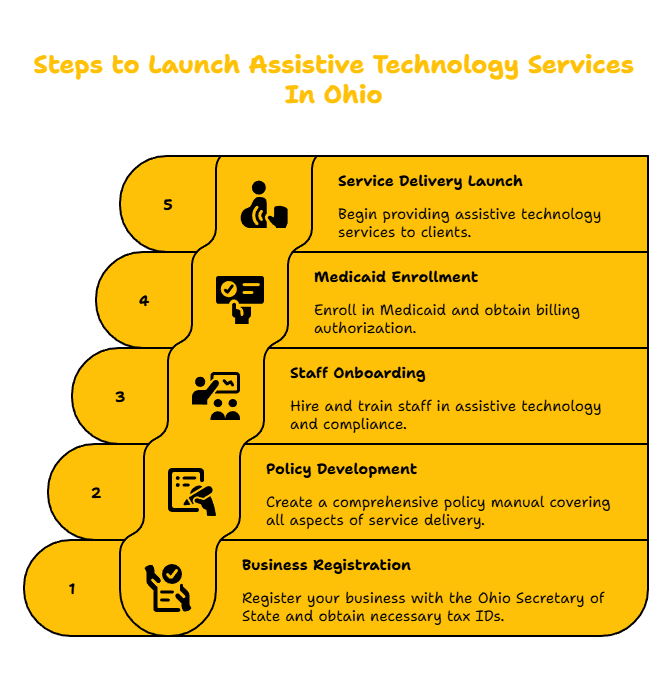
Becoming an approved Medicaid provider in Ohio requires a disciplined, step-by-step approach to documentation and regulatory alignment. Before delivering services, an agency must establish its legal and professional identity, starting with business registration through the Ohio Secretary of State and obtaining a federal Employer Identification Number (EIN) and a Type 2 National Provider Identifier (NPI).
The enrollment path typically involves applying through the DODD Provider Certification Portal or the Ohio Medicaid Provider Network, depending on the target waiver population. During the readiness review, the governing agency evaluates the provider’s internal infrastructure, including their policy and procedure manuals, staff qualification records, and inventory protocols. Only after this verification process is complete will the agency be granted a Medicaid billing number, signaling the formal authorization to begin service delivery.
What Are the Essential Staffing and Policy Requirements?
The credibility of an Assistive Technology agency rests on the expertise of its staff and the robustness of its internal policies. The program manager must possess a deep understanding of rehabilitation engineering, occupational therapy, or human services, combined with specific knowledge of Medicaid waiver regulations. Technology specialists and trainers are required to hold relevant certifications, such as those from the Rehabilitation Engineering and Assistive Technology Society of North America (RESNA), to ensure the highest standard of technical support.
Beyond technical certifications, all staff must complete mandatory training on HIPAA compliance, participant rights, and safety protocols for home-based device installation. Furthermore, agencies must maintain a comprehensive Policy and Procedure Manual that addresses every aspect of service delivery, including:
- Procedures for device tracking and usage monitoring.
- Protocols for handling repairs, replacements, and troubleshooting.
- Quality assurance measures, including grievance procedures and participant satisfaction surveys.
- Detailed documentation standards for clinical progress tracking and billing accuracy.
Which Medicaid Waiver Programs Include AT Services?
Assistive Technology is a critical benefit available across several Ohio Medicaid waiver programs. These programs are designed to offer flexibility, allowing individuals to choose supports that best fit their lifestyle, whether they are living independently or with family. Understanding which waiver a client falls under is vital for determining the scope of covered equipment and service limits.
The primary waivers that include Assistive Technology Services are:
- Individual Options (IO) Waiver: Comprehensive support for individuals with developmental disabilities.
- SELF Waiver: A participant-directed option that allows for greater autonomy in selecting technology services.
- Level One Waiver: Provides support with specific limitations on service costs.
- PASSPORT Waiver: Focused on older adults who require assistance to remain in their homes.
- Ohio Home Care Waiver: For individuals with significant medical or physical needs.
- MyCare Ohio: An integrated program for dual-eligible individuals receiving both Medicaid and Medicare.
Frequently Asked Questions
How long does the typical startup process take for an AT provider?
The timeline varies based on organizational readiness, but the process generally spans four distinct phases. Business registration and policy development typically take 1–2 months, followed by 2–3 months for staff onboarding. Medicaid enrollment and the subsequent readiness review usually last 60–90 days, with billing setup and service launch requiring an additional 30–45 days.
What are the primary documentation requirements for billing?
Providers must maintain detailed records that justify the medical necessity of the technology provided. This includes copies of the initial assessment, proof of installation, training logs signed by the participant or caregiver, and maintenance or repair records. All documentation must demonstrate that the service was delivered in accordance with the individual’s person-centered service plan.
Are there ongoing compliance obligations after enrollment?
Yes, compliance is continuous. Providers must ensure that all staff remain up-to-date with annual training refreshers on Medicaid regulations and HIPAA standards. Additionally, providers must participate in periodic quality assurance audits and maintain active records of device inventory and consumer satisfaction to remain in good standing with the authorizing agencies.
Key Takeaway: Establishing a successful Assistive Technology agency in Ohio requires meticulous attention to both technical proficiency and administrative compliance. By aligning business operations with the rigorous standards set by ODM, DODD, and ODA, providers can effectively bridge the gap between available technology and the individuals who need it most to live independent, dignified lives.
Last verified: October 2023. Disclaimer: This information is for educational purposes and does not constitute legal or professional advice. Always verify current requirements with the Ohio Department of Medicaid and relevant governing bodies before initiating business or billing activities.