ASSISTIVE TECHNOLOGY SERVICES PROVIDER IN NORTH DAKOTA
By Fatumata Kaba · 2025-09-18 · 6 min read
ENHANCING INDEPENDENCE AND ACCESSIBILITY THROUGH TECHNOLOGY SOLUTIONS
Assistive Technology Services in North Dakota provide individuals with disabilities, chronic conditions, or age-related challenges access to specialized devices and digital tools that promote autonomy, communication, and safety in daily living. These critical services, authorized under North Dakota Medicaid Home and Community-Based Services (HCBS) waiver programs, encompass a comprehensive lifecycle of care including professional assessment, device procurement, individualized training, and ongoing technical maintenance to ensure equipment is effectively integrated into a participant’s life.
What Are the Governing Agencies for Assistive Technology in North Dakota?
The delivery of assistive technology within North Dakota is structured through a collaborative regulatory framework involving state and federal oversight bodies. The North Dakota Department of Human Services (NDDHS) serves as the primary authority, administering the Medicaid waiver funding, overseeing the enrollment of qualified providers, and managing the authorization and reimbursement processes for services rendered.
Working in tandem, the North Dakota Medical Services Division (MSD) manages the specific requirements of Medicaid waiver services and monitors provider participation to ensure state-wide standards are met. Additionally, North Dakota Assistive (ND Assistive) acts as a vital resource for consultation, providing expert device demonstration and training support. At the federal level, the Centers for Medicare & Medicaid Services (CMS) maintains oversight to ensure that all Medicaid-funded services adhere to strict federal guidelines regarding person-centered care, safety, and quality.
What Scope of Services Must an Authorized Provider Deliver?
Authorized providers of Assistive Technology Services are expected to offer more than just equipment procurement; they must provide a full continuum of support that enables the participant to utilize technology to increase their independence. This includes the initial assessment to identify specific needs, followed by the customization and setup of hardware or software to ensure the solution matches the individual’s functional requirements.
Providers are responsible for the ongoing success of the assistive solution through thorough documentation, regular maintenance, and consistent follow-up. The scope of service generally includes:
- Device Assessment: Evaluating the individual's needs to recommend suitable devices.
- Customization and Setup: Modifying hardware or software to suit specific functional requirements.
- Device Procurement: Assisting with obtaining and funding necessary assistive devices.
- Training and Education: Teaching individuals and caregivers to use devices effectively for daily life.
- Adaptive Communication Aids: Providing speech-generating devices or communication boards.
- Mobility Devices: Offering powered wheelchairs, scooters, and transfer aids.
- Environmental Control Units (ECUs): Allowing remote control of home features like lighting and doors.
- Sensory Aids: Providing tools for visual, auditory, or tactile enhancements.
- Smart Home Integration: Connecting assistive devices with broader home automation systems.
- Maintenance and Support: Ensuring devices remain functional and accessible.
- Documentation: Keeping detailed records of assessments, device provision, training, and maintenance.
How Do Agencies Meet Licensing and Provider Enrollment Requirements?
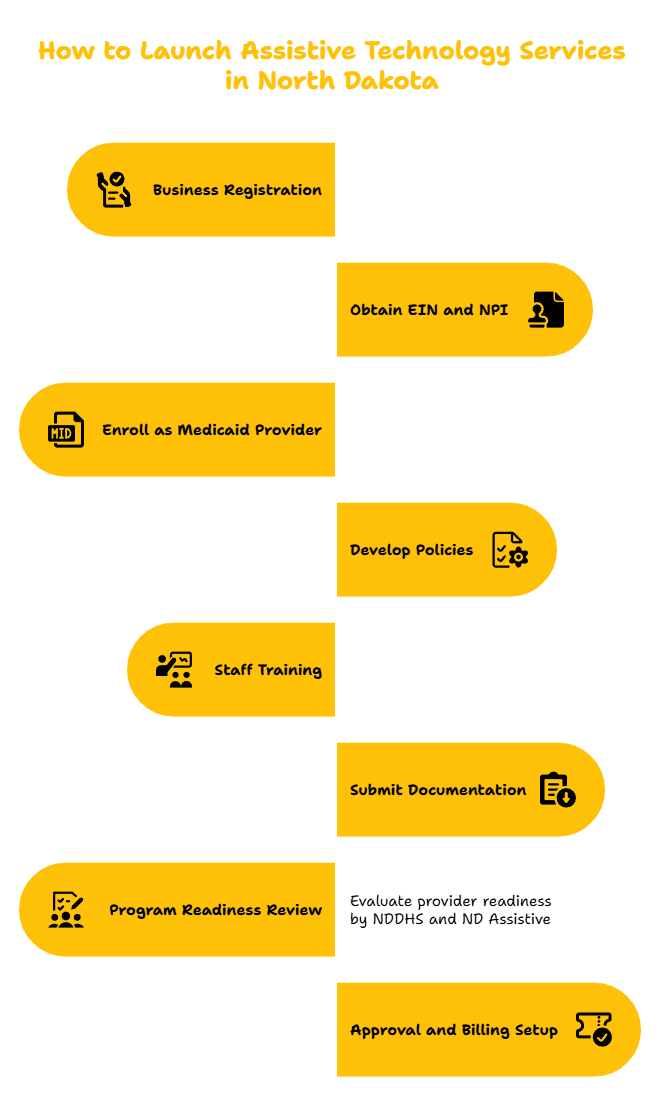
Becoming an approved Medicaid provider requires a rigorous adherence to state business and healthcare regulations. Before seeking reimbursement, an agency must register as a legal business entity with the North Dakota Secretary of State and obtain both an EIN from the IRS and a Type 2 NPI. The agency must then formalize its operations by enrolling as a Medicaid Waiver Assistive Technology provider through the North Dakota Medicaid Management Information System (MMIS).
A significant portion of the enrollment process involves the development of robust internal policies. Agencies are required to demonstrate the existence of formal procedures for device selection, user training, and safety management. Furthermore, the agency must carry adequate general and professional liability insurance. Documentation regarding staff health screenings, background checks, and specialized training must be ready for review by NDDHS to ensure all personnel are qualified to serve the vulnerable populations covered by the waiver.
What is the Standard Process for Program Approval and Readiness?
The path to becoming an active provider involves a sequential readiness review. After initial interest is expressed, the applicant submits a formal application via the MMIS. This submission must be accompanied by all required corporate documentation, including proof of insurance, policy manuals, and staff qualifications. NDDHS and ND Assistive then conduct a program readiness review to evaluate the provider’s technology assessment protocols, safety standards, and administrative structure.
The timeline for launching these services is generally broken into distinct phases. Business formation and compliance preparation typically take one to two months, followed by two to three months for staff hiring and credentialing. The formal Medicaid provider enrollment and readiness review process often spans 60 to 90 days. Once these milestones are met, the agency can finalize its Medicaid billing setup and begin service delivery within 30 to 45 days.
What Are the Mandatory Staffing and Documentation Standards?
Provider agencies are held to high staffing standards to ensure the quality of assistive services. The leadership must include an Assistive Technology Program Director with a degree in rehabilitation engineering, healthcare administration, or human services, along with proven management experience. Specialists and technicians must hold relevant certifications in assistive technology or rehabilitation technology to ensure that technical support and repairs meet clinical expectations.
Every employee must undergo continuous professional development. Essential training modules include HIPAA compliance, participant rights, safety and emergency response protocols, and best practices for documentation. The agency’s internal policy manual must be comprehensive, covering everything from HIPAA-compliant grievance handling to detailed maintenance logs. Accurate record-keeping is critical, as these documents are essential for both quality assurance audits and successful Medicaid billing.
Frequently Asked Questions
Which Medicaid Waiver programs cover Assistive Technology Services in North Dakota?
Assistive Technology Services are accessible through several key programs, including the Aged and Disabled Waiver, the Technology Dependent Waiver, the Developmental Disabilities Waiver, and the standard Home and Community-Based Services (HCBS) Waiver.
What specific documentation is required to enroll as a provider?
Applicants must provide Articles of Incorporation, IRS EIN confirmation, NPI documentation, proof of liability insurance, and a comprehensive Assistive Technology Policy & Procedure Manual that addresses assessment, training, HIPAA compliance, and quality assurance.
How does the Readiness Review impact the launch timeline?
The Readiness Review is a critical evaluation of an agency’s ability to perform services according to state standards. It typically occurs after the application phase and is a prerequisite for final Medicaid enrollment, often requiring 60 to 90 days to complete as part of the overall setup process.
WAIVER CONSULTING GROUP’S START-UP ASSISTANCE SERVICE — NORTH DAKOTA ASSISTIVE TECHNOLOGY SERVICES PROVIDER
WCG supports agencies in launching Medicaid-compliant Assistive Technology Services in North Dakota, offering:
- Business registration, Medicaid enrollment, and licensing assistance.
- Policy manual development for device assessment, training, and maintenance.
- Staff credentialing, training program templates, and compliance documentation.
- Medicaid billing setup and audit-prepared financial management.
- Branding, website development, and client outreach strategies.
- Quality assurance systems for assistive technology and compliance monitoring.
- Collaboration with healthcare providers, technology specialists, and community organizations.
Our Client Portal offers a wealth of resources that you can explore related to various programs and state requirements.
Key takeaway: Establishing an Assistive Technology program in North Dakota requires a meticulous approach to regulatory compliance, encompassing both business formation and clinical readiness. Success is rooted in the development of thorough policy manuals, the hiring of qualified technology specialists, and strict adherence to the enrollment timelines established by the North Dakota Department of Human Services.
Last verified: May 22, 2024. This information is for educational purposes only and does not constitute legal or financial advice. Please consult with the North Dakota Department of Human Services or legal counsel for the most current regulations and specific compliance requirements for your organization.