ASSISTIVE TECHNOLOGY SERVICES PROVIDER IN NORTH CAROLINA
By Fatumata Kaba · 2025-09-15 · 5 min read
ENHANCING INDEPENDENCE AND ACCESSIBILITY THROUGH CUSTOMIZED TECHNOLOGICAL SOLUTIONS
Assistive Technology Services in North Carolina function as a critical component of the state’s Home and Community-Based Services (HCBS) framework, designed to empower individuals with disabilities or chronic conditions by facilitating greater autonomy. These services provide essential technology-based solutions that enhance daily living, communication, mobility, and environmental control for participants across various Medicaid waiver programs.
What Are Assistive Technology Services and Who Governs Them?
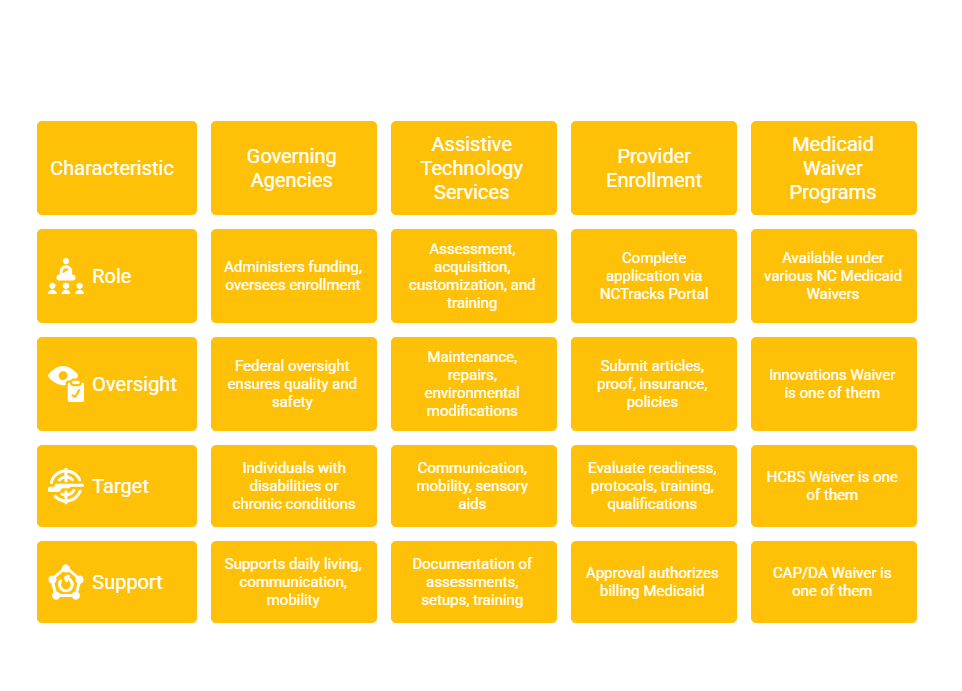
Assistive Technology Services encompass a comprehensive spectrum of professional support, including the assessment of individual needs, the acquisition of specialized devices, and the subsequent customization, training, and maintenance required for long-term usability. These services are vital for integrating technology into the home environment, such as automated lighting or adaptive controls, and ensuring that communication devices and mobility aids are perfectly tailored to the participant’s unique functional requirements.
The regulatory environment for these services is governed by a multi-tiered oversight structure. At the federal level, the Centers for Medicare & Medicaid Services (CMS) ensures that all Medicaid-funded services adhere to rigorous standards for quality, safety, and person-centered care. Within North Carolina, the Department of Health and Human Services (NCDHHS) serves as the primary authority, overseeing provider enrollment, service authorization, and the mechanics of reimbursement. Complementing these efforts, the North Carolina Division of Health Benefits (NC Medicaid) manages the administrative aspects of waiver services, while the Division of Mental Health, Developmental Disabilities, and Substance Abuse Services (DMH/DD/SAS) provides specific oversight for technology services targeting individuals with developmental disabilities and behavioral health needs.
What Is the Scope of Services Provided Under North Carolina Medicaid?
Approved Assistive Technology providers are expected to deliver a standardized range of services that go beyond mere equipment procurement. This includes conducting thorough technology assessments to identify the specific tools that will best improve an individual's independence. Once identified, providers manage the acquisition, delivery, and professional setup of the technology, ensuring that each device is adapted correctly to the user’s environment and personal capabilities.
Beyond the technical installation, providers are responsible for educating both the participant and their caregivers on the safe and effective use of the equipment. This education is supported by robust documentation practices, where providers maintain detailed records of all assessments, training sessions, and maintenance interactions. The core categories of provided solutions generally include:
- Communication Devices: Providing speech-generation tools and alternative communication interfaces.
- Mobility Aids: Supplying powered wheelchairs and adaptive driving equipment.
- Sensory Aids: Delivering specialized devices for visual or hearing impairments, such as screen readers or hearing amplifiers.
- Environmental Modifications: Integrating automated systems for enhanced home accessibility.
- Technical Support: Providing ongoing maintenance, repairs, and troubleshooting for all deployed technologies.
How Do Agencies Fulfill Licensing and Provider Approval Requirements?
Establishing an Assistive Technology agency in North Carolina requires strict adherence to state business and healthcare regulations. Founders must first ensure the legal formation of their business entity through the North Carolina Secretary of State and obtain the necessary federal identifiers, including an Employer Identification Number (EIN) and a Type 2 National Provider Identifier (NPI). These foundational steps are prerequisites for interacting with the state’s fiscal and regulatory systems.
Once the business is formed, providers must complete the enrollment process through the NCTracks Provider Portal specifically for HCBS waiver services. During this phase, applicants must demonstrate operational readiness by submitting comprehensive documentation, including evidence of general and professional liability insurance and a robust policy manual. This manual must detail internal processes for device management, user training protocols, HIPAA compliance, and procedures for maintaining participant rights and grievance handling.
What Is the Typical Process for Provider Enrollment and Readiness?
The enrollment path is structured to ensure that only qualified providers enter the Medicaid network. After the initial application is submitted via the NCTracks Portal, the NCDHHS and the relevant divisions, such as DMH/DD/SAS, conduct a formal Program Readiness Review. This evaluation is critical, as it confirms that the agency possesses the infrastructure to support its participants effectively. The review process examines the agency’s technical protocols, its ability to execute staff training plans, and the overall adequacy of its service delivery model.
Upon a successful review, the agency is formally approved for enrollment as a Medicaid provider, allowing them to begin billing for services using the designated Medicaid codes. The timeline for this transition typically ranges from several months to a year, accounting for business formation, staff recruitment, and the final state-led readiness audit. Maintaining compliance post-enrollment requires ongoing commitment to documentation standards and periodic quality assurance monitoring by state agencies.
What Are the Staffing and Documentation Standards?
Professional staffing is a cornerstone of Assistive Technology Services, requiring a mix of management expertise and technical proficiency. Agencies are generally required to employ an Assistive Technology Program Director who holds relevant credentials in fields such as biomedical engineering, rehabilitation technology, or healthcare administration. They are supported by Assistive Technology Specialists, who should possess field-specific certifications, and technical support staff responsible for the physical installation and maintenance of equipment.
Documentation requirements are equally stringent. Providers must maintain meticulous records, as these are the primary evidence used during Medicaid audits to verify that services were delivered as authorized. Required documentation includes:
- Comprehensive Assistive Technology Policy & Procedure Manual.
- Evidence of staff credentialing, background checks, and health screenings.
- Records of ongoing training regarding device safety and technical troubleshooting.
- Detailed case notes for every technology assessment, setup, and training session.
- Proof of compliance with HIPAA and participant safety protocols.
Frequently Asked Questions
Which Medicaid Waivers Cover Assistive Technology Services?
In North Carolina, these services are available to participants enrolled in several specific programs, including the Innovations Waiver, the Community Alternatives Program for Disabled Adults (CAP/DA), the Community Alternatives Program for Children (CAP/C), the Traumatic Brain Injury (TBI) Waiver, and the standard Home and Community-Based Services (HCBS) Waiver.
What is the role of the Program Director in an AT agency?
The Program Director is responsible for the overall clinical and operational integrity of the agency. This role typically requires a degree in a relevant technical or healthcare field and involves overseeing staff credentialing, ensuring the agency remains in compliance with NCDHHS regulations, and managing the quality assurance systems for all deployed technologies.
How does an agency stay prepared for Medicaid audits?
Agencies maintain audit readiness by adhering to established documentation standards from day one. This includes keeping updated records on staff training, device maintenance logs, signed assessments, and clear evidence of service delivery. Regularly reviewing internal policies against the latest guidance from the NCDHHS and the NCTracks portal is essential for long-term compliance.
Key Takeaway
Launching an Assistive Technology Services agency in North Carolina is a structured process that hinges on rigorous adherence to state Medicaid policies, professional staffing, and detailed documentation. Success in this field requires agencies to not only maintain technical expertise in adaptive equipment but also to navigate the complex administrative requirements of the NCDHHS and the NCTracks provider enrollment system to ensure high-quality outcomes for waiver participants.
Last verified August 2024. The information provided in this article is for general informational purposes only and does not constitute legal, medical, or professional advice. Always consult with the North Carolina Department of Health and Human Services (NCDHHS) or a qualified consultant before making decisions regarding Medicaid provider enrollment or service delivery.