ASSISTIVE TECHNOLOGY SERVICES PROVIDER IN NEW YORK
By Fatumata Kaba · 2025-09-04 · 5 min read
ENHANCING INDEPENDENCE AND ACCESSIBILITY THROUGH TECHNOLOGICAL SUPPORT IN HOME AND COMMUNITY SETTINGS
Assistive Technology (AT) Services in New York provide critical support to individuals with disabilities or chronic health conditions, enabling them to live more independently in home and community-based settings. These services encompass the assessment, acquisition, customization, and training required to utilize specialized devices that improve daily living, communication, mobility, and environmental control for participants enrolled in New York Medicaid Home and Community-Based Services (HCBS) Waiver programs.
As the demand for person-centered technology solutions grows, provider agencies must navigate a complex regulatory landscape to ensure compliance with New York State Department of Health (NYSDOH) standards. By integrating technology into the daily lives of waiver participants, providers play a vital role in reducing the need for institutional care and promoting long-term health, safety, and community integration.
What Are the Governing Agencies and Regulatory Oversight Requirements?
The delivery of Assistive Technology Services in New York is subject to rigorous oversight by both state and federal authorities. The New York State Department of Health (NYSDOH) serves as the primary entity responsible for the administration of Medicaid waiver funding, including the management of provider enrollment, service authorization processes, and reimbursement protocols. Coordination with the NYSDOH ensures that all technological services align with state-wide quality and safety benchmarks.
Depending on the specific waiver program and the participant population, other agencies exercise additional oversight. The Office for People With Developmental Disabilities (OPWDD) provides specific guidance for AT services targeted at individuals with developmental disabilities, while the New York State Office of Mental Health (OMH) ensures that programs serving individuals with mental and behavioral health needs adhere to clinical and regulatory standards. At the federal level, the Centers for Medicare & Medicaid Services (CMS) maintains oversight to ensure that these Medicaid-funded services uphold person-centered care mandates.
What Scope of Services Must an AT Provider Deliver?
Assistive Technology Services involve a comprehensive lifecycle of support, ranging from the initial identification of a participant’s needs to ongoing technical maintenance. Approved providers are expected to offer a continuum of care that addresses the functional, physical, and cognitive requirements of the individuals they serve. This scope of work is foundational to the service’s success and its ability to meet Medicaid billing requirements.
- Technology Assessment: Systematically evaluating individual needs to identify appropriate assistive devices that enhance functional independence.
- Device Acquisition: Procurement and delivery of technology tailored to support specific mobility, communication, or environmental needs.
- Customization and Setup: Modifying and installing devices to ensure they are compatible with the participant’s specific environment and capabilities.
- Training and Education: Instructing both the individual participant and their primary caregivers on the effective and safe use of technology.
- Maintenance and Repairs: Providing ongoing technical support to ensure all provided devices remain functional, secure, and up-to-date.
- Specialized Device Categories: Providing solutions such as environmental controls (automated lighting), communication aids (speech generation), mobility devices (powered wheelchairs), and sensory aids (screen readers).
How Does the Medicaid Provider Enrollment Process Function?
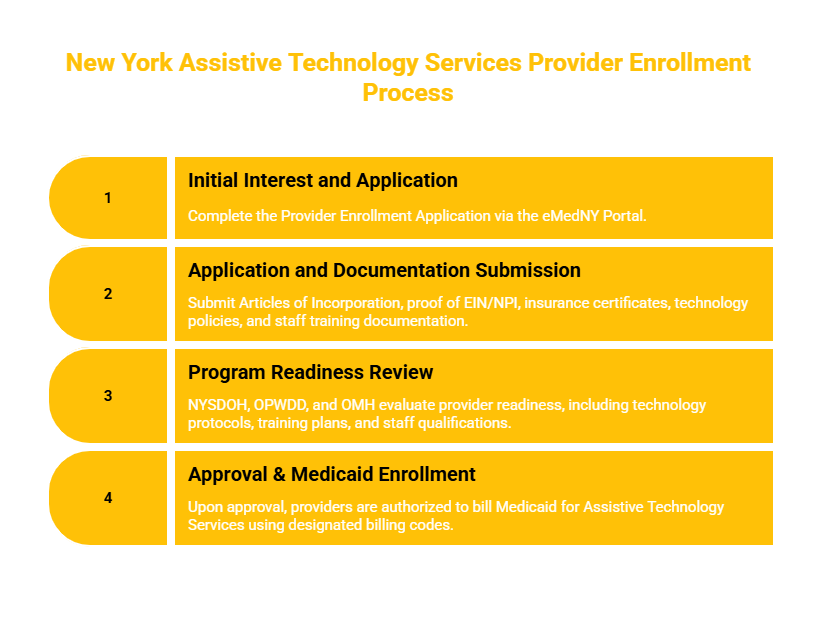
The path to becoming an authorized Medicaid waiver provider begins with formal enrollment via the New York Medicaid Provider Enrollment Portal, known as eMedNY. The process is designed to vet the provider’s readiness, operational capacity, and ability to meet the strict standards associated with HCBS waivers. Prospective agencies must demonstrate that they have the infrastructure to manage sensitive medical information and deliver high-quality, reliable technical assistance.
The enrollment journey typically involves an initial application followed by the submission of extensive organizational documentation, including Articles of Incorporation, proof of EIN/NPI registration, and evidence of necessary liability insurance coverage. Following the application submission, a program readiness review is conducted by the relevant state agencies—such as the NYSDOH, OPWDD, or OMH—to evaluate the provider’s technology protocols, training plans, and staff qualifications. Only after this successful review does a provider gain the authority to begin billing Medicaid for approved services.
What Are the Essential Documentation and Policy Requirements?
Regulatory compliance for an AT provider is built upon the strength of its internal policies and documentation practices. Every provider agency is required to maintain a comprehensive Assistive Technology Policy & Procedure Manual. This document serves as the backbone of the organization, outlining how the agency approaches everything from initial client assessments to the final decommissioning of a device. It must demonstrate a clear commitment to participant rights, HIPAA compliance, and grievance resolution.
Beyond internal manuals, providers must maintain rigorous records to justify Medicaid claims and ensure quality assurance. This includes keeping up-to-date documentation on:
- Detailed records of device setups, including serial numbers and compatibility documentation.
- Staff credentialing records, including background check results and ongoing professional development certificates.
- Incident reports and emergency response procedures related to equipment failure.
- Systematic logs of training sessions provided to participants and their caregivers.
- Protocols for safety and usability evaluations that occur throughout the device's service life.
How Should Staffing and Professional Development Be Managed?
The quality of Assistive Technology Services is highly dependent on the expertise of the staff. Agencies must recruit personnel who possess a blend of technical acumen and a deep understanding of the healthcare landscape. The Assistive Technology Program Director acts as the leader for these efforts, generally requiring a bachelor’s or master’s degree in biomedical engineering, rehabilitation technology, or a related healthcare field, paired with proven experience in program management.
All staff—including Specialists and technical support personnel—must undergo continuous training to remain effective. This includes mandatory education on HIPAA compliance, participant rights, and the nuances of the specific Medicaid waiver programs being served. By fostering an environment of ongoing learning, providers ensure that their team is prepared to handle the evolving nature of assistive hardware and software, ultimately providing better support to their participants.
Frequently Asked Questions
Which Medicaid waiver programs include Assistive Technology Services?
These services are available under several New York Medicaid Waivers, specifically the OPWDD Comprehensive Waiver, the Home and Community-Based Services (HCBS) Waiver, the Nursing Home Transition and Diversion (NHTD) Waiver, the Traumatic Brain Injury (TBI) Waiver, and the Children’s Waiver.
What is the typical timeline for launching an AT provider agency?
The process generally takes several months: 1–2 months for business formation, 2–3 months for staffing and internal development, 60–90 days for the Medicaid enrollment and readiness review process, and 30–45 days for final billing setup and service launch.
What is the primary role of an Assistive Technology Specialist?
The Specialist is responsible for the direct application of technology, including evaluating the participant's specific needs, customizing devices to match those needs, and providing hands-on training to ensure the participant can independently operate the provided equipment.
Key Takeaway
Launching an Assistive Technology Services provider in New York requires a disciplined approach to organizational structure, strict adherence to state regulatory protocols, and a commitment to maintaining comprehensive documentation. By aligning business operations with the requirements of the NYSDOH, OPWDD, and other governing bodies, providers can successfully deliver life-enhancing technological support that remains fully reimbursable under Medicaid waiver programs.
Last verified: August 2024. This content is provided for informational purposes only and does not constitute legal or professional advice. Always consult with the New York State Department of Health or the relevant regulatory oversight agency for the most current requirements and guidance specific to your organization.