ASSISTIVE TECHNOLOGY SERVICES PROVIDER IN NEW MEXICO
By Fatumata Kaba · 2025-09-05 · 6 min read
How Do Assistive Technology Services Enhance Independence in New Mexico?
Assistive Technology (AT) Services in New Mexico serve as a critical bridge between individuals with disabilities or age-related limitations and the environment around them. By providing customized technological solutions, these services enable participants to perform essential daily tasks, bridge communication gaps, and maintain a level of independence that might otherwise be unattainable. Authorized under New Mexico’s Medicaid Home and Community-Based Services (HCBS) waiver programs, these services go beyond mere equipment provision; they encompass the professional assessment, installation, training, and ongoing technical support necessary to ensure that technology effectively meets the unique needs of each individual.
For provider agencies, delivering these services requires a commitment to person-centered planning and rigorous adherence to state quality standards. Because AT encompasses everything from simple adaptive utensils to complex electronic communication devices and smart home integration, providers must maintain a high level of technical competency. By ensuring that participants are fully trained in the use of their devices and that equipment is regularly maintained for safety, agencies play a vital role in supporting the long-term goals of individuals served by New Mexico’s Medicaid waiver system.
Which Agencies Govern Assistive Technology Services in New Mexico?
The regulatory landscape for Assistive Technology in New Mexico is defined by a multi-tiered oversight structure designed to ensure compliance, safety, and fiscal responsibility. At the federal level, the Centers for Medicare & Medicaid Services (CMS) sets the overarching standards for all HCBS waiver programs. CMS ensures that state-run programs remain person-centered, provide adequate participant protections, and deliver quality outcomes that justify the use of federal Medicaid funds.
At the state level, the New Mexico Human Services Department (HSD) serves as the primary authority for administering Medicaid waiver funding. HSD manages the operational aspects of provider enrollment, authorizes services, and oversees the reimbursement process. Simultaneously, the Developmental Disabilities Supports Division (DDSD) works to ensure that services are delivered in accordance with state-specific quality standards. The DDSD is responsible for monitoring service delivery, conducting compliance reviews, and ensuring that providers adhere to the programmatic requirements outlined in the state’s waiver applications.
What Are the Core Components of Assistive Technology Service Delivery?
Assistive Technology providers are responsible for a comprehensive service array that addresses both the physical and functional needs of participants. The delivery model is strictly tied to the participant's Individualized Service Plan (ISP), ensuring that every piece of equipment or software provided is directly linked to an identified need for increased independence or communication.
Approved providers generally manage the following service domains:
- Communication & Computer Access: Provision of speech-generating devices, voice amplifiers, tablets with communication apps, screen readers, and adaptive keyboards or mice.
- Mobility & Environmental Control: Installation of electric wheelchairs, powered transfer devices, smart home systems, adaptive switches, and home accessibility features like stair lifts or automatic door openers.
- Daily Living Support: Provision of adaptive feeding utensils, plate guards, sensory aids (auditory/visual alerts), and specialized bed positioning systems.
- Support Services: Ongoing professional training for the participant and their caregivers, as well as routine maintenance, troubleshooting, and repairs to ensure devices remain operational and safe.
How Do Agencies Meet Licensing and Provider Approval Requirements?
To operate as a Medicaid-enrolled Assistive Technology provider, an organization must navigate a structured vetting process. The initial requirements focus on establishing a formal legal entity, such as registering with the New Mexico Secretary of State, and securing essential administrative identifiers including a federal EIN and a Type 2 NPI. These foundational steps ensure that the provider is recognized as a legitimate business entity capable of contracting with state programs.
Beyond basic business licensing, prospective providers must demonstrate operational readiness. This involves developing a robust set of internal policies regarding technology assessment protocols, installation workflows, and user training methodologies. Agencies must also maintain professional and general liability insurance. Furthermore, because these services involve direct interaction with vulnerable populations, all staff must undergo rigorous background checks and health screenings. Developing a comprehensive Policy & Procedure manual is a critical milestone, as it serves as the blueprint for compliance during state audits.
What Is the Required Documentation and Staffing Structure?
Successful provider enrollment relies on the submission of a detailed documentation package. This includes proof of business formation, tax identification, and evidence of specialized technology certifications. The Policy & Procedure manual is perhaps the most critical document; it must clearly detail HIPAA compliance, grievance procedures, safety protocols for equipment installation, and staff training records. These documents provide the state with evidence that the agency can manage risk while maintaining high standards of service.
Staffing requirements are equally specific to ensure clinical and technical accuracy:
- Assistive Technology Program Director: Must possess a Bachelor’s or Master’s degree in a related field (e.g., occupational therapy or rehabilitation engineering) and demonstrate experience with adaptive technology.
- Assistive Technology Specialists: Should hold industry-recognized certifications, such as a RESNA ATP, and have proven experience in conducting assessments and user training.
- Installation Technicians and Support Staff: Responsible for the physical setup and maintenance of devices; all personnel in these roles must clear background checks and complete specialized training in safety protocols and HIPAA compliance.
How Are Assistive Technology Services Integrated into Medicaid Waiver Programs?
Assistive Technology Services are accessible to qualified participants across several New Mexico Medicaid waivers, including the Developmental Disabilities (DD) Waiver, the Mi Via Waiver, the Medically Fragile Waiver, and the Supports Waiver. Because each waiver is designed for a specific population, providers must be well-versed in the unique documentation and billing requirements associated with each program. Generally, the waiver pathway covers the full lifecycle of the technology, from the initial evaluation to the final installation and long-term maintenance.
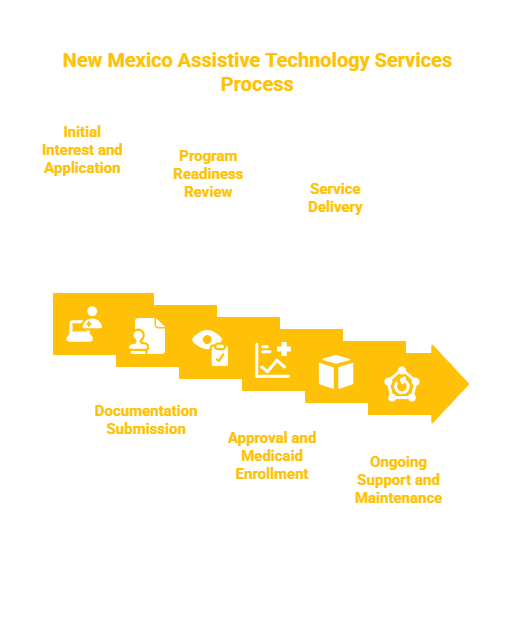
The timeline for launching these services is multi-phased. Agencies should expect a 1–2 month period for business formation and initial compliance preparation. Following this, the hiring and program development phase typically spans 2–3 months. The formal enrollment process with the state can take 60–90 days, while the final billing setup and service launch generally requires an additional 30–45 days. Proper sequencing of these phases is essential to minimize delays in service authorization and revenue generation.
Frequently Asked Questions
What specific certifications are required for my staff?
While requirements can vary, staff members involved in assessments are often expected to hold professional credentials like the Assistive Technology Professional (ATP) certification from RESNA. Technical staff must demonstrate competency in device-specific installation and safety protocols.
Can we bill for training if the device was purchased elsewhere?
Services such as device training, maintenance, and troubleshooting are billable components of the Assistive Technology service category. Providers must ensure these activities are clearly outlined in the participant's ISP and that all support is documented in accordance with Medicaid billing codes.
What is the role of the DDSD in the ongoing monitoring of our agency?
The DDSD monitors providers to ensure consistent adherence to service delivery standards. This includes periodic audits of your documentation, such as user training logs, safety inspection records, and staff credentialing files to confirm that your agency continues to meet state quality and safety requirements.
Key Takeaway
Establishing an Assistive Technology services agency in New Mexico requires a disciplined approach to clinical accuracy, administrative compliance, and state-mandated reporting. By prioritizing the development of comprehensive policy manuals and securing qualified staff with the appropriate technical certifications, provider agencies can effectively meet the complex needs of the waiver participant population while maintaining full Medicaid compliance.
Last verified: October 2023. Disclaimer: This article is for informational purposes only and does not constitute legal or professional advice. Always verify current state regulations, Medicaid statutes, and provider enrollment requirements directly with the New Mexico Human Services Department and the Developmental Disabilities Supports Division before initiating any business activities.