ASSISTIVE TECHNOLOGY SERVICES PROVIDER IN NEW HAMPSHIRE
By Fatumata Kaba · 2025-08-12 · 5 min read
ENHANCING INDEPENDENCE THROUGH TECHNOLOGICAL INNOVATION AND SUPPORT
Assistive Technology (AT) Services in New Hampshire represent a vital component of the state’s Home and Community-Based Services (HCBS) framework, providing the adaptive tools and equipment necessary for individuals with disabilities to maintain independence in their own homes. These services encompass a comprehensive lifecycle of care, from initial needs assessment and device selection to installation, training, and ongoing technical maintenance, all authorized through specific Medicaid waiver programs.
What is the Regulatory Landscape for Assistive Technology in New Hampshire?
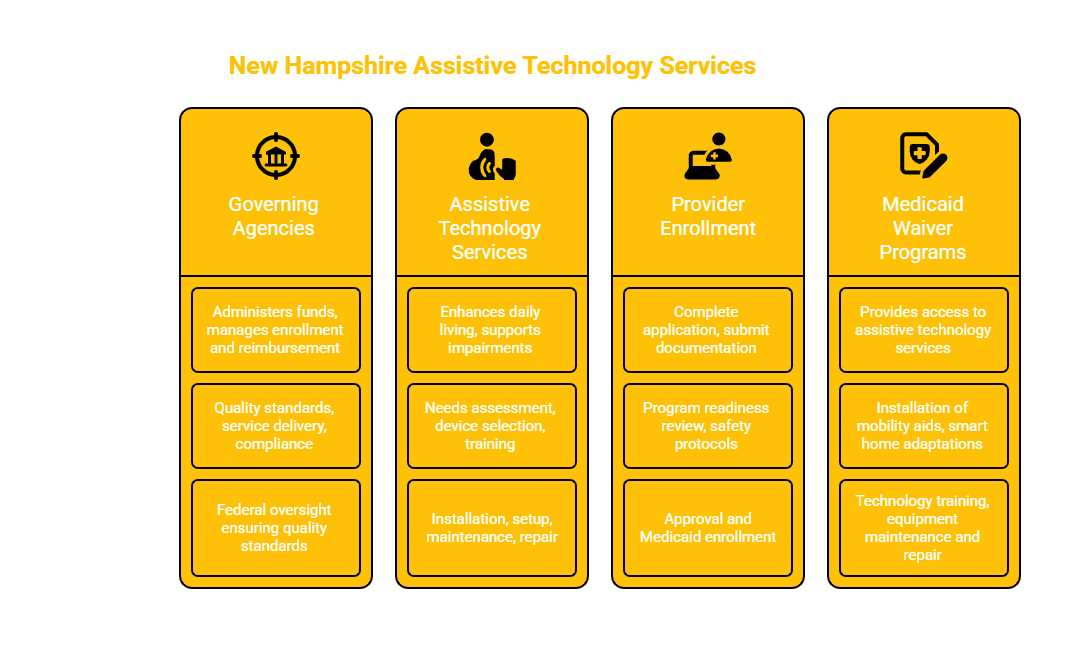
The delivery of Assistive Technology Services in New Hampshire is governed by a multi-tiered regulatory structure that ensures safety, quality, and fiscal responsibility. The New Hampshire Department of Health and Human Services (DHHS) serves as the primary authority, managing Medicaid waiver funding, overseeing the provider enrollment process, and maintaining rigorous standards for service authorization and reimbursement.
Within the DHHS, the Bureau of Elderly and Adult Services (BEAS) plays a central role in ensuring that service delivery remains compliant with state-specific quality standards and HCBS waiver regulations. Simultaneously, the Centers for Medicare & Medicaid Services (CMS) provides the federal oversight framework, mandating that all Medicaid-funded AT services adhere to person-centered planning principles and participant protection requirements designed to safeguard vulnerable populations.
How Are Assistive Technology Services Structured for Participants?
Assistive Technology Services are designed to address physical, sensory, or cognitive impairments that create barriers to daily living. By integrating specialized technology into a participant’s environment, providers can significantly enhance an individual's ability to live independently and interact with their community. Every service intervention must be clearly outlined within the participant’s Individualized Service Plan (ISP) to ensure the technology provided directly addresses identified needs.
Approved providers are responsible for a full continuum of support, ensuring the technology is not only acquired but effectively integrated into the user's life. This includes:
- Needs Assessment: Evaluating individual requirements through professional clinical or functional assessment.
- Device Selection: Recommending specific tools, such as mobility aids, communication devices, or adaptive household equipment.
- Installation and Setup: Professional integration of devices into the home or community environment.
- User Training: Comprehensive education for participants and their caregivers on device operation and safety.
- Device Maintenance: Ongoing technical support, repairs, and adjustments to ensure long-term functionality.
- Specialized Solutions: Provision of adaptive communication tools, hearing or visual aids, and environmental control systems.
What Are the Prerequisites for Provider Approval and Enrollment?
Establishing an agency to provide Assistive Technology under New Hampshire Medicaid waivers requires a structured approach to business formation and regulatory compliance. Organizations must first be legally registered with the New Hampshire Secretary of State and possess a valid EIN from the IRS and a Type 2 NPI. These foundational steps must precede the formal application process via the New Hampshire Medicaid Provider Enrollment Portal.
Beyond legal formation, providers must demonstrate operational readiness. This involves obtaining necessary certifications for technical installation, securing comprehensive general and professional liability insurance, and formalizing internal policies. Providers are expected to maintain stringent documentation regarding equipment assessment, installation safety, and staff qualifications to meet the state’s quality assurance expectations.
How Does an Agency Navigate the New Hampshire Provider Enrollment Process?
The enrollment process is a sequenced journey that begins with demonstrating administrative capability. After submitting an initial application through the state portal, the agency must provide a comprehensive portfolio of documentation. This includes proof of business identity, insurance certificates, and a detailed Policy & Procedure Manual that covers everything from HIPAA compliance and grievance handling to specific device maintenance protocols.
Once the initial documentation is submitted, the DHHS and BEAS conduct a program readiness review. This evaluation assesses whether the provider is prepared to deliver services in accordance with state law. The review includes verifying staff credentials and checking safety protocols for equipment installation. Upon successful completion of this review and final approval, the provider is officially authorized to deliver services and bill Medicaid using the designated service codes.
What Are the Essential Staffing and Quality Standards?
High-quality AT services rely on a skilled, interdisciplinary team. The Assistive Technology Program Director typically requires a bachelor’s degree in a relevant field, such as rehabilitation technology or healthcare administration, with a preference for those holding an Assistive Technology Professional (ATP) certification. This leader is responsible for overseeing the clinical and technical integrity of the program.
Supporting the director are Assistive Technology Specialists and Support Technicians. These roles require specialized technical training in device setup, repair, and customer support. Regardless of the role, all staff must undergo rigorous background checks and health screenings. Furthermore, the agency is mandated to provide ongoing training regarding client safety, HIPAA privacy standards, and annual competency evaluations to ensure that all team members remain current with evolving technologies.
Which Medicaid Waivers Cover Assistive Technology Services?
Assistive Technology Services are integrated into several key New Hampshire Medicaid waiver programs, ensuring that support is accessible to diverse populations. These include the Choices for Independence (CFI) Waiver, the Developmental Disabilities (DD) Waiver, the Acquired Brain Disorder (ABD) Waiver, the In-Home Support (IHS) Waiver for Children, and the broader Home and Community-Based Services (HCBS) Waiver framework.
Under these programs, services are highly flexible. They may involve the physical installation of mobility aids like walkers or transfer devices, the implementation of smart home technologies to improve safety, or the setup of speech-generating devices for those with communication challenges. The focus remains consistently on the participant’s functional outcomes, ensuring the technology serves as a bridge to greater autonomy.
Frequently Asked Questions
What documentation is required for the initial provider application?
Providers must submit proof of business registration with the New Hampshire Secretary of State, IRS EIN, NPI, professional liability insurance certificates, and an extensive Policy & Procedure Manual detailing their assessment, installation, and maintenance standards.
How long does the launch process typically take?
The timeline involves several phases: 1–2 months for business formation, 2–3 months for hiring and program development, 60–90 days for Medicaid enrollment and readiness review, and 30–45 days for final billing setup.
Are specific staff certifications required for AT services?
While the Assistive Technology Program Director is preferred to have an ATP certification, all staff involved in assessment and implementation must possess demonstrated technical training in their respective areas, undergo background clearances, and participate in ongoing professional development regarding equipment safety and client rights.
WAIVER CONSULTING GROUP’S START-UP ASSISTANCE SERVICE — NEW HAMPSHIRE ASSISTIVE TECHNOLOGY SERVICES PROVIDER
WCG supports agencies in launching Medicaid-compliant Assistive Technology Services in New Hampshire, offering professional guidance in business registration, Medicaid enrollment, policy development, staff training structures, and the creation of audit-prepared financial management systems to ensure long-term agency success.
Key Takeaway: Providing Assistive Technology in New Hampshire requires a combination of strict regulatory adherence, robust staff training, and a person-centered approach to device integration, ensuring that every technological intervention meaningfully improves the lives of Medicaid waiver participants.
Last verified: 2024. This content is provided for informational purposes only and does not constitute legal or professional medical advice. Always consult with the New Hampshire Department of Health and Human Services (DHHS) and current state regulations for the most up-to-date program requirements.