ASSISTIVE TECHNOLOGY SERVICES PROVIDER IN MISSISSIPPI
By Fatumata Kaba · 2025-08-06 · 5 min read
ENHANCING INDEPENDENCE AND ACCESSIBILITY FOR INDIVIDUALS WITH DISABILITIES THROUGH TECHNOLOGY
Assistive Technology (AT) services in Mississippi provide essential adaptive devices and technological solutions designed to enhance the quality of life, mobility, and communication for individuals with disabilities. By integrating these services into Mississippi’s Home and Community-Based Services (HCBS) waiver programs, the state empowers participants to maintain their independence within their homes and communities through highly customized, person-centered technology.
What Are the Governing Agencies for Assistive Technology in Mississippi?
The regulatory landscape for Assistive Technology in Mississippi involves a coordinated effort between federal oversight and state-level implementation. Understanding the hierarchy of these agencies is the first step for any provider looking to enter the market. The framework ensures that technological solutions meet strict health and safety standards while remaining compliant with federal funding requirements.
The Mississippi Department of Rehabilitation Services (MDRS) serves as a primary state partner, focusing on vocational rehabilitation and the practical application of assistive devices. Simultaneously, the Mississippi Division of Medicaid (DOM) acts as the central authority for all HCBS waiver programs, managing the funding and administrative policies that allow providers to bill for AT services. Finally, the Centers for Medicare & Medicaid Services (CMS) provides the overarching federal guidelines, ensuring that Mississippi’s waiver programs remain in compliance with national standards for accessibility and care quality.
- Mississippi Department of Rehabilitation Services (MDRS): Administers vocational rehabilitation and assistive technology programs.
- Mississippi Division of Medicaid (DOM): Administers Medicaid and HCBS waiver programs, including funding for assistive technology services.
- Centers for Medicare & Medicaid Services (CMS): Provides federal oversight and ensures waiver compliance.
What Services Comprise Assistive Technology Under HCBS Waivers?
Assistive Technology services are highly individualized, determined by the participant's unique needs as documented in their Individual Service Plan (ISP) or Person-Centered Plan (PCP). The goal is to provide tools that bridge the gap between physical, sensory, or cognitive limitations and the participant's functional goals. Providers are expected to assess the environment, recommend the appropriate technology, and ensure the participant can use the equipment effectively.
Services often extend beyond the initial procurement of a device. They encompass the entire lifecycle of the technology, including the initial setup, training for the participant and their caregivers, and ongoing maintenance or repair. Whether the requirement is a sophisticated speech-generating device or smart home environmental controls, the provider must demonstrate technical competence and a commitment to sustained usability.
- Mobility aids (e.g., wheelchairs, walkers)
- Communication devices (e.g., speech-generating devices)
- Environmental control units (e.g., smart home adaptations)
- Sensory and adaptive devices (e.g., vision or hearing aids)
- Technology training and support
- Maintenance and repair services
How Do Providers Secure Medicaid Enrollment and Licensing?
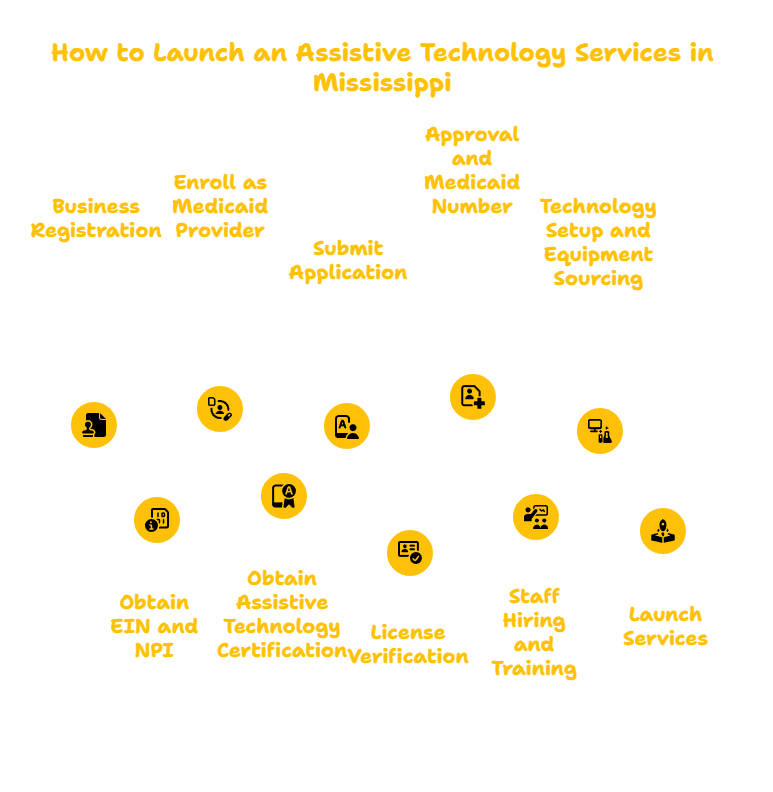
The process of becoming a Medicaid-approved provider for Assistive Technology is structured and deliberate, requiring a focus on administrative accuracy. Prospective agencies must first ensure their business entity is legally recognized within the state of Mississippi. This involves registration with the Secretary of State, obtaining a federal Employer Identification Number (EIN), and securing a National Provider Identifier (NPI) specifically assigned as a Type 2 entity.
Once the business foundation is laid, the agency must initiate the enrollment process with the Mississippi Division of Medicaid. This involves demonstrating that the agency meets all specific qualifications for AT delivery, including the possession of relevant certifications if required for specific device categories. Providers must also maintain comprehensive liability insurance and detailed documentation of staff credentials to satisfy state requirements throughout the enrollment period.
What Are the Core Documentation and Staffing Standards?
Success as an AT provider depends heavily on rigorous internal documentation. An agency must maintain a comprehensive policy and procedure manual that covers everything from the initial client assessment to the final maintenance log. Regulatory auditors look for evidence that the agency has a repeatable, safe process for recommending, installing, and repairing equipment. Documentation should clearly map out how the agency manages risk, ensures safety, and tracks the distribution of sensitive medical equipment.
Staffing requirements are equally stringent to ensure that participants receive professional support. Key roles, such as the Assistive Technology Program Manager and the Assistive Technology Specialist, require specific backgrounds in fields like occupational therapy, physical therapy, or rehabilitation. Specialist roles often mandate certifications such as the Assistive Technology Professional (ATP) designation. Ongoing training is mandatory, covering not only technical device repair but also accessibility standards, user support communication, and the precise documentation required for Medicaid billing compliance.
What Is the Expected Timeline for Agency Launch?
Launching an Assistive Technology agency in Mississippi involves multiple phases that typically span several months. Business formation is the most rapid stage, usually completed in 1–2 weeks, provided all legal filings are prepared correctly. However, the Medicaid provider enrollment process is significantly more intensive and typically requires 60–90 days to navigate through the state's vetting system.
Following the business and enrollment phases, agencies must dedicate time to building a qualified team and sourcing the necessary technology. Hiring and staff training generally takes 30–45 days to ensure every team member meets the necessary credentialing standards. The final phase involves establishing supply chains and internal inventory management systems, which can take an additional 2–4 weeks. Administrators should plan for a total lead time of approximately four to six months from initial planning to service delivery readiness.
Frequently Asked Questions
Which Medicaid waivers currently cover Assistive Technology in Mississippi?
Assistive Technology services are covered under several key programs, including the 1915(c) HCBS Waiver for the Elderly and Disabled, the Independent Living Waiver, and the Technology-Assisted Care Waiver. Providers must confirm which specific waiver their clients are enrolled in to ensure correct billing and service authorization.
Are there specific certifications required for staff members?
Yes, while specific requirements can vary based on the device or service provided, it is highly recommended and often required that staff, such as Assistive Technology Specialists, hold industry-recognized certifications like the Assistive Technology Professional (ATP) credential. Agencies must also ensure all staff maintain current CPR/First Aid certification.
What does the provider enrollment process look like for new agencies?
The enrollment process begins with a pre-application phase to clarify specific state requirements, followed by the submission of all business documentation, including EIN, NPI, and liability insurance. Once the Mississippi Division of Medicaid verifies these documents and any necessary certifications, the agency is assigned a Medicaid provider number, granting them the authorization to begin delivering services.
Key Takeaway: Establishing a compliant Assistive Technology agency in Mississippi requires a disciplined approach to documentation, staffing credentialing, and adherence to the guidelines set by the Mississippi Division of Medicaid and MDRS. By focusing on operational transparency and technical expertise, providers can effectively support the independence of waiver participants while maintaining a sustainable, compliant business model.
Last verified: August 2024. This information is for educational purposes only and does not constitute legal or professional consulting advice. Always refer to the latest policies published by the Mississippi Division of Medicaid and the Centers for Medicare & Medicaid Services (CMS) for current requirements.