ASSISTIVE TECHNOLOGY SERVICES PROVIDER IN MASSACHUSETTS
By Fatumata Kaba · 2025-08-07 · 5 min read
ENABLING GREATER INDEPENDENCE THROUGH PERSONALIZED DEVICES AND TECHNOLOGICAL SUPPORT FOR INDIVIDUALS WITH DISABILITIES
Becoming an Assistive Technology (AT) services provider in Massachusetts allows organizations to play a pivotal role in enhancing the functional independence and quality of life for individuals with disabilities. By delivering specialized devices, environmental controls, and training supports through MassHealth and HCBS waiver programs, providers bridge the gap between clinical needs and daily living autonomy.
What Are the Roles of Governing Agencies in Massachusetts AT Services?
The delivery of assistive technology in Massachusetts is governed by a multi-layered regulatory framework. The Massachusetts Executive Office of Health and Human Services (EOHHS) serves as the primary authority, overseeing broad Medicaid policy and the administration of Home and Community-Based Services (HCBS) waivers. Their oversight ensures that services remain aligned with federal mandates and state-specific goals for community integration.
Operational execution and provider oversight are split among several key entities. The Massachusetts Rehabilitation Commission (MRC) administers state-funded AT programs and acts as a primary facilitator for service referrals. MassHealth (Massachusetts Medicaid) manages the authorization of specific AT services, including Durable Medical Equipment (DME) and environmental adaptations. Furthermore, the Centers for Medicare & Medicaid Services (CMS) provides the federal funding structure and regulatory oversight required for 1915(c) waivers and Money Follows the Person (MFP) programs.
How Do You Define the Scope of Assistive Technology Services?
Assistive Technology services are defined as equipment or supports that maintain or improve the functional capabilities of an individual. To remain compliant, these services must be explicitly outlined in the individual’s care plan and justified through a rigorous clinical or functional assessment. Providers should be prepared to manage the entire lifecycle of a device, from initial procurement to long-term maintenance.
The scope of service includes a diverse range of activities that go beyond simple equipment delivery:
- Comprehensive evaluation of assistive technology needs.
- Procurement, leasing, or custom fabrication of adaptive devices.
- Training for the individual, their family caregivers, and support providers.
- Routine device maintenance, troubleshooting, and necessary repairs.
- Implementation of environmental control units or augmentative communication systems.
- Deployment of specialized software or mobility aids.
- Home modifications for accessibility, where permitted by specific waiver guidelines.
What Are the Essential Requirements for Licensing and Provider Approval?
Launching a service agency requires strict adherence to both general business standards and specialized healthcare regulations. Every provider must first register their business with the Massachusetts Secretary of the Commonwealth and secure an IRS Employer Identification Number (EIN) and a Type 2 National Provider Identifier (NPI). Comprehensive general liability and professional insurance policies are mandatory to mitigate operational risks.
For organizations specializing in home modifications or physical installations, the regulatory bar is higher. Providers must ensure they possess the necessary contractor licensure and strictly adhere to Massachusetts building codes and Americans with Disabilities Act (ADA) guidelines. Furthermore, all agencies must maintain HIPAA-compliant systems for storing client records, device logs, and diagnostic data to ensure the privacy and security of sensitive health information.
What Is the Step-by-Step Provider Enrollment Process?
The enrollment path is a sequenced process that requires precision in documentation and coordination with MassHealth systems. The primary portal for interaction is the Provider Online Service Center (POSC), which serves as the hub for all Medicaid provider enrollments. Failure to accurately classify the business during this stage can result in significant delays in claims processing.
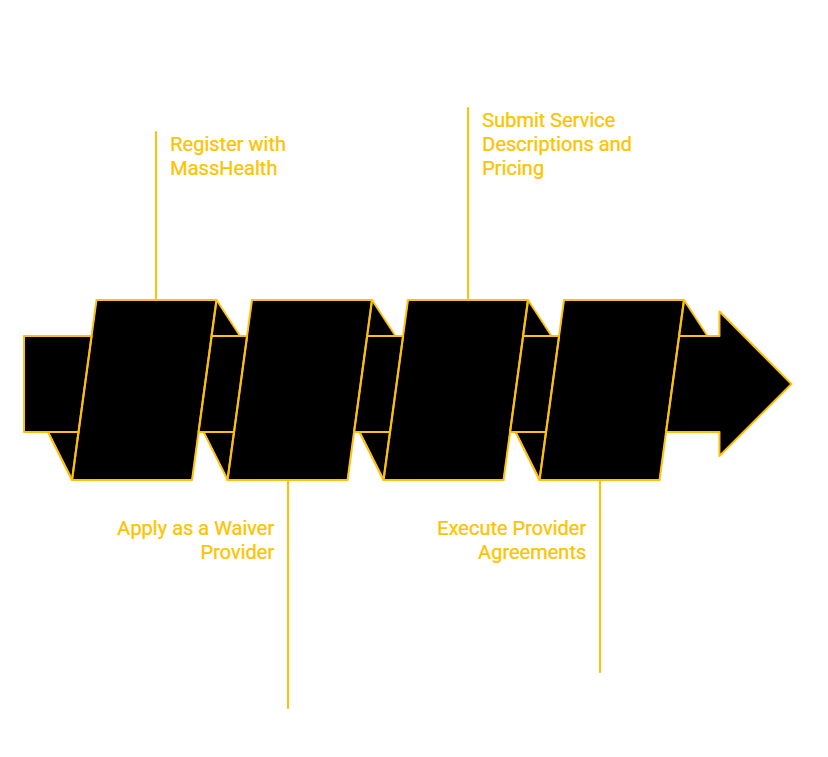
The enrollment workflow typically follows this structure:
- Step 1: Register with MassHealth through the Provider Online Service Center (POSC).
- Step 2: Apply specifically as a Waiver Provider, identifying the relevant programs such as the Acquired Brain Injury (ABI), MFP, or Department of Developmental Services (DDS) waivers.
- Step 3: Submit formal service descriptions and pricing tiers, detailing the types of devices offered, installation methodologies, and maintenance support protocols.
- Step 4: Execute formal provider agreements and MRC partnership forms, which solidify the legal relationship between the agency and the state.
What Documentation and Staffing Standards Are Required?
A provider's internal policies serve as the roadmap for both quality assurance and audit readiness. Essential documentation includes a comprehensive Policy & Procedure Manual that covers assessment templates, equipment recommendation workflows, and logs for installation and repair. It must also include specific protocols for emergency device support and clear mechanisms for obtaining informed consent.
Staffing requirements are centered on professional expertise. Assistive Technology Professionals (ATP) should ideally hold certification from RESNA or possess equivalent professional experience. Occupational and Physical Therapists performing assessments must hold active, valid Massachusetts licensure. For technicians and installers, documented training in accessibility standards and device mounting is essential. All staff must undergo mandatory training on HIPAA compliance, device troubleshooting, and the specific billing protocols associated with the waiver programs they serve.
Frequently Asked Questions
How long does the provider enrollment process typically take?
While timelines vary based on individual readiness, the initial registration and credentialing phase typically requires one month. Medicaid enrollment and waiver-specific applications often take an additional one to two months. Developing the necessary service manuals and staffing protocols generally requires four to six weeks of preparation.
Which HCBS waivers cover Assistive Technology?
Assistive Technology services are covered under several key programs, including the ABI (Acquired Brain Injury) waivers, the MFP-Residential Supports and Community Living waivers, and various DDS (Department of Developmental Services) waivers. These are often coordinated alongside standard DME benefits or environmental adaptation services.
Are providers required to maintain specific certifications?
Yes, professional standards are enforced. For instance, those acting as an Assistive Technology Professional (ATP) should have RESNA certification. Additionally, any provider performing home modifications must maintain relevant contractor licensing to ensure all structural changes meet Massachusetts building codes and ADA accessibility requirements.
Key Takeaway
Establishing an Assistive Technology provider agency in Massachusetts requires a disciplined approach to clinical compliance, administrative accuracy, and technical proficiency. Success depends on navigating the nuances of the MassHealth Provider Online Service Center while ensuring that all staff—from therapists to installation technicians—remain aligned with the rigorous documentation standards required by the state's various HCBS waiver programs.
Last verified: 2024. This article is for informational purposes only and does not constitute legal or professional advice. Always refer to the official MassHealth Provider Manual and current state regulations for the most up-to-date program requirements.