ASSISTIVE TECHNOLOGY SERVICES PROVIDER IN MARYLAND
By Fatumata Kaba · 2025-09-02 · 6 min read
ENHANCING INDEPENDENCE AND DAILY FUNCTION THROUGH INNOVATIVE TOOLS, DEVICES, AND TRAINING FOR INDIVIDUALS WITH DISABILITIES
Becoming an Assistive Technology (AT) services provider in Maryland is a specialized pathway for businesses aiming to enhance the independence, communication, and mobility of individuals with disabilities through Medicaid Home and Community-Based Services (HCBS). By providing essential tools, devices, and the necessary training for their effective use, providers play a critical role in the Maryland Developmental Disabilities Administration (DDA) and Community First Choice (CFC) programs, ensuring participants can successfully navigate their daily lives and environments.
What Are the Governing Agencies and Regulatory Frameworks?
Navigating the Maryland Medicaid landscape requires a clear understanding of the hierarchy of oversight. The Maryland Department of Health (MDH) serves as the primary entity responsible for the overall administration of Medicaid-funded HCBS services. Beneath this umbrella, the Developmental Disabilities Administration (DDA) takes the lead on administering AT services specifically tailored to DDA waivers, including the Community Supports, Family Supports, and Community Pathways waivers.
Furthermore, providers must align their operations with both state and federal mandates. The Centers for Medicare & Medicaid Services (CMS) sets the overarching federal regulations to which all HCBS programs must adhere. Locally, the Office of Long-Term Services and Supports (LTSS Maryland) serves as the technical backbone for the program, managing the billing systems and housing the documentation required for service delivery compliance.
- Maryland Department of Health (MDH): Oversees Medicaid-funded HCBS services and the CFC program.
- Developmental Disabilities Administration (DDA): Administers AT services under DDA Waivers.
- Office of Long-Term Services and Supports (LTSS Maryland): Manages billing systems and service documentation.
- Centers for Medicare & Medicaid Services (CMS): Ensures compliance with federal HCBS regulations.
How Do You Define Assistive Technology Services Under Medicaid?
Assistive Technology encompasses a broad spectrum of equipment and professional support services designed to increase, maintain, or improve the functional capabilities of individuals with disabilities. For an agency to provide these services, they must be included within a participant's Person-Centered Plan (PCP) or Individual Plan (IP). Approval by the DDA or the relevant Medicaid waiver authority is a prerequisite before any equipment is purchased or training is initiated.
The scope of service is intentionally wide to meet diverse participant needs. It includes not only the hardware—such as communication devices, mobility aids, and smart home environmental controls—but also the professional services required to make those tools effective. This includes clinical evaluations, custom device installation, staff training for caregivers, and ongoing maintenance or repairs.
- Communication devices (AAC systems) and specialized software.
- Mobility aids including walkers, standing frames, and adapted strollers.
- Environmental modifications such as smart home controls, automated lights, and door openers.
- Clinical evaluations and device recommendations by licensed professionals.
- Training for individuals, families, and support staff.
- Maintenance, customization, and repair of issued equipment.
What Are the Licensing and Provider Approval Prerequisites?
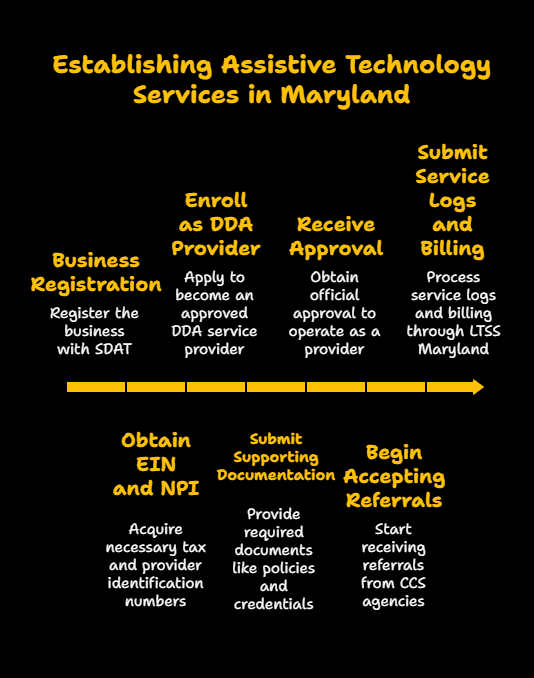
Before offering services, an agency must establish a formal business structure and obtain necessary credentials. This begins with registering the business with the Maryland Department of Assessments and Taxation (SDAT) and securing an Employer Identification Number (EIN) and a Type 2 National Provider Identifier (NPI). These are foundational requirements for any entity interacting with the Medicaid system.
Provider enrollment is a rigorous process conducted through the DDA Provider Application Portal or the ePREP system for CFC providers. Agencies must demonstrate that they possess the qualified staff to perform clinical tasks if they intend to provide evaluations. This requires evidence of credentials for Occupational Therapists (OT), Physical Therapists (PT), Speech-Language Pathologists (SLP), or RESNA-certified professionals. Furthermore, all agencies must maintain HIPAA-compliant systems, secure comprehensive liability insurance, and establish robust, replicable documentation protocols.
How Do You Manage the Enrollment and Service Authorization Process?
The roadmap to becoming an active provider involves four distinct phases, starting with business infrastructure development. Agencies must define their service model—deciding whether to focus on assessments, installations, or comprehensive device support—and hire staff who meet the specific educational and licensing requirements of the state.
Once the infrastructure is set, the agency submits the DDA or CFC provider application, identifying "Assistive Technology" as their service category. The application must be accompanied by a comprehensive policy manual that covers everything from intake forms to incident reporting. After the state reviews the documentation and grants approval, the agency can begin accepting referrals. Coordination of Community Services (CCS) agencies are the primary partners in this step, as they connect authorized participants with the provider agency. Finally, all service delivery logs must be meticulously maintained and submitted via the LTSS Maryland portal to ensure accurate and timely reimbursement.
What Are the Essential Staffing and Training Requirements?
The quality of an AT program is measured by the expertise of its staff. An Assistive Technology Specialist typically brings a background in rehabilitation engineering, special education, or therapy, often bolstered by a RESNA Assistive Technology Professional (ATP) certification. For clinical assessments, the agency must employ or contract with licensed professionals, such as OTs, PTs, or SLPs, who possess specific experience in conducting AT assessments and navigating the nuances of DDA/CFC program requirements.
Beyond technical certifications, all staff must undergo standardized training. This includes mandatory education on HIPAA, client confidentiality, and the principles of Person-Centered Planning. Because the safety of the individual is paramount, staff must also be trained in the safe handling, storage, and installation of specialized equipment, as well as the professional communication standards required when working with participants and their primary caregivers.
Frequently Asked Questions
What is the difference between DDA and CFC AT services?
DDA-funded AT services are specifically linked to Developmental Disabilities Administration waivers like Community Pathways or Family Supports, while Community First Choice (CFC) AT services are designed to help Medicaid enrollees remain in their homes by funding devices that replace or reduce the need for hands-on personal care assistance.
Can an agency provide both evaluations and hardware installation?
Yes, many agencies choose to provide a full-service model that includes clinical assessment, device procurement, and physical installation. However, the agency must ensure that the staff performing the evaluations meet the necessary clinical licensing requirements, while those performing installations have the required technical training and safety certifications.
What happens if a piece of assistive equipment stops working?
Repairs and maintenance are authorized components of the Assistive Technology service category. Providers are responsible for maintaining documentation on equipment status and having an emergency back-up plan in place for critical AT devices, ensuring that the participant's safety and independence are not compromised during the repair process.
WAIVER CONSULTING GROUP'S START-UP ASSISTANCE SERVICE — MARYLAND ASSISTIVE TECHNOLOGY PROVIDER
We help rehabilitation professionals, educators, and tech innovators establish Medicaid-enrolled Assistive Technology services that transform accessibility for Maryland residents with disabilities. Our services include support for business registration, DDA/CFC provider application submission, policy manual development, staff credentialing, and assistance with Medicaid billing through the LTSS Maryland system.
The primary takeaway for prospective AT providers is that success depends on the intersection of technical clinical expertise and strict adherence to Medicaid administrative requirements. By establishing a compliant, well-documented foundation—from your initial SDAT registration to the final submission of billing logs in LTSS Maryland—you ensure that your organization can sustainably serve Maryland’s disability community while meeting all federal and state regulatory expectations.
Last verified: October 2023. Disclaimer: This article is for informational purposes only and does not constitute legal or professional medical advice. Always consult with the Maryland Department of Health and current DDA/CFC policy manuals for the most accurate and up-to-date program requirements.