ASSISTIVE TECHNOLOGY SERVICES PROVIDER IN MAINE
By Fatumata Kaba · 2025-08-12 · 5 min read
ENHANCING INDEPENDENCE AND FUNCTIONAL ABILITY THROUGH CUSTOMIZED DEVICES AND SUPPORTIVE TECHNOLOGY SOLUTIONS
Assistive Technology (AT) services in Maine provide essential support to individuals with disabilities by facilitating communication, mobility, and independent living through the provision of customized devices and specialized training. These services are vital for members utilizing MaineCare State Plan benefits and Home and Community-Based Services (HCBS) waivers, ensuring that technology bridges the gap between functional limitations and daily autonomy.
What is the Regulatory Landscape for Assistive Technology in Maine?
The delivery of AT services is governed by a collaboration between federal oversight and state administration. The Maine Department of Health and Human Services (DHHS) serves as the primary authority, specifically through the Office of MaineCare Services (OMS), which manages the financial integrity and billing protocols for Medicaid-funded equipment and services. Simultaneously, the Office of Aging and Disability Services (OADS) coordinates the clinical delivery of these supports specifically for participants enrolled in Sections 19, 20, 21, and 29 waivers.
Providers must align their operations with federal standards set by the Centers for Medicare & Medicaid Services (CMS). These standards emphasize person-centered planning, ensuring that all technology solutions are tailored to the specific functional goals of the individual participant. Furthermore, while the Maine CITE Coordinating Center does not function as a direct billing or funding source, it remains a critical infrastructure partner for providers and participants alike, offering equipment loans, device demonstrations, and professional training resources.
What Services Comprise an Assistive Technology Program?
An effective AT program extends far beyond the simple procurement of devices. It encompasses a comprehensive lifecycle of support that begins with professional evaluations to determine the most effective tools for an individual’s unique circumstances. This includes the initial assessment, the customization and fitting of hardware or software, and the physical installation or environmental setup within the participant’s home or workplace.
Once the technology is in place, providers are responsible for ensuring that the user, their caregivers, and their support staff receive thorough training on device operation and safety. Ongoing maintenance, repair services, and regular coordination with the participant's broader care team—including case managers, therapists, and medical professionals—are essential to ensure that the technology remains effective over time. Covered devices often include augmentative and alternative communication (AAC) devices, power-assisted mobility aids, smart home environmental controls, and specialized ergonomic tools.
How Do Providers Obtain MaineCare Authorization and Enrollment?
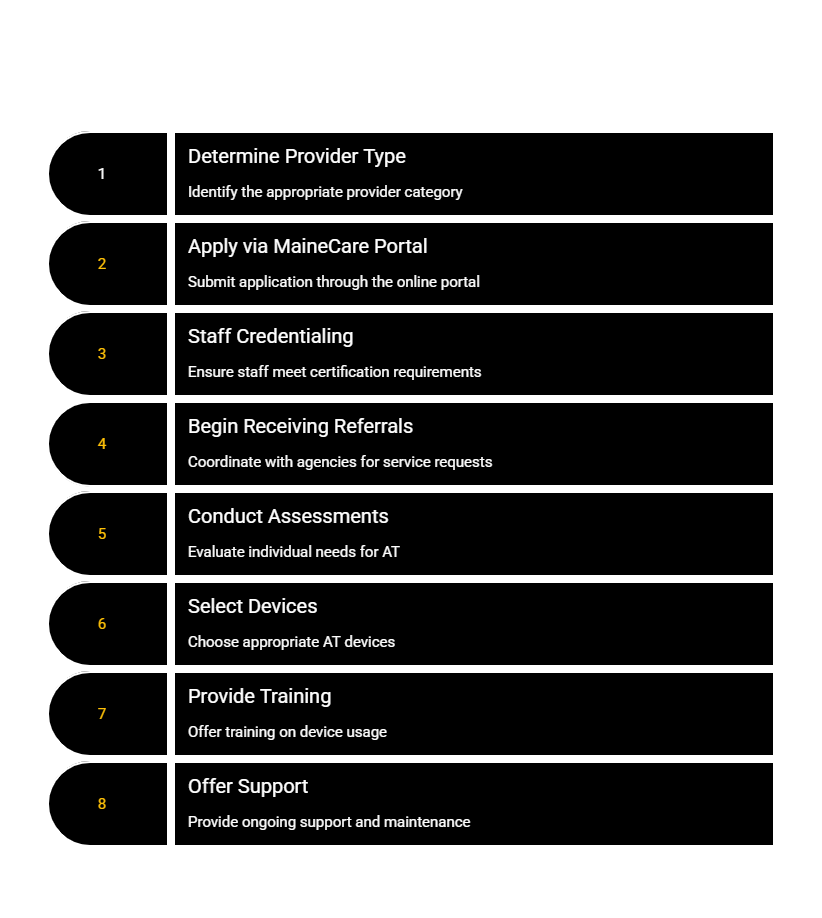
Entering the MaineCare provider network requires a structured approach to registration and credentialing. Businesses must first be legally registered with the Maine Secretary of State and possess a valid IRS EIN and Type 2 NPI. The enrollment process is conducted through the official MaineCare Provider Enrollment Portal, where providers must designate the appropriate provider category—such as a Durable Medical Equipment (DME) supplier, an OT/PT with AT specialization, or a specialized AT service provider—based on their internal capabilities and clinical qualifications.
- Register the entity with the Maine Secretary of State and secure necessary tax identifiers.
- Obtain a Type 2 NPI specifically for organizational billing purposes.
- Select the appropriate enrollment category within the MaineCare Provider Enrollment Portal.
- Submit documentation verifying the licensure or certification of all professional staff, including ATP (Assistive Technology Professional) credentials.
What Are the Essential Documentation and Policy Requirements?
Compliance in the Medicaid space is predicated on meticulous documentation and the maintenance of a robust Policy & Procedure Manual. This manual serves as the operational backbone of the agency, detailing how the provider manages every phase of the client journey. It must include standardized forms for referral intake, professional assessment templates, and detailed logs confirming the delivery and successful installation of devices, as well as the completion of participant training sessions.
Policies must explicitly address HIPAA compliance and the protection of client confidentiality, particularly when dealing with electronic devices that may collect or transmit personal data. Furthermore, providers are expected to maintain comprehensive records concerning warranty information, service request logs, and Medicaid billing codes. Failure to maintain these records in an audit-ready format can jeopardize reimbursement eligibility and program participation.
What Are the Core Staffing and Professional Qualifications?
The quality of AT services is directly tied to the expertise of the personnel. Key roles include the Assistive Technology Professional (ATP), who typically holds a RESNA certification or maintains a relevant clinical license such as an Occupational Therapist (OT), Speech-Language Pathologist (SLP), or Physical Therapist (PT). These professionals are responsible for the clinical integrity of the technology recommendations.
Technical support staff, such as installers and repair technicians, must possess the mechanical and electronic skills necessary to configure and maintain devices safely. Furthermore, all staff, regardless of their role, must undergo training in HIPAA compliance, data privacy, device safety protocols, and cultural competence. A program supervisor or case coordinator should also be designated to oversee the intersection of clinical recommendations and administrative billing requirements to ensure seamless service delivery.
Frequently Asked Questions
How does an AT provider coordinate with MaineCare waiver programs?
Providers coordinate by working directly with waiver case managers and OADS representatives to confirm that a participant's individual support plan includes the necessary technology authorizations. This involves aligning the requested equipment with the specific coverage rules of the participant’s waiver section, such as Section 19, 20, 21, or 29.
What is the typical timeline to launch an AT service?
Business registration typically takes 2–4 weeks. Once established, MaineCare enrollment can take between 60–90 days, while the development of internal policies and the hiring of qualified staff generally require 4–6 weeks. Referral coordination and active service delivery begin once all administrative approvals are in place.
Is training a reimbursable service under MaineCare?
Yes, training for the participant, their family members, and their direct care staff is a critical component of AT services. It is intended to ensure the safe and effective use of the provided technology and is documented through logs that confirm the completion of sessions as part of the overall service authorization.
Key Takeaway
Successfully operating as an Assistive Technology provider in Maine requires a rigorous commitment to both clinical excellence and administrative compliance. By aligning staff credentials with RESNA or professional licensure standards, maintaining a robust, audit-ready Policy & Procedure Manual, and closely navigating the MaineCare Provider Enrollment Portal requirements, agencies can effectively support the independence of individuals across the state’s various HCBS waiver programs.
Last verified: October 2023. Disclaimer: This document is for informational purposes only and does not constitute legal or professional medical billing advice. Requirements for MaineCare and HCBS waivers are subject to change. Always consult directly with the Maine Department of Health and Human Services (DHHS) and current MaineCare provider manuals for the most accurate and up-to-date guidance.