ASSISTIVE TECHNOLOGY SERVICES PROVIDER IN KENTUCKY
By Fatumata Kaba · 2025-07-25 · 5 min read
ENHANCING INDEPENDENCE AND ACCESS THROUGH INNOVATIVE DEVICES AND PERSONALIZED SUPPORT SYSTEMS
Assistive Technology (AT) Services in Kentucky enable Medicaid-eligible individuals to acquire specialized devices and professional training, bridging the gap between functional limitations and daily independence. By leveraging Kentucky Medicaid Home and Community-Based Services (HCBS) waivers, provider agencies play a critical role in delivering communication aids, environmental controls, and mobility supports that allow participants to live safely within their homes and communities.
What Are the Governing Agencies and Oversight Roles in Kentucky?
The delivery of Assistive Technology services in Kentucky operates within a structured regulatory environment designed to ensure participant safety and fiscal accountability. Several key agencies collaborate to manage the program, each holding distinct responsibilities ranging from policy definition to provider reimbursement.
The Kentucky Cabinet for Health and Family Services (CHFS), through the Department for Medicaid Services (DMS), functions as the primary authority, managing Medicaid coverage, provider enrollment processes, and billing protocols. Simultaneously, the Kentucky Department for Aging and Independent Living (DAIL) is responsible for defining service guidelines and ensuring that providers remain in compliance with the requirements set forth in Kentucky’s HCBS waivers.
At the federal level, the Centers for Medicare & Medicaid Services (CMS) oversees regulatory compliance and enforces the principles of person-centered care. Locally, Managed Care Organizations (MCOs) bridge the gap between policy and practice by authorizing specific services within a participant’s care plan, credentialing vendors, and managing the actual reimbursement for approved devices and training sessions.
What Constitutes Approved Assistive Technology Services?
Assistive Technology services encompass the entire lifecycle of a device, including the initial assessment, acquisition, customization, and comprehensive user training. To be considered for reimbursement, every device or service must directly align with the participant’s Person-Centered Service Plan (PCSP) and be backed by clinical recommendations or a formal evaluation by an Assistive Technology Specialist.
Approved services and devices typically include the following:
- Speech-generating devices and communication boards for non-verbal individuals.
- Adaptive computer hardware, software, and specialized smart home systems.
- Environmental control units, such as voice-activated lighting, door openers, and climate controls.
- Specialized keyboards, switches, or ergonomic tools designed to improve physical access.
- Tablets pre-loaded with accessibility applications when justified by clinical need.
- Mobility supports that do not fall under the standard classification of durable medical equipment.
- Professional AT assessments, personalized user training, equipment installation, and ongoing technical support.
How Do Providers Navigate Licensing and Enrollment Requirements?
Establishing an AT service provider agency in Kentucky requires adherence to a rigorous set of administrative and operational prerequisites. Before enrolling with Medicaid, a business must be properly registered with the Kentucky Secretary of State and possess an active IRS EIN and Type 2 NPI. Maintaining robust liability and product warranty insurance is essential to protecting both the organization and the participants served.
Operational readiness is demonstrated through the creation of a comprehensive Assistive Technology Services Policy & Procedure Manual. This document must detail the provider's approach to HIPAA compliance, record security, product trials, and equipment troubleshooting. Furthermore, agencies must ensure they employ or contract with qualified professionals—such as Assistive Technology Professionals (ATP), occupational therapists (OT), or speech-language pathologists (SLP)—to conduct valid, reliable assessments.
What Is the Kentucky Medicaid Provider Enrollment Process?
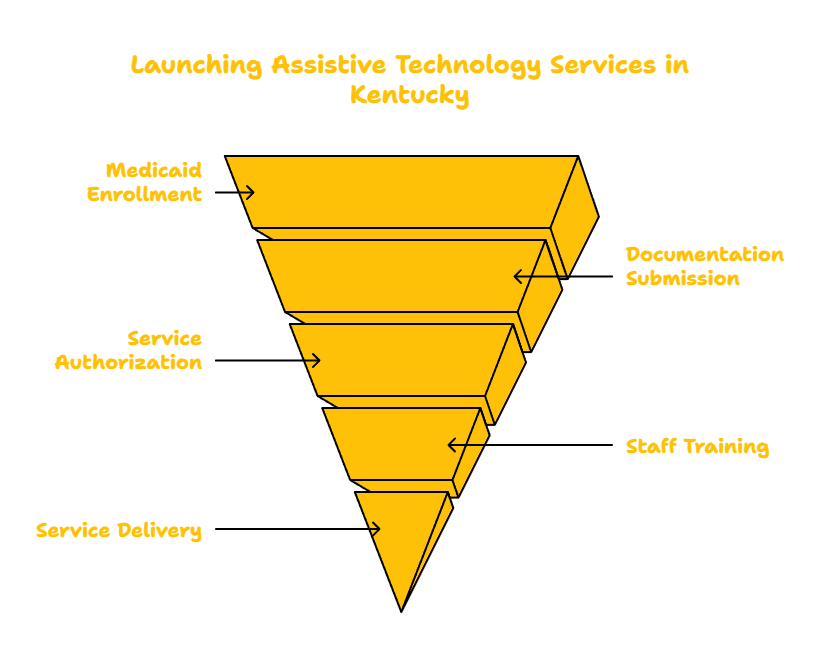
The transition from a business entity to a Medicaid-authorized provider follows a three-step sequential process. First, the agency must register via the Medicaid Partner Portal Application (MPPA), selecting the appropriate HCBS waiver categories such as AT or Specialized Medical Equipment. This phase establishes the provider’s baseline identity within the state system.
Second, the provider must submit a full documentation packet, including staff credentials, proof of insurance, and the previously established policy manuals. Once enrolled, the service delivery cycle begins. This involves conducting or reviewing functional assessments, submitting authorization requests to the participant’s MCO, and coordinating the physical delivery and installation of equipment. Finally, providers must submit claims using standardized HCPCS codes, ensuring all service delivery is backed by detailed documentation.
Which HCBS Waivers Support Assistive Technology Services?
Assistive Technology is authorized under several distinct Kentucky HCBS waivers, each serving specific populations with unique clinical and developmental needs. These include the Supports for Community Living (SCL) Waiver, the Michelle P. Waiver (MPW), the Acquired Brain Injury (ABI and ABI-LTC) Waivers, the Model II Waiver (MIIW), and in limited circumstances, the Home and Community Based (HCB) Waiver.
Delivery of these services is flexible, occurring in environments where the participant resides or engages in daily life. This typically includes the participant’s home, but may also extend to day programs, schools, or community environments, provided the delivery is consistent with the goals outlined in the individual’s case management plan.
Frequently Asked Questions
What credentials are required for an Assistive Technology Specialist?
Staff in this role must hold a certification from the Rehabilitation Engineering and Assistive Technology Society of North America (RESNA) or an equivalent body. They must also undergo background screenings and demonstrate comprehensive knowledge of disability-related technology.
What must be included in the Policy & Procedure Manual?
The manual must contain protocols for participant intake and functional needs assessment, documentation templates for device trials and installation, HIPAA and data privacy consent forms, equipment maintenance and replacement schedules, and internal systems for quality assurance and satisfaction reviews.
How long is the typical startup timeline for an AT provider?
The process generally takes several months: business formation and vendor setup typically require 1–2 months, MPPA enrollment and MCO credentialing take 60–90 days, and the final phase of staff hiring and device evaluation setup takes an additional 1–2 months before services can be fully launched.
Key Takeaways for Prospective Providers
Success in the Kentucky Assistive Technology market requires a blend of administrative precision and clinical focus. By strictly adhering to the requirements set by the CHFS, DMS, and relevant MCOs, providers can build sustainable organizations that significantly improve the functional independence of Medicaid participants. Maintaining up-to-date documentation, ensuring staff possess the necessary credentials, and keeping detailed records of service delivery are the pillars of long-term compliance and operational success.
Last verified: 2024. This information is intended for educational purposes and does not constitute legal or professional medical advice. Always consult with the Kentucky Cabinet for Health and Family Services and relevant Managed Care Organizations for the most current regulatory requirements.