ASSISTIVE TECHNOLOGY SERVICES PROVIDER IN KANSAS
By Fatumata Kaba · 2025-07-24 · 5 min read
ENHANCING INDEPENDENCE THROUGH CUSTOM DEVICES, EQUIPMENT, AND TECHNOLOGICAL SUPPORTS
Assistive Technology (AT) Services in Kansas provide individuals with disabilities access to specialized equipment and support needed to improve communication, mobility, environmental control, and independence. These services are offered under various Home and Community-Based Services (HCBS) waiver programs through Kansas Medicaid (KanCare) and are tailored to meet each participant’s functional needs in their home or community setting.
What is the Role of Governing Agencies in Kansas AT Services?
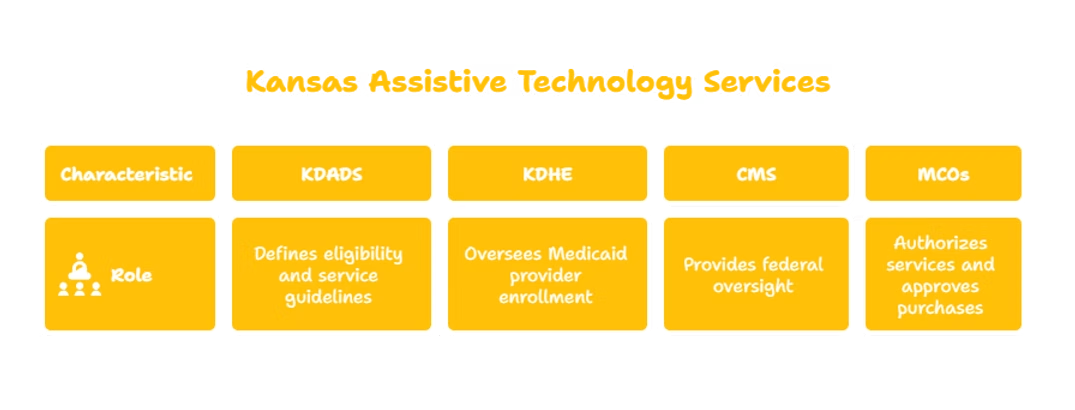
The administration of Assistive Technology services in Kansas is a collaborative effort involving state and federal oversight to ensure fiscal responsibility and service quality. The Kansas Department for Aging and Disability Services (KDADS) serves as the primary regulatory body, defining eligibility criteria, establishing service guidelines for AT under HCBS waivers, and monitoring participant outcomes. Their role is critical in ensuring that all technology provided aligns with the person-centered goals outlined in a participant's service plan.
Financial and operational oversight is managed by the Kansas Department of Health and Environment (KDHE) — Division of Health Care Finance, which handles Medicaid provider enrollment, equipment billing standards, and reimbursement protocols. On a federal level, the Centers for Medicare & Medicaid Services (CMS) provides the overarching regulatory framework, ensuring that Kansas programs remain in compliance with national Medicaid requirements. Finally, the Managed Care Organizations (MCOs) act as the operational bridge, responsible for authorizing specific services, approving individual device purchases, and processing provider reimbursements under the KanCare program.
What Services Do Approved AT Providers Deliver?
Assistive Technology is defined broadly as any item, piece of equipment, software, or product system that serves to increase, maintain, or improve the functional capabilities of individuals with disabilities. Approved providers are tasked with a comprehensive lifecycle of support, ranging from the initial identification of a participant's needs to the long-term maintenance of the technology. This service delivery model is designed to be highly individualized, ensuring the AT is medically necessary and functionally appropriate for the user's specific environment.
Approved providers may deliver the following essential services:
- Comprehensive evaluation of assistive technology needs.
- Expert device selection, customization, and user trialing.
- Procurement, professional setup, and individualized training on the use of devices.
- Maintenance, technical support, and repairs for approved AT items.
- Instructional support for caregivers and team members to ensure safe operation.
- Documentation and submission of funding or warranty claims to MCOs.
- Coordination with therapists or specialists to ensure exact fit and functional utility.
Covered items under these services include communication devices (AAC) and voice output systems, environmental control systems such as smart switches, modified keyboards, specialized seating, adaptive utensils, and portable ramps or reachers that fall outside the scope of standard Durable Medical Equipment (DME).
How Do Agencies Meet Licensing and Provider Approval Requirements?
To operate as an HCBS AT provider in Kansas, an agency must demonstrate both professional competency and administrative readiness. Before entering the provider network, a business must be registered with the Kansas Secretary of State and possess a valid EIN from the IRS. Furthermore, the agency must secure a Type 2 NPI, which is the standard identifier for organizational health care providers, and enroll specifically as an AT provider through the Kansas Medical Assistance Program (KMAP) portal.
Beyond basic business registration, agencies are expected to maintain comprehensive operational policies. These policies must cover the entire service workflow, including evaluation, device delivery, training, and documentation. Providers must also maintain proof of product liability and general business insurance to protect both the participant and the agency. Success in this field requires established partnerships with reputable AT vendors, manufacturers, and suppliers to ensure a steady, reliable supply chain for specialized equipment.
What is the Process for Enrollment and Authorization?
The enrollment process is a multi-step sequence requiring precision and coordination with multiple entities. Initial registration occurs via the KMAP portal, where the agency classifies itself as an Assistive Technology provider. Simultaneously, the agency must engage with the three KanCare MCOs—Sunflower Health Plan, UnitedHealthcare Community Plan, and Aetna Better Health of Kansas—to establish service contracts and credentialing. During this phase, it is vital to compile and submit organizational documents, including Articles of Incorporation, proof of NPI, insurance documentation, and evidence of staff training.
Once enrolled, the operational process for each participant follows a specific pathway:
- A licensed professional, such as an Occupational Therapist (OT), Speech-Language Pathologist (SLP), or Physical Therapist (PT), provides a prescription or clinical justification for the equipment.
- The provider submits an equipment proposal and pricing quotes to the relevant MCO for clinical review and financial authorization.
- Upon authorization, the provider delivers and installs the AT, followed by rigorous documentation of the setup and the training provided to the participant or caregiver.
What Are the Essential Staffing and Documentation Requirements?
Staffing requirements for AT providers are centered on technical expertise and participant safety. Core roles include the Assistive Technology Specialist or Coordinator, who typically holds a background in rehabilitation engineering, special education, or a clinical field such as OT or SLP. Achieving a professional certification, such as a RESNA Assistive Technology Professional (ATP) designation, is highly preferred. Installation technicians are also required, as they must be trained in device-specific handling and manufacturer safety protocols.
Documentation is the backbone of Medicaid compliance. Every agency must maintain a detailed Policy & Procedure Manual that encompasses HIPAA compliance, participant rights, grievance procedures, and audit-ready service logs. Staff must undergo mandatory training on HIPAA privacy standards, equipment safety, and participant communication strategies. Annual refreshers are required to ensure that all team members remain updated on evolving equipment capabilities and safety mandates.
Frequently Asked Questions
Which Kansas HCBS waivers allow for Assistive Technology services?
Assistive Technology services are authorized under the Intellectual/Developmental Disability (IDD) Waiver, Physical Disability (PD) Waiver, Technology Assisted (TA) Waiver, Autism Waiver, Brain Injury (BI) Waiver, and the Frail Elderly (FE) Waiver.
What is the typical timeline to launch an AT services agency?
While timelines vary based on organizational readiness, the process generally takes several months: 1–2 months for business formation, 2–3 months for hiring and policy development, 60–90 days for KMAP and MCO enrollment, and 30–45 days for final billing system setup.
Can AT providers bill for services not covered by standard DME?
Yes, AT services are often utilized for devices that improve independence but fall outside the coverage parameters of standard Durable Medical Equipment, provided the item is authorized as medically necessary within the participant’s Individualized Service Plan (ISP) or Plan of Care (POC).
Key Takeaway
Launching an Assistive Technology provider agency in Kansas requires a strategic approach to clinical coordination, regulatory compliance, and MCO contracting. By focusing on robust policy development, specialized staff training, and seamless billing workflows, providers can effectively bridge the gap between technological innovation and the functional independence of Kansas Medicaid participants across all major HCBS waiver programs.
Last verified: October 2023. Disclaimer: This information is for educational purposes and does not constitute legal or professional advice. Always consult the latest Kansas Department for Aging and Disability Services (KDADS) and KMAP manuals for the most current regulatory requirements.