ASSISTIVE TECHNOLOGY SERVICES PROVIDER IN INDIANA
By Watchen Roberts · 2025-07-21 · 5 min read
An Assistive Technology Services provider in Indiana acts as a critical link between innovative hardware solutions and the individuals who rely on them to maintain independence within their homes and communities. These providers facilitate the procurement, customization, and integration of specialized equipment—ranging from communication devices to environmental controls—that are authorized under the Indiana Family and Social Services Administration (FSSA) Medicaid Home and Community-Based Services (HCBS) waiver programs.
By bridging the gap between clinical need and technical implementation, these agencies ensure that participants receive the necessary tools to increase their autonomy, safety, and community participation. Establishing such a provider agency requires a rigorous commitment to compliance, quality assurance, and the development of robust, person-centered service protocols.
Understanding the Regulatory Landscape and Agency Oversight
The provision of assistive technology in Indiana is governed by a multi-tiered regulatory framework designed to ensure participant safety and the appropriate allocation of Medicaid funding. At the state level, the Indiana Family and Social Services Administration (FSSA), specifically the Division of Disability and Rehabilitative Services (DDRS), serves as the primary authority. They are responsible for establishing service standards, monitoring the quality of care, and providing the necessary authorization for technology services within the waiver frameworks.
The Indiana Office of Medicaid Policy and Planning (OMPP) manages the fiscal and administrative aspects of the programs. This includes the management of provider enrollment, reimbursement processes, and ensuring that all claims align with state policies. On a federal level, the Centers for Medicare & Medicaid Services (CMS) provides overarching guidance and oversight to ensure that state waiver programs remain consistent with federal mandates regarding participant-centered planning and medical necessity requirements.
- FSSA (DDRS): Oversight of service standards and quality assurance.
- OMPP: Administration of funding, reimbursement, and provider enrollment.
- CMS: Federal compliance and policy adherence oversight.
Core Components of Assistive Technology Service Delivery
Assistive Technology Services encompass more than the mere provision of hardware; they involve a comprehensive service cycle that begins with an assessment of the participant’s functional limitations. Providers are expected to perform thorough evaluations to identify which devices will best support the participant's goals as outlined in their Individualized Service Plan (ISP). Following the assessment, the provider manages the selection, procurement, and customization of the required technology to ensure it meets the individual's specific physical or cognitive needs.
Beyond the hardware, the service delivery model emphasizes installation, configuration, and extensive training. Participants and their caregivers must be thoroughly instructed on the operation, safety protocols, and maintenance of the equipment to ensure long-term functionality. As a participant’s needs evolve, providers are responsible for reassessment and the potential upgrading of technology, ensuring that the services rendered remain relevant and effective over time.
Meeting Licensure and Provider Enrollment Requirements
To operate as an Assistive Technology Services provider in Indiana, an organization must navigate a series of foundational requirements. This begins with the formal registration of the business entity with the Indiana Secretary of State and obtaining the necessary federal documentation, including an EIN and a Type 2 NPI. If the agency plans to supply medical-grade equipment, obtaining specific Durable Medical Equipment (DME) supplier licensure or certification is a mandatory prerequisite.
Once the legal and operational foundations are established, the agency must enroll through the Indiana Medicaid Provider Enrollment Portal. This process includes the submission of extensive documentation, such as proof of general liability and product liability insurance, as well as a comprehensive Policy and Procedure Manual. This manual must demonstrate a clear commitment to HIPAA compliance, participant rights protections, and the establishment of audit-ready documentation systems for all services performed.
Strategic Staffing and Operational Competency
The effectiveness of an Assistive Technology Services provider hinges on the caliber and training of its staff. The organization must appoint a qualified Program Director or Supervisor who possesses a background in fields such as occupational therapy, rehabilitation engineering, or assistive technology specialization. This leadership role is responsible for overseeing the clinical and technical aspects of service delivery while ensuring all operations remain in compliance with state standards.
Staff members, including technicians and assistants, must undergo rigorous training programs that cover device fitting, installation, and participant instruction. If clinical evaluations are required, the agency must employ or contract with licensed professionals, such as OTs, PTs, or SLPs, who hold active Indiana licenses. Every employee, regardless of their specific role, must complete mandatory training on participant safety, emergency response, and the ethical standards surrounding the delivery of HCBS services.
Navigating the Waiver Programs and Launch Timeline
Assistive Technology Services are integrated into several key Indiana Medicaid waiver programs, including the Community Integration and Habilitation (CIH) Waiver, the Family Supports Waiver (FSW), the Aged and Disabled (A&D) Waiver, and the Traumatic Brain Injury (TBI) Waiver. Each of these programs provides a pathway for participants to access the assistive technology necessary for community living. Understanding the nuances of each waiver is essential for providers to ensure they are billing correctly for services rendered.
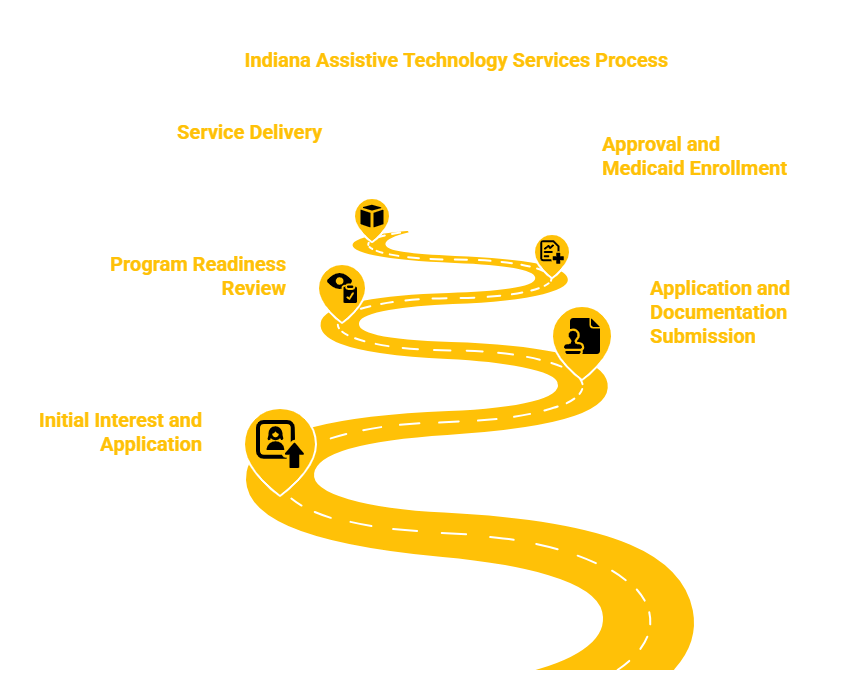
The timeline for launching an agency is typically an 8 to 12-month process. This includes 1–2 months for business formation and compliance setup, 1–2 months for staff recruitment and training development, 60–90 days for the Medicaid enrollment and readiness review phase, and 30–45 days to finalize billing systems and launch services. Success in this sector requires careful project management to ensure all administrative, clinical, and fiscal benchmarks are reached in proper sequence.
Frequently Asked Questions
What documents are essential for the Medicaid provider enrollment application?
Providers must submit articles of incorporation, an EIN and NPI confirmation, valid insurance certificates (general and product liability), and a comprehensive Policy and Procedure Manual. This manual must detail intake procedures, device procurement, installation protocols, and audit-ready documentation systems.
Are Assistive Technology providers required to have a physical office in Indiana?
While specific geographic requirements may vary based on the scope of services, providers must be registered with the Indiana Secretary of State and be capable of performing on-site installations and participant training throughout their service area. Maintaining a functional business infrastructure that supports timely service delivery and record-keeping is a mandatory component of compliance.
How does the Readiness Review process work?
The FSSA (DDRS) conducts a readiness review to evaluate a provider’s ability to adhere to state standards. This includes assessing the organization's device procurement procedures, participant training protocols, health and safety compliance, and the ability to maintain accurate billing records that align with the specific requirements of the Indiana Medicaid waiver programs.
Key Takeaway
Launching an Assistive Technology Services provider in Indiana is a complex, multi-phase endeavor that requires strict adherence to both state-specific Medicaid guidelines and federal HCBS standards. From the initial business registration and staff credentialing to the final stages of the readiness review, every operational detail must be documented to support the overarching goal of enhancing participant independence through technology. By maintaining rigorous compliance systems and investing in qualified, well-trained staff, providers can successfully deliver these essential services to Indiana’s vulnerable populations.
Last verified: October 2023. Disclaimer: This information is for educational purposes only and does not constitute legal or professional advice. Always consult with the Indiana Family and Social Services Administration (FSSA) or professional legal counsel regarding specific regulatory requirements and Medicaid compliance obligations.