ASSISTIVE TECHNOLOGY SERVICES PROVIDER IN HAWAII
By Fatumata Kaba · 2025-07-16 · 5 min read
Becoming an Assistive Technology (AT) Services provider in Hawaii is a vital step toward supporting individuals with disabilities, chronic illnesses, and aging-related needs in achieving greater independence. By facilitating access to adaptive devices and customized technological solutions, providers play a critical role in the Hawaii Medicaid Home and Community-Based Services (HCBS) ecosystem, effectively removing barriers to community living, employment, and personal autonomy.
How Does the Assistive Technology Service Framework Function in Hawaii?
Assistive Technology Services are designed to address functional limitations through the strategic acquisition and utilization of adaptive equipment. Under Hawaii’s Medicaid HCBS waiver programs, these services are not merely about the provision of hardware; they encompass a comprehensive service loop that begins with a functional assessment to identify specific needs and concludes with ongoing technical support and maintenance.
Approved providers are responsible for a full spectrum of interventions. This includes the selection of appropriate devices, the procurement or leasing of equipment, professional installation, and rigorous training for both the participant and their caregivers to ensure the technology is used safely and effectively. This person-centered approach ensures that each solution is integrated seamlessly into the individual’s daily life at home, work, or in the community.
- Functional assessments to determine specific AT needs.
- Recommendations and procurement for appropriate devices and equipment.
- Installation, setup, and participant training on device usage.
- Repair, maintenance, and ongoing technical support for equipment.
- Integration of AT solutions into the participant’s daily routine.
Which Governing Agencies Oversee AT Service Providers?
The regulatory landscape for AT services in Hawaii involves a multi-tiered oversight structure designed to ensure compliance with federal standards and state-specific waiver requirements. Understanding the roles of these agencies is essential for any administrative team preparing to enter the provider market.
The Hawaii Department of Human Services (DHS), specifically the Med-QUEST Division, acts as the primary point of contact for Medicaid provider enrollment, service authorization, and reimbursement protocols. Concurrently, the Department of Health (DOH) Developmental Disabilities Division (DDD) administers the specific HCBS waiver services for individuals with intellectual and developmental disabilities. At the federal level, the Centers for Medicare & Medicaid Services (CMS) provides the overarching regulatory framework, ensuring that all services adhere to person-centered planning principles and Medicaid standards.
What Are the Essential Requirements for Provider Enrollment?
Entering the Hawaii Medicaid network as an AT provider requires meticulous preparation of business, operational, and clinical documentation. Prospective providers must first establish a legal business entity registered with the Hawaii Department of Commerce and Consumer Affairs (DCCA), secure an EIN, and obtain a Type 2 National Provider Identifier (NPI).
Beyond basic business registration, agencies must demonstrate operational readiness. This involves developing a robust Policy and Procedure manual that outlines how the organization will manage participant intake, handle device repairs, maintain HIPAA confidentiality, and process billing. Furthermore, organizations must demonstrate that they carry adequate general and product liability insurance to protect against risks associated with medical equipment management.
- Register business with the Hawaii Department of Commerce and Consumer Affairs (DCCA).
- Obtain Employer Identification Number (EIN) from the IRS and Type 2 NPI.
- Enroll as a Medicaid provider through the Med-QUEST Division.
- Develop comprehensive service protocols for assessment, installation, and maintenance.
- Ensure all staff meet background screening and credentialing requirements.
What Are the Staffing and Competency Standards?
The quality of AT service delivery is heavily dependent on the technical expertise of the staff. Providers must employ individuals capable of both technical hardware management and compassionate, person-centered support. The role of the Assistive Technology Specialist or Program Manager typically requires an Assistive Technology Professional (ATP) certification or equivalent professional experience.
In addition to specialized technical roles, staff responsible for equipment delivery must be trained in device safety and emergency response. All personnel, regardless of their technical focus, must undergo mandatory training on HIPAA compliance, participant rights, and Medicaid documentation practices. Annual continuing education is strongly recommended to keep pace with rapid advancements in adaptive technology and to ensure services remain aligned with best practices in the field.
How Is the Provider Enrollment Process Sequenced?
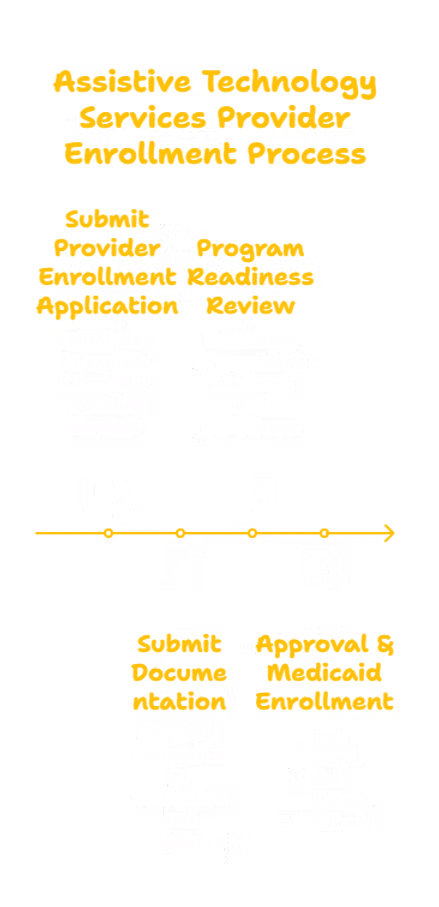
The path to becoming a certified provider is structured into distinct phases, beginning with business formation and concluding with final system integration for billing. The initial phase focuses on credentialing and establishing the legal foundation, which typically takes one to two weeks, followed by the submission of the Provider Enrollment Application to Med-QUEST.
Once the application is submitted, the program readiness review period begins, which can take between 60 to 90 days. During this time, the state reviews the applicant’s staffing models, internal operational policies, and documentation compliance. Following approval, the final phase involves setting up internal systems to manage Medicaid billing codes and establishing the infrastructure for ongoing quality assurance. Proper planning during these stages is critical to avoid unnecessary delays in the 4-to-6-month total launch timeline.
Frequently Asked Questions
Which Medicaid waivers currently authorize Assistive Technology Services in Hawaii?
Assistive Technology Services are primarily authorized under the Developmental Disabilities/Intellectual Disabilities (DD/ID) Waiver and the Community Care Services (CCS) Program, which serves adults with serious mental illness and chronic conditions.
What specific types of devices are generally covered under these services?
Covered devices include a wide array of tools such as speech-generating communication aids, power wheelchairs, transfer devices, smart home environmental control units, sensory equipment for visual or auditory needs, and adaptive computer hardware or software designed to improve daily functioning.
Are there specific requirements for maintaining AT equipment after the initial setup?
Yes, providers are required to have established protocols for the repair, maintenance, and technical support of devices. The provider must ensure that equipment remains in good working order throughout the duration of the participant’s enrollment to ensure ongoing safety and functionality.
Key Takeaway for New Providers
Launching an Assistive Technology service in Hawaii requires a strategic balance between maintaining high technical standards for equipment and ensuring rigorous compliance with Medicaid administrative requirements. Success is defined by a commitment to the person-centered planning model, which mandates that every device provided is customized to the participant’s unique functional goals as outlined in their Individualized Service Plan (ISP).
Waiver Consulting Group (WCG) supports adaptive technology vendors, service providers, and community health organizations in launching Medicaid-compliant Assistive Technology Services under Hawaii’s HCBS waiver programs. Our scope of work includes business registration and EIN/NPI setup, Med-QUEST and DHS provider enrollment assistance, development of Assistive Technology Services Policy & Procedure Manuals, staff credentialing templates, participant assessment forms, Medicaid billing configuration, and quality assurance programs for service delivery monitoring. Our Client Portal offers a wealth of resources that you can explore related to various programs and state requirements.
Last verified: October 2023. This information is for educational purposes only and does not constitute legal or professional advice. Always verify current state requirements with the Hawaii Department of Human Services (DHS) Med-QUEST Division.