ASSISTIVE TECHNOLOGY SERVICES PROVIDER IN GEORGIA
By Fatumata Kaba · 2025-07-14 · 5 min read
Becoming an Assistive Technology (AT) Services provider in Georgia allows organizations to bridge the gap between disability and independence by delivering essential adaptive equipment and technological support. By participating in Georgia’s Medicaid Home and Community-Based Services (HCBS) waiver programs, agencies play a critical role in increasing the functional capabilities of individuals living in their homes and communities.
Operating as an AT provider requires adherence to strict oversight from the Georgia Department of Community Health (DCH), the Department of Behavioral Health and Developmental Disabilities (DBHDD), and the Centers for Medicare & Medicaid Services (CMS). Agencies must navigate a multifaceted landscape of enrollment, clinical credentialing, and regulatory compliance to ensure that every device—from communication aids to environmental control units—meets the specific needs identified in a participant’s Individual Service Plan (ISP).
How Do Georgia Medicaid HCBS Waivers Authorize AT Services?
Assistive Technology services are formally integrated into several of Georgia’s Medicaid waiver programs, including the Comprehensive Supports Waiver Program (COMP), the New Options Waiver Program (NOW), and the Independent Care Waiver Program (ICWP). These programs provide the regulatory framework for the assessment, acquisition, customization, and ongoing maintenance of technology designed to improve an individual's autonomy.
Authorization is not a universal process; it is tied directly to the clinical necessity outlined in the participant’s ISP. Approved providers facilitate the entire lifecycle of the technology, which includes initial evaluations to determine the correct fit, the purchase or leasing of equipment, customization to meet individual physical or cognitive needs, and the necessary training for the participant and their caregivers to ensure the technology is utilized safely and effectively.
What Are the Governance and Regulatory Requirements for Providers?
The regulatory structure for AT providers in Georgia involves three primary tiers of oversight. The DCH acts as the primary authority for provider enrollment and reimbursement, while the DBHDD handles the day-to-day administration and service delivery oversight for individuals on the NOW and COMP waivers. At the federal level, CMS provides the overarching mandate, ensuring that all state-level delivery meets established federal HCBS standards.
Providers must be fully enrolled within the Georgia Medicaid Management Information System (GAMMIS) to receive reimbursement. This process is not merely administrative; it requires a deep commitment to maintaining insurance, including general and product liability, and ensuring that all staff are vetted and trained in accordance with state requirements. Compliance documentation—ranging from HIPAA confidentiality protocols to equipment maintenance logs—must be audit-ready at all times.
How Does the DBHDD and DCH Provider Enrollment Process Work?
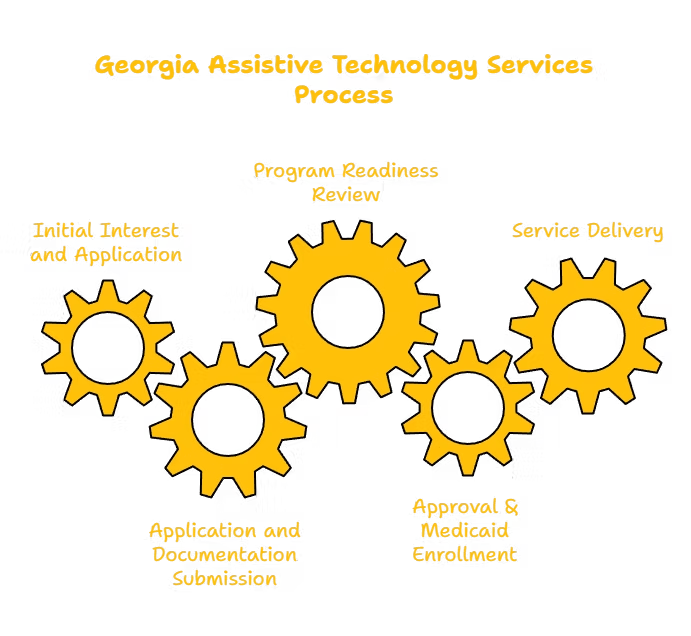
The journey to becoming an approved provider begins with a formal expression of interest through a Letter of Intent submitted to the DBHDD. Following this, the agency must undergo a rigorous pre-qualification process, which involves verifying business status, staffing plans, and insurance coverage. Applicants should be prepared to present a comprehensive Policy & Procedure Manual that addresses every aspect of service delivery, including how the agency handles intake, device troubleshooting, and emergency responses.
Once the initial application is reviewed, the provider enters the Program Readiness Review phase. During this period, the DBHDD evaluates whether the agency has the technical and clinical infrastructure to manage Medicaid billing and provide high-quality AT services. Only upon successful completion of this review can the agency finalize its enrollment through GAMMIS and begin configuring billing codes for specific assistive technologies.
- Submit a Letter of Intent to the DBHDD Provider Enrollment division.
- Compile and submit corporate documentation, NPI/EIN verification, and staff credentials.
- Complete the DBHDD Program Readiness Review to demonstrate operational competency.
- Finalize Medicaid enrollment via the GAMMIS portal and set up billing systems.
What Are the Key Staffing and Training Mandates?
Quality of service is intrinsically linked to the competency of the staff. For complex equipment assessments, the presence of an Assistive Technology Professional (ATP) is often preferred or required to ensure that the technology prescribed is clinically appropriate for the user’s specific disability or chronic condition. Beyond lead clinicians, agencies must employ capable technicians who are skilled in the setup, repair, and maintenance of specialized hardware and software.
Mandatory training is a pillar of the provider’s operational requirement. All staff members must maintain documentation of ongoing education in areas such as HIPAA confidentiality, client rights, and abuse prevention. Furthermore, staff are required to receive regular training on the specific device safety protocols and emergency management procedures, ensuring that if a technology fails, the participant’s safety and continuity of care remain uncompromised.
Frequently Asked Questions
What types of devices are typically covered under AT services?
Covered items include speech-generating communication devices, environmental control units for home automation, specialized seating and positioning systems, and adaptive software or switches. Mobility aids are generally handled under separate durable medical equipment (DME) categories and are not typically covered as AT services.
How long does the startup process take for a new provider?
The timeline varies based on organizational readiness, but generally spans 4 to 7 months. Business formation and initial setup typically take 1–2 weeks, the DBHDD application and readiness review process take 60–90 days, staff onboarding takes 30–45 days, and final Medicaid billing system configuration takes 45–60 days.
Are providers required to offer ongoing maintenance?
Yes. A core expectation of the AT provider role is the ability to provide repairs, maintenance, and modifications to equipment throughout its useful life. Policies regarding equipment replacement and emergency repair procedures must be clearly documented in the agency’s Policy & Procedure Manual.
Key Takeaways for Prospective Agencies
Launching an Assistive Technology service in Georgia is a high-compliance venture that requires meticulous attention to both clinical standards and administrative regulations. By aligning business operations with the guidelines provided by the DCH, DBHDD, and CMS, providers can ensure they remain eligible for Medicaid reimbursement while effectively improving the quality of life for the participants they serve. Maintaining audit-ready documentation and prioritizing staff training are the most critical factors in achieving long-term success as a waiver program provider.
Waiver Consulting Group supports providers, clinicians, and adaptive technology companies in launching Medicaid-compliant Assistive Technology Services under Georgia’s HCBS waiver programs. Our services include business registration, Medicaid provider enrollment, the development of robust Policy & Procedure Manuals, and the creation of billing and quality assurance systems designed to streamline your operations from day one.
Last verified: October 2023. This information is provided for educational purposes only and does not constitute legal or financial advice. Regulations governing Georgia Medicaid waivers are subject to change. Prospective providers should consult directly with the Georgia Department of Community Health (DCH) and the Department of Behavioral Health and Developmental Disabilities (DBHDD) for the most current requirements and statutes.