ASSISTIVE TECHNOLOGY SERVICES PROVIDER IN FLORIDA
By Fatumata Kaba · 2025-07-11 · 5 min read
Becoming an Assistive Technology (AT) Services provider in Florida involves a structured integration with the state’s Medicaid Home and Community-Based Services (HCBS) waiver system, specifically under the oversight of the Agency for Persons with Disabilities (APD). Providers play a vital role in enabling independence by facilitating the assessment, acquisition, and maintenance of specialized equipment that bridges the gap between individual functional limitations and daily living requirements.
Understanding the Role of Assistive Technology in Medicaid Waivers
Assistive Technology Services are designed to provide individualized support to participants by enhancing their ability to perform activities of daily living, communicate, and navigate their environments. For many individuals with developmental or long-term care needs, these devices are not mere conveniences but essential tools that sustain community integration and health, thereby fulfilling the core mission of Florida’s HCBS waivers.
Authorized providers must go beyond simple retail sales by offering comprehensive service models. This includes the professional assessment of needs, the procurement of appropriate devices, the technical installation or customization of hardware, and the provision of thorough training to participants and their caregivers. By focusing on the functional utility of technology, providers ensure that equipment is not only delivered but effectively integrated into the participant’s life.
Navigating the Regulatory Landscape and Governing Agencies
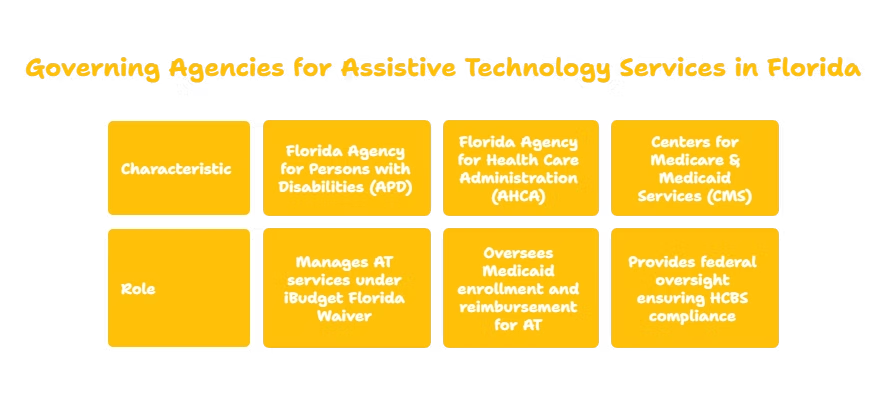
The delivery of AT services is governed by a tripartite structure of regulatory oversight. The Agency for Persons with Disabilities (APD) acts as the primary gatekeeper for the iBudget Florida Waiver, establishing the standards for qualified providers and managing the service authorization process for individuals with developmental disabilities. Concurrently, the Agency for Health Care Administration (AHCA) manages the financial and enrollment aspects, ensuring that providers meet the technical requirements for Medicaid reimbursement.
At the federal level, the Centers for Medicare & Medicaid Services (CMS) provides the overarching regulatory framework for HCBS programs. CMS mandates that all state-level service delivery remains compliant with person-centered planning requirements, ensuring that every piece of technology funded by Medicaid is tied directly to a documented functional necessity identified in the participant’s support plan.
Essential Requirements for Provider Enrollment and Licensing
To operate as an approved AT provider, a business entity must first establish its legal and operational foundation. This begins with registering the company with the Florida Division of Corporations (Sunbiz) and obtaining a federal Employer Identification Number (EIN) and a Type 2 National Provider Identifier (NPI). These credentials serve as the baseline for all subsequent interactions with state agencies and insurance carriers.
Provider agencies must also demonstrate institutional readiness by developing a robust suite of internal policies. These documents must cover critical operational areas, including assessment protocols, procurement strategies, equipment maintenance, and participant confidentiality under HIPAA. Agencies must also maintain appropriate levels of general liability insurance and verify that any equipment provided adheres to manufacturer certifications and safety standards.
- Registration of business entity via Sunbiz.
- Securing of EIN and NPI (Type 2) identifiers.
- Completion of the APD Qualified Provider Application.
- Development of internal manuals for procurement, training, and troubleshooting.
- Establishment of quality assurance and incident reporting systems.
The Step-by-Step Provider Enrollment and Readiness Process
The journey toward becoming a Medicaid-approved provider is a phased approach that requires rigorous attention to detail. Initially, prospective providers must request an application packet from the APD and are strongly encouraged to attend official provider orientation sessions. These sessions clarify the specific expectations regarding service delivery and the ethical requirements of working within the waiver population.
Once the application is submitted, the APD will conduct a Program Readiness Review. This phase focuses on the provider’s business model, including how they source equipment and how they document participant needs. After achieving APD approval, the provider must then navigate the Medicaid Provider Enrollment Portal to finalize their enrollment. This step is crucial, as it involves the configuration of billing codes specific to Assistive Technology Services, ensuring that the agency can successfully process claims for services rendered.
Staffing Standards and Competency Requirements
The quality of AT services is heavily dependent on the caliber of the staff executing them. The role of the Assistive Technology Specialist or Program Manager requires a strong foundation in rehabilitation science, occupational therapy, or a related field. These professionals are responsible for the clinical and practical evaluation of participant needs, meaning they must possess both technical literacy and a firm grasp of disability-related support strategies.
Technical support staff, such as installers, must hold a high school diploma or GED and demonstrate proficiency in equipment setup and hardware maintenance. Regardless of their specific role, all staff members are mandated to complete comprehensive training modules. These include Medicaid documentation standards, HIPAA compliance, emergency response, and specialized training in recognizing and preventing abuse, which is paramount when working with vulnerable populations.
Frequently Asked Questions
What is the typical timeline for launching an AT provider agency?
The total timeline varies, but generally spans from 150 to 220 days. Business formation takes roughly 1–2 weeks, the APD readiness review takes 60–90 days, staff training and documentation takes 30–45 days, and final Medicaid enrollment and billing setup takes 45–60 days.
What types of equipment are typically covered under the waiver?
Authorized items range widely based on the participant’s functional needs, including AAC communication devices, mobility aids like wheelchairs and scooters, environmental control systems such as smart home tech, adaptive computer software, and specialized sensory aids for hearing or vision impairments.
Are providers required to perform repairs on the equipment they provide?
Yes, approved providers are responsible for troubleshooting and performing minor repairs. Part of the service mandate includes ongoing support, which covers ensuring that equipment remains functional and that caregivers are trained on how to properly maintain the devices to prevent malfunction.
Expert Assistance for New Provider Launch
WCG supports assistive technology providers, rehabilitation agencies, and entrepreneurs in launching Medicaid-compliant Assistive Technology Services under Florida’s HCBS Waiver programs. By providing templates for intake forms, assistance with NPI/EIN setup, and guidance on the development of comprehensive Policy & Procedure Manuals, WCG helps simplify the complex regulatory landscape. Services extend to Medicaid billing configuration, quality assurance system development, and staff credentialing guidance to ensure that new providers are fully prepared for the APD readiness review and long-term program compliance.
Key Takeaway: Establishing a successful Assistive Technology agency in Florida requires a dual focus: meeting rigorous administrative and documentation standards set by the APD and AHCA, and maintaining high-quality technical support to ensure participants receive functional, reliable equipment that directly supports their independence.
Last verified: May 2024. This content is for informational purposes only and does not constitute legal or professional regulatory advice. Always consult with the Florida Agency for Persons with Disabilities (APD) or the Agency for Health Care Administration (AHCA) for the most current program requirements and state statutes.