ASSISTIVE TECHNOLOGY SERVICES PROVIDER IN DELAWARE
By Fatumata Kaba · 2025-07-07 · 5 min read
EMPOWERING INDEPENDENCE THROUGH CUSTOMIZED DEVICES AND TECHNOLOGY SOLUTIONS FOR DAILY FUNCTION AND COMMUNICATION
Assistive Technology Services in Delaware empower individuals with disabilities by providing access to essential tools, specialized equipment, and expert training designed to enhance daily independence, safety, and functional capacity. These services are authorized through the Delaware Lifespan Waiver, administered by the Division of Developmental Disabilities Services (DDDS), and require a clear, documented nexus between the requested technology and the specific needs outlined in a participant’s Individual Service Plan (ISP).
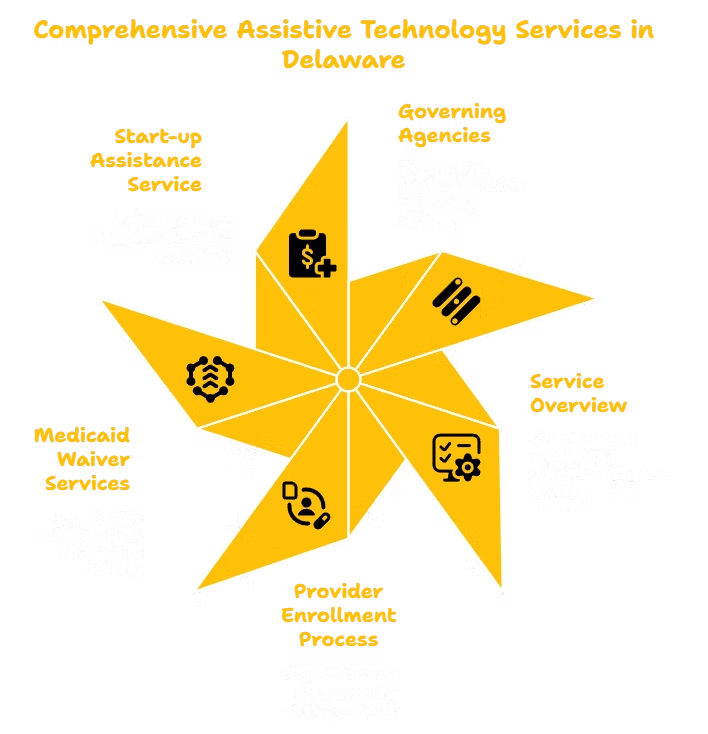
What Are the Governing Agencies and Regulatory Frameworks?
The delivery of assistive technology (AT) in Delaware is governed by a tripartite structure involving state and federal entities. The Delaware Division of Developmental Disabilities Services (DDDS) serves as the primary authority, responsible for approving service delivery under the Lifespan Waiver and ensuring that providers adhere to strict state-level operational standards. Their oversight ensures that services remain person-centered and aligned with the participant's long-term care goals.
Complementing the DDDS, the Delaware Division of Medicaid and Medical Assistance (DMMA) manages the fiscal integrity of the program, including Medicaid reimbursement processes and waiver funding allocation. At the federal level, the Centers for Medicare & Medicaid Services (CMS) provides the overarching regulatory framework for Home and Community-Based Services (HCBS), mandating that all device procurement and service delivery methods uphold the principles of community integration and participant safety.
What Does the Assistive Technology Service Model Encompass?
Assistive Technology services involve a comprehensive, life-cycle approach to technological support. This includes initial clinical evaluation, the acquisition of hardware or software, customized setup, and rigorous training for the participant and their care circle. Every service must be clinically justified, prescribed by a qualified professional, and pre-authorized by DDDS and Medicaid before procurement occurs.
Approved providers are expected to deliver a holistic range of support functions, including:
- Conducting detailed technology assessments and consultations.
- Purchasing, customizing, and configuring assistive devices.
- Performing onsite installation and environmental modifications.
- Providing comprehensive training for participants, family caregivers, and support staff.
- Executing maintenance and repair protocols as authorized within the ISP.
- Maintaining meticulous documentation of device effectiveness and usage monitoring.
What Are the Licensing and Provider Approval Requirements?
Establishing an agency to provide these services requires a commitment to both administrative and clinical excellence. Prospective providers must first formalize their business structure through the Delaware Division of Corporations and secure essential identifiers, including an Employer Identification Number (EIN) from the IRS and a Type 2 National Provider Identifier (NPI). This foundational work ensures the agency is prepared to interface with state systems.
Beyond basic registration, providers must meet specific operational prerequisites. Agencies must demonstrate that they employ or subcontract qualified personnel—such as certified Assistive Technology Professionals (ATPs), Occupational Therapists (OTs), or Speech-Language Pathologists (SLPs)—to lead evaluations. Furthermore, the agency must maintain robust, HIPAA-compliant documentation systems, carry adequate liability insurance, and establish a framework for safety standards that govern the storage, handling, and delivery of medical-grade technology.
What Is the Step-by-Step Provider Enrollment Process?
The enrollment journey is a sequenced progression designed to ensure that providers are fully vetted before interacting with the vulnerable populations served by the Lifespan Waiver. The process begins with the registration of the legal business entity and the acquisition of the NPI. Once the entity is established, the provider must formally apply to the DDDS for enrollment, which requires the submission of a comprehensive provider profile, detailed service descriptions, staff credentialing records, and examples of clinical assessment reports.
Following approval from the DDDS, the agency must register with the Delaware Medicaid Provider Enrollment (DMAP) portal to authorize billing capabilities. The final phase involves active networking; new providers must connect with waiver case managers and support coordinators to ensure they are visible in the referral network. Establishing these professional relationships early is critical for receiving service authorizations and becoming an active participant in the waiver ecosystem.
How Should Staffing and Operational Documentation Be Managed?
Staffing requirements are centered on the necessity for specialized, high-level expertise. Assistive Technology Specialists must possess active certifications such as an ATP or maintain state licensure as an OT, PT, or SLP, with specific experience in the AT field. Support staff involved in device installation must demonstrate technical aptitude and possess a clean driving record, along with a history of professional engagement with individuals living with disabilities.
Documentation is the backbone of the provider’s operational compliance. Agencies must maintain a comprehensive Policy & Procedure Manual that covers the entire service lifecycle, including:
- Standardized templates for device justification and procurement.
- Rigorous consent protocols and confidentiality documentation.
- Detailed tracking for delivery, maintenance, and repair work orders.
- Procedures for incident reporting and emergency management.
- Continuous education records, ensuring all staff stay updated on CEUs and safety mandates.
Frequently Asked Questions
Can I provide assistive technology services without an ATP certification?
While an ATP certification is the industry standard for specialized consultants, the DDDS typically accepts state-licensed OTs, PTs, or SLPs who can demonstrate sufficient experience in the assessment and implementation of adaptive technology within an HCBS setting.
What is the typical timeframe to become a fully operational provider?
The entire process generally spans from 4 to 12 weeks. Initial business formation takes roughly 1–2 weeks, DDDS waiver enrollment requires 30–60 days, and the final phase of workflow setup and staff training typically adds another 2–4 weeks.
Is maintenance for assistive devices covered under the waiver?
Yes, maintenance and repair services are reimbursable provided they are clearly defined and authorized within the participant’s Individual Service Plan (ISP) and relate directly to keeping the equipment functional and safe.
Key Takeaway
Becoming an approved Assistive Technology Services provider in Delaware is a rigorous process that demands high standards of clinical expertise, administrative accuracy, and adherence to DDDS and Medicaid guidelines. By focusing on person-centered outcomes, robust documentation, and collaborative relationships with support coordinators, providers can successfully integrate into the Lifespan Waiver system and deliver transformative technology to Delaware residents.
Last verified: [Date]. Disclaimer: This information is for educational purposes and does not constitute legal or professional advice. Always verify current requirements with the Delaware Division of Developmental Disabilities Services (DDDS) and the Division of Medicaid and Medical Assistance (DMMA) before making business decisions.