ASSISTIVE TECHNOLOGY SERVICES PROVIDER IN COLORADO
By Fatumata Kaba · 2025-07-06 · 5 min read
Defining Assistive Technology Services in the Colorado HCBS Ecosystem
Assistive Technology (AT) services in Colorado serve as a critical bridge between Medicaid members with disabilities and their ability to live independently within their chosen communities. These services encompass the selection, acquisition, customization, and training for specialized devices that enhance functional capabilities, communication, and safety. By integrating these solutions into daily life, providers enable members to maintain mobility and personal agency, directly supporting the core goals of Colorado’s Home and Community-Based Services (HCBS) waivers.
Authorized under specific Medicaid programs—including the Supported Living Services (SLS), Children’s Extensive Support (CES), and Developmental Disabilities (DD) waivers—AT services are governed by the Colorado Department of Health Care Policy and Financing (HCPF). Providers operating in this space must ensure that all interventions meet rigorous standards for medical necessity and follow person-centered planning protocols. By providing both the hardware and the necessary human support for installation and training, these agencies play a pivotal role in the long-term success of waiver participants.
Navigating the Regulatory and Governance Landscape
The provision of Assistive Technology is subject to oversight by both state and federal entities to ensure taxpayer funds are utilized effectively and that participant needs are met safely. The Colorado Department of Health Care Policy and Financing (HCPF) acts as the primary state authority, setting the requirements for provider enrollment, monitoring ongoing compliance, and establishing the parameters for authorized services. Agencies must remain current with HCPF bulletins and policy updates, as these documents dictate the scope of reimbursable AT activities.
At the federal level, the Centers for Medicare & Medicaid Services (CMS) provides the framework that states must follow to operate their HCBS waiver programs. CMS requires that every AT service delivered to a Medicaid member be documented as medically necessary and integrated into the individual’s person-centered plan. Providers are responsible for maintaining a comprehensive audit trail that verifies how each piece of equipment or software directly contributes to the member’s functional goals and supports their integration into the community.
Essential Scope of Service and Technology Categories
An effective Assistive Technology provider offers more than just the delivery of devices; they provide a comprehensive lifecycle of support. This begins with an accurate assessment or evaluation to determine which tool will best bridge the gap between a member’s current abilities and their desired level of independence. Following the evaluation, the provider manages the procurement, setup, and installation, followed by specialized training to ensure the member and their caregivers are proficient in the device’s daily operation.
The scope of eligible technology is broad, reflecting the diverse needs of the population served. Approved providers often facilitate access to the following categories:
- Augmentative and Alternative Communication (AAC) devices to assist individuals with speech impairments.
- Environmental control units and smart home technology, including automated switches and voice-activated interfaces.
- Mobility and positioning equipment, such as adapted seating or custom navigation aids.
- Cognitive support tools and specialized software designed to assist with executive function or daily scheduling.
- Sensory aids for individuals with vision or hearing impairments to improve navigation and interaction within the home.
Provider Enrollment and Operational Compliance
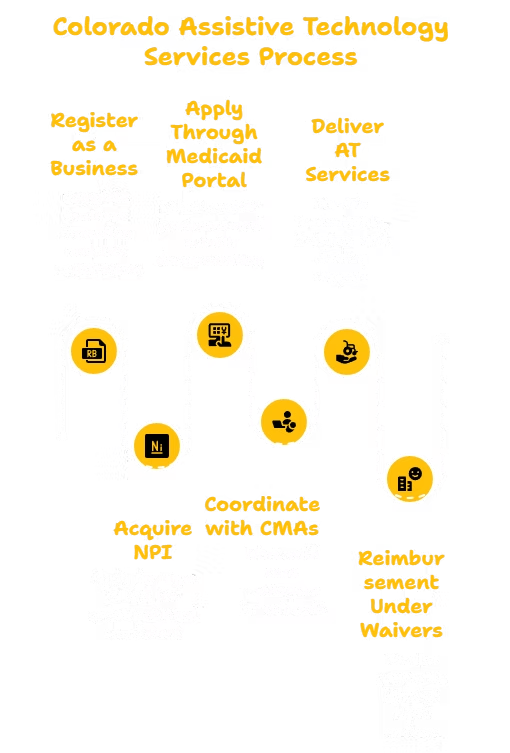
Transitioning into the role of a Medicaid AT provider requires a structured approach to business formation and enrollment. Before interacting with the state system, an organization must be properly registered with the Colorado Secretary of State and hold an active Employer Identification Number (EIN). Furthermore, the agency must secure a Type 2 National Provider Identifier (NPI), which is essential for organizational enrollment within the Medicaid system. Once these foundational steps are complete, the agency can proceed with the formal enrollment process through the Gainwell Technologies Provider Portal.
During the enrollment phase, applicants must select the appropriate waiver programs and designate "Assistive Technology" as their primary service type. This stage requires the submission of detailed business documentation, including proof of credentials for staff members such as Assistive Technology Professionals (ATPs), speech-language pathologists, or occupational therapists. Because the state requires strict adherence to HIPAA guidelines, applicants must also demonstrate that their internal policies and procedures adequately protect participant privacy and maintain secure data storage for all service records.
Staffing, Training, and Professional Standards
The quality of AT services is inherently tied to the expertise of the staff delivering them. A qualified team generally consists of a lead specialist—typically an ATP, PT, OT, or SLP—who possesses the clinical or technical knowledge required to conduct formal assessments and design personalized technology plans. This clinical lead is often supported by installation technicians who handle the physical deployment of devices and provide hands-on training to the member and their primary caregivers.
All personnel, regardless of their specific technical role, must undergo mandatory training to ensure safety and compliance. This includes rigorous education on HIPAA and participant confidentiality, infection control protocols for in-home visits, and emergency response procedures. Furthermore, staff must demonstrate a solid understanding of the person-centered planning process, ensuring that the technology is not just installed, but actively integrated into the member's life to achieve the specific goals outlined in their Medicaid service plan.
Frequently Asked Questions
What criteria must a device meet to be considered for Medicaid reimbursement?
For an item to be eligible, it must be directly related to the member’s disability, demonstrate a clear functional benefit, and be identified as medically necessary within the individual’s person-centered plan. General household items or convenience devices that do not specifically address a functional limitation are typically not covered.
How does a provider receive service authorizations?
Authorization occurs through coordination with the member's Case Management Agency (CMA). The provider performs the assessment and submits the justification to the CMA, who then facilitates the approval process within the state’s management system. Once authorized, the provider can proceed with the purchase and installation.
What are the primary documentation requirements for an audit?
Providers must maintain detailed records including signed service plans, proof of delivery or installation, training logs, and receipts for all purchased equipment. Furthermore, incident reports, maintenance logs for equipment, and documentation regarding staff credentials and continuing education are essential to demonstrate ongoing regulatory compliance.
Key Takeaway
Becoming an Assistive Technology provider in Colorado involves a rigorous balance of technical expertise, clinical assessment capabilities, and strict adherence to Medicaid administrative requirements. Success requires a commitment to the person-centered model, ensuring that every piece of technology is effectively integrated to foster independence for the waiver participant while maintaining the high standards of accountability required by HCPF and CMS.
Last verified: October 2023. This information is provided for educational purposes only and does not constitute legal or professional advice. Always consult directly with the Colorado Department of Health Care Policy and Financing (HCPF) or official state guidelines to ensure your business operations remain in full compliance with current Medicaid regulations.