ASSISTIVE TECHNOLOGY SERVICES PROVIDER IN ARKANSAS
By Fatumata Kaba · 2025-07-06 · 5 min read
Assistive Technology (AT) services in Arkansas are specialized supports designed to help individuals with disabilities acquire, utilize, and maintain critical equipment that fosters functional independence. Authorized primarily under the Arkansas Community and Employment Supports (CES) Waiver, these services bridge the gap between physical limitations and daily living requirements by providing personalized high-tech and low-tech solutions.
For provider agencies, entering this space requires navigating the regulatory framework established by the Arkansas Department of Human Services (DHS) and the Division of Developmental Disabilities Services (DDS). By delivering structured assessments, equipment procurement, and comprehensive staff training, providers play a vital role in ensuring that individuals with developmental disabilities can effectively participate in their communities and achieve their personal goals.
How Are Assistive Technology Services Regulated in Arkansas?
The oversight of AT services is a collaborative effort involving state and federal entities to ensure quality and compliance. The Arkansas Department of Human Services (DHS) through the Division of Developmental Disabilities Services (DDS) serves as the primary regulatory body for the CES Waiver. DDS is responsible for reviewing provider applications, authorizing specific services, and ensuring that providers adhere to state-mandated service delivery standards.
At the state-wide financial level, Arkansas Medicaid and the Division of Medical Services (DMS) manage the administrative aspects of provider enrollment and reimbursement. These agencies work in tandem to process claims and verify that service delivery aligns with federal requirements established by the Centers for Medicare & Medicaid Services (CMS). Agencies operating in this sector must maintain ongoing compliance with both DDS quality assurance protocols and CMS Medicaid regulations.
What Are the Core Responsibilities of an AT Service Provider?
An AT provider’s primary responsibility is to facilitate the evaluation, selection, acquisition, and configuration of devices that are medically necessary for an individual. These services must be clearly documented within the individual's Individualized Service Plan (ISP). Providers are not merely vendors; they are partners in the individual's care plan, responsible for ensuring that the technology is appropriate, functional, and safe for the user.
The scope of service delivery is broad and requires specialized operational workflows to manage equipment lifecycles. Essential functions include:
- Conducting professional AT assessments and evaluations to identify appropriate equipment.
- Managing the procurement, assembly, and setup of approved devices.
- Customizing and configuring technology to meet unique ergonomic or communication needs.
- Providing thorough training to individuals, their caregivers, and support staff on device usage.
- Offering ongoing maintenance, troubleshooting, and repair services to minimize downtime.
- Maintaining meticulous documentation regarding service delivery and the impact of the AT on ISP goals.
What Are the Essential Steps for Provider Enrollment?
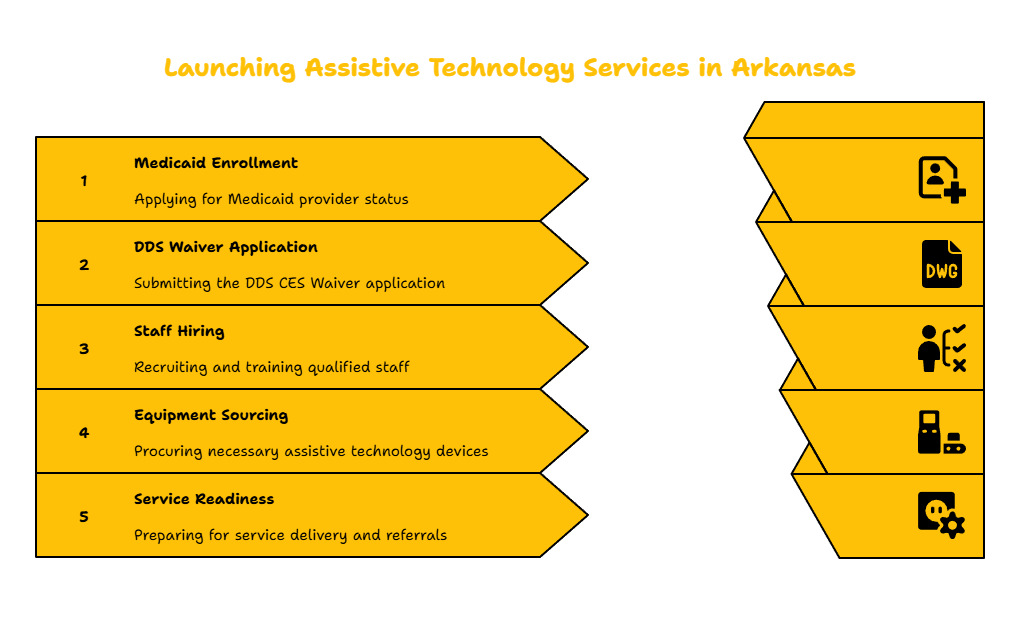
Provider enrollment is a sequential process that requires rigorous attention to detail and organizational readiness. Before applying, a business must be properly registered with the Arkansas Secretary of State and possess a valid Federal Employer Identification Number (EIN) and a Type 2 National Provider Identifier (NPI). This foundational administrative work is necessary to proceed with Medicaid and DDS requirements.
The enrollment process generally unfolds in three distinct phases:
- Medicaid Enrollment: Agencies must apply through the Arkansas Medicaid Provider Portal, selecting AT services under the CES Waiver designation and submitting all required organizational documentation, staff credentials, and Electronic Funds Transfer (EFT) information.
- DDS CES Waiver Provider Application: Agencies must submit a comprehensive proposal to DDS detailing their service delivery model, equipment procurement policies, and staff qualification standards.
- ISP Coordination: Following successful approval from both DMS and DDS, the agency is formally eligible to receive referrals from support coordinators to initiate service for individuals on the CES Waiver.
What Documentation and Staffing Standards Must Be Maintained?
Operational success hinges on robust internal policies and the employment of qualified staff. Providers are required to maintain a comprehensive policy and procedure manual that covers the entire lifecycle of AT services, from the initial assessment through ongoing equipment maintenance and incident reporting. This manual must explicitly address HIPAA compliance, client rights, and secure inventory tracking systems.
Staffing requirements are centered on expertise and safety. AT Specialists should possess professional backgrounds in rehabilitation, occupational therapy, or specialized AT delivery. All personnel, including technicians responsible for delivery and setup, must undergo thorough background checks. Furthermore, all staff must participate in mandatory training programs focused on device sanitation, client safety protocols, and privacy standards to ensure the highest quality of service.
Frequently Asked Questions
Can AT services be provided under waivers other than the CES Waiver?
While the CES Waiver is the primary program for these services, they may be authorized under the ARChoices in Homecare Waiver in specific instances and as permitted by state guidelines. Providers should always verify individual eligibility through the current ISP and relevant Medicaid documentation.
What is the typical timeline for becoming a certified provider?
The business formation phase typically takes 1–2 weeks, while the Medicaid and DDS application process generally ranges from 45 to 90 days. Following approval, agencies usually dedicate an additional 2–4 weeks to coordinate referrals and achieve full service readiness.
What happens if a device requires specialized repair?
Providers are responsible for the maintenance and repair of the AT devices they supply. The internal policy and procedure manual must include clear protocols for warranty management, troubleshooting, and timely repairs to ensure that the individual’s daily activities and communication abilities are not interrupted for an extended period.
Key Takeaway
Launching an Assistive Technology services agency in Arkansas requires a disciplined approach to regulatory compliance, encompassing state-level DDS approval and federal Medicaid enrollment. By establishing clear operational protocols for assessment, procurement, and ongoing staff training, providers can ensure they meet the complex needs of individuals with disabilities while maintaining strict alignment with the Arkansas CES Waiver requirements. Success in this field is defined by the ability to integrate administrative excellence with the delivery of life-enhancing technology that promotes long-term independence for the populations served.
Last verified: October 2023. Disclaimer: This information is for educational purposes only and does not constitute legal or professional advice. Always verify current state regulations and waiver requirements directly with the Arkansas Department of Human Services and the Division of Medical Services.