ASSISTIVE TECHNOLOGY SERVICES PROVIDER IN ALABAMA
By Fatumata Kaba · 2025-06-30 · 5 min read
Assistive Technology (AT) services in Alabama are specialized supports funded through Home and Community-Based Services (HCBS) Medicaid Waivers, designed to improve the functional independence and daily living capabilities of individuals with intellectual and developmental disabilities (IDD). By providing curated technological aids—ranging from communication devices to environmental control systems—these services empower participants to remain safely integrated within their homes and communities, meeting rigorous regulatory standards established by the Alabama Department of Mental Health (ADMH).
What is the Scope of Assistive Technology Services Under Alabama HCBS Waivers?
Assistive Technology Services encompass a comprehensive lifecycle of support, starting with a professional evaluation of the individual’s unique functional needs. The service is not merely about providing hardware; it is a clinical and practical process that includes identifying appropriate technology, customizing devices to the user's specific capabilities, installing equipment, and providing ongoing training to ensure the user and their caregivers can operate the technology effectively.
To be reimbursable under Medicaid, every piece of technology must be linked to the individual's person-centered plan and documented as medically necessary. Providers must maintain a high level of accountability, which includes troubleshooting equipment failures, performing minor repairs, and ensuring that all deployed technology remains in good working order throughout its lifespan.
- Functional needs assessments for technology suitability.
- Procurement, customization, and installation of adaptive devices.
- Instructional training for individuals, family members, and caregivers.
- Maintenance, technical support, and minor repair services.
How are Regulatory Responsibilities Divided Between Agencies?
The successful delivery of Assistive Technology in Alabama relies on a tri-agency regulatory framework. The Alabama Department of Mental Health (ADMH) serves as the primary regulator for provider oversight, meaning they are responsible for approving entities to operate, setting the specific standards of care, and conducting routine monitoring to ensure high-quality service delivery for individuals with IDD.
The Alabama Medicaid Agency manages the fiscal and administrative backend of the program, including the enrollment of providers into the Medicaid system, the processing of claims, and the reimbursement of approved services. Finally, the Centers for Medicare & Medicaid Services (CMS) provide the federal foundation for these waivers, ensuring that Alabama’s programs remain in compliance with national Medicaid regulations regarding community integration and participant safety.
What Are the Essential Requirements for Provider Enrollment?
Becoming an approved provider is a systematic process that begins with establishing the legal and technical foundation of the business. An entity must be formally registered with the Alabama Secretary of State and possess a valid EIN from the IRS and a Type 2 National Provider Identifier (NPI). A physical presence in Alabama is required, and the applicant must prove their capability to store equipment safely and manage a fleet of technological assets.
Beyond legal documentation, applicants must demonstrate a clear operational readiness. This involves submitting a robust policy and procedure manual that covers everything from the initial referral intake to the final disposal or repair of a device. The ADMH requires evidence that the provider understands the nuances of assistive technology, including current safety standards, privacy protections for sensitive user data, and the ability to maintain accurate service logs.
- Business formation and tax identification (EIN/NPI).
- Maintenance of an Alabama-based physical office or service center.
- Submission of a comprehensive ADMH-compliant policy and procedure manual.
- Demonstration of professional experience in rehabilitation technology or disability support.
How Does the ADMH Credentialing and Approval Process Work?
The credentialing process is designed to ensure that only qualified, capable entities serve the IDD population. It begins with a formal request for an Assistive Technology Services Provider Application Packet from the ADMH. Once the application is submitted, it is vetted for operational integrity, which includes reviewing the provider's inventory systems, service delivery protocols, and documentation for staff training and safety procedures.
A critical component of this phase is the Program Readiness Review. During this stage, regulators evaluate the provider's ability to handle the logistics of the service, including the consent processes for clients and the ability to document service delivery in a way that satisfies Medicaid audit requirements. Only after receiving formal approval from the ADMH may an organization enroll as an official provider within the Alabama Medicaid management system to begin billing for services.
What Are the Staffing and Training Mandates for Providers?
Staffing requirements are centered on expertise. Each provider must designate an Assistive Technology Program Manager who possesses a background in rehabilitation technology, occupational therapy, or a related field. This individual is responsible for ensuring that all technology solutions are both safe and appropriate for the individuals they serve. Specialists or technicians working under the manager must hold relevant certifications or equivalent experience in adaptive device installation and support.
Ongoing compliance is not a one-time event but a continuous requirement. All staff members must undergo ADMH-mandated orientation and HCBS compliance training. Furthermore, because technology evolves rapidly, providers are expected to participate in annual technical training to stay current with new devices, software updates, and best practices in disability advocacy and patient interaction protocols.
Frequently Asked Questions
Which Medicaid Waivers include Assistive Technology Services?
Assistive Technology Services are authorized under the Intellectual Disabilities (ID) Waiver, the Living at Home (LAH) Waiver, and the State of Alabama Community Waiver Program.
How long should a provider expect the launch process to take?
While timelines vary based on organizational readiness, the process typically takes several months. This includes up to 90 days for the ADMH application review, up to 60 days for equipment procurement, and up to 90 days for final Medicaid enrollment.
What documentation must a provider maintain for audits?
Providers must maintain comprehensive records including, but not limited to, signed individual service plans, training logs, equipment maintenance records, and detailed service delivery notes that verify the necessity and usage of the technology provided.
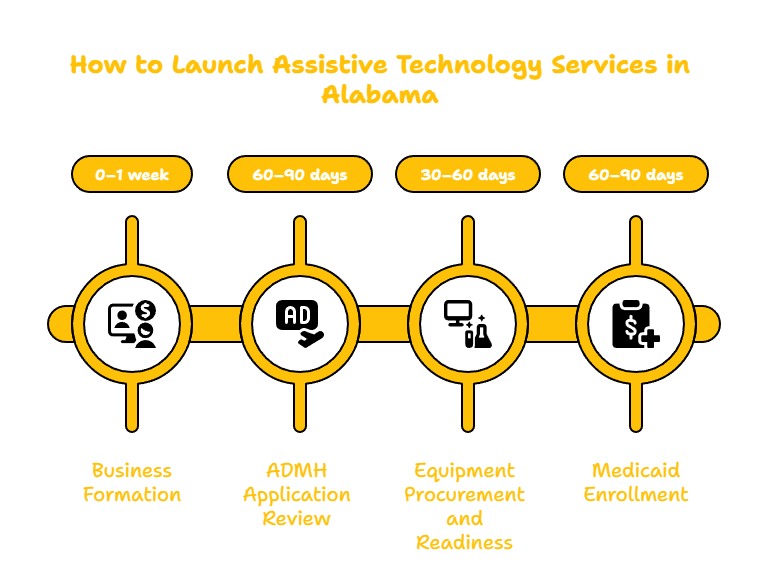
Key takeaway: Achieving success as an Assistive Technology provider in Alabama requires a dual focus on technical expertise regarding adaptive devices and strict adherence to the administrative and compliance standards set by the Alabama Department of Mental Health and the Alabama Medicaid Agency. By maintaining rigorous documentation and staff training, providers can effectively bridge the gap between technological innovation and the independence of individuals with intellectual and developmental disabilities.
Last verified: October 2023. This information is for educational purposes only and does not constitute legal or professional advice. Requirements are subject to change based on state and federal regulation updates. Consult the Alabama Department of Mental Health or the Alabama Medicaid Agency directly for the most current provider bulletins and policy changes.