ASSISTIVE TECHNOLOGY & ADAPTIVE AIDS SERVICES PROVIDER IN MICHIGAN
By Fatumata Kaba · 2025-07-27 · 5 min read
ENHANCING INDEPENDENCE THROUGH TECHNOLOGY AND ADAPTIVE DEVICES FOR INDIVIDUALS WITH DISABILITIES OR CHRONIC CONDITIONS
Assistive Technology (AT) and Adaptive Aids services in Michigan are specialized provisions designed to empower individuals with disabilities or chronic conditions to achieve greater independence and safety within their homes and communities. These services, which encompass a wide array of devices ranging from mobility aids to complex environmental control systems, are primarily funded through Michigan Medicaid, Home and Community-Based Services (HCBS) waivers, and the MI Choice Waiver Program.
For provider agencies, establishing an AT and Adaptive Aids service line requires a deep understanding of the regulatory landscape governed by the Michigan Department of Health and Human Services (MDHHS) and the Centers for Medicare & Medicaid Services (CMS). By aligning service delivery with these federal and state frameworks, providers can successfully bridge the gap between essential medical technology and the individuals who rely on it for daily functional autonomy.
What Are the Roles of Governing Agencies in Michigan?
The regulatory environment for AT and adaptive aids is multi-faceted, requiring providers to interact with several state and federal bodies to ensure compliance and reimbursement eligibility. The Michigan Department of Health and Human Services (MDHHS) serves as the primary authority, overseeing the approval and reimbursement protocols under Medicaid and various HCBS waivers. Concurrently, the Centers for Medicare & Medicaid Services (CMS) maintains federal oversight to ensure that waiver-funded technologies meet established standards for efficacy and necessity.
Beyond MDHHS and CMS, providers must coordinate with specialized agencies to address the diverse needs of their clientele. Michigan Rehabilitation Services (MRS) is pivotal for supporting vocational-related aids, while local Area Agencies on Aging (AAA) facilitate the distribution of adaptive equipment for seniors enrolled in the MI Choice Waiver. Additionally, the Michigan Department of Licensing and Regulatory Affairs (LARA) acts as the gatekeeper for service authorization by issuing the necessary licenses for durable medical equipment (DME) providers, ensuring that all entities meet baseline safety and operational requirements.
How Do Providers Classify Assistive Technology and Adaptive Aids?
Assistive technology and adaptive aids are categorized by their functional impact on the individual. These devices are intended to overcome physical, sensory, or cognitive limitations, enabling users to perform critical activities of daily living (ADLs) that would otherwise be restricted. Services in this sector are comprehensive, covering the entire lifecycle of a device from initial clinical assessment and procurement to expert installation, personalized training, and long-term maintenance.
- Mobility Devices: Manual and power wheelchairs, scooters, walkers, canes, and crutches.
- Communication Aids: Augmentative and Alternative Communication (AAC) devices, speech-generating devices (SGDs), and voice amplification systems.
- Home Accessibility Aids: Stair lifts, ramps, vertical lifts, adaptive kitchen and bathroom modifications, and environmental control units (ECUs).
- Personal Assistance and Monitoring: Adaptive utensils, grooming aids, medication management devices, hearing/visual enhancement systems, fall detectors, and smart home safety integrations.
What Are the Prerequisites for Provider Licensing and Enrollment?
Launching a service provider agency requires a rigorous commitment to documentation and credentialing. Before applying for state contracts, a prospective provider must formally register their business with LARA, obtain a federal Employer Identification Number (EIN), and secure a Type 2 National Provider Identifier (NPI). Furthermore, adequate insurance coverage—including both general liability and product liability—is essential to mitigate the risks associated with equipment installation and operation.
Operational readiness is demonstrated through the creation of a robust Policy & Procedure Manual. This manual must explicitly address HIPAA-compliant data handling, client intake protocols, and safety maintenance records. Providers should ensure they have access to qualified personnel, such as certified Assistive Technology Professionals (ATP), rehabilitation engineers, or occupational therapists, whose credentials are vital for medical necessity determinations and equipment fitting.
What Is the Step-by-Step Provider Enrollment Process?
The enrollment journey is structured to ensure that only qualified providers enter the Medicaid network. The process begins with the procurement of a DME or AT Service License through the LARA Licensing Portal. Once the business is legally authorized to operate, the next step involves enrolling with Michigan Medicaid via the CHAMPS system. This platform is the central hub for billing and provider management in the state.
Following Medicaid enrollment, providers must expand their reach by registering as a vendor with Michigan Rehabilitation Services (MRS) for vocational aids. Finally, finalizing credentialing with local waiver programs is critical. This involves direct coordination with local AAAs for MI Choice Waiver authorization and partnering with Community Mental Health (CMH) programs to support technology services for individuals with developmental disabilities. Each of these steps contributes to a comprehensive service network that ensures seamless access for participants.
What Are the Specific Staffing and Training Requirements?
High-quality AT service delivery depends on a professional team capable of translating technical device specifications into practical user benefits. Key roles include the Assistive Technology Professional (ATP), who must hold certification from RESNA (or an equivalent body) and possess expertise in evaluations. Occupational Therapists (OT) or Physical Therapists (PT) are also essential for conducting functional assessments and ensuring that adaptive devices are integrated into the individual’s daily life effectively.
Ongoing staff training is a regulatory necessity. All team members, including device installers and program supervisors, must undergo regular training in HIPAA data security, infection control protocols for reusable equipment, device fitting techniques, and emergency safety procedures. By maintaining a well-trained staff, agencies can ensure that equipment is not only installed correctly but that the user and their caregivers are fully trained in safe, effective usage.
Frequently Asked Questions
How long does the provider enrollment process typically take?
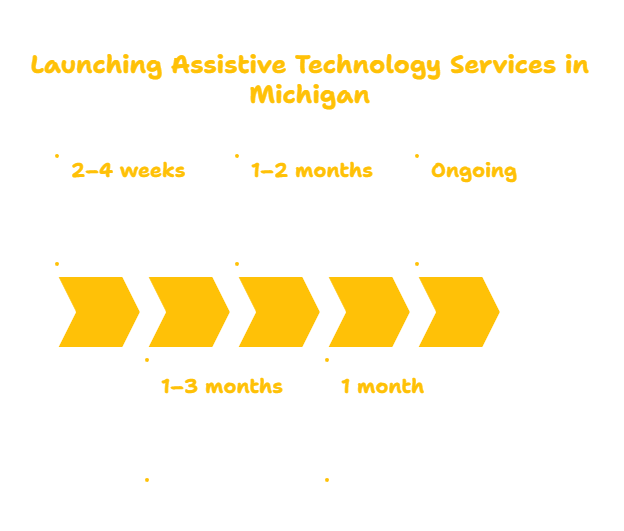
The timeline varies by phase, with initial business registration taking 2–4 weeks, followed by DME licensing and Medicaid enrollment (CHAMPS) spanning 1–3 months. Staff hiring and equipment procurement add another 1–3 months before the service rollout phase begins.
Which specific Medicaid waiver programs cover assistive technology?
AT and adaptive aids are authorized under several programs, including the MI Choice Waiver, the Habilitation Supports Waiver (HSW), the Children’s Waiver Program (CWP), various Community Mental Health (CMH) initiatives, and Michigan Rehabilitation Services (MRS) vocational programs.
What documentation is required to ensure audit readiness?
Providers must maintain comprehensive logs, including client intake assessments, device installation and maintenance records, warranty agreements, training documentation for caregivers, and detailed billing logs that align with the participant’s Plan of Care (POC).
Key Takeaways for Prospective Providers
Establishing an Assistive Technology and Adaptive Aids service provider in Michigan is a structured process that relies on strict adherence to state licensing, Medicaid enrollment via CHAMPS, and the deployment of qualified, certified personnel. By organizing services around the needs of the HCBS and MI Choice Waiver populations and maintaining rigorous documentation, agencies can successfully provide essential tools that foster independence for Michigan residents. Success in this field is predicated on the ability to navigate complex regulatory requirements while delivering high-quality, safe, and effective technological solutions.
Last verified: October 2023. Disclaimer: This article is for informational purposes only and does not constitute legal or professional advice. Requirements for Medicaid providers may be subject to change based on MDHHS or CMS policy updates. Providers are encouraged to consult directly with state portals and official documentation for the most current regulatory guidance.