ASSISTED LIVING SERVICES PROVIDER IN CONNECTICUT
By Fatumata Kaba · 2025-07-08 · 5 min read
Assisted Living Services in Connecticut provide essential personal care, health monitoring, and supportive services to older adults and individuals with disabilities residing in managed residential communities. By operating as a licensed Assisted Living Services Agency (ALSA), providers play a critical role in supporting residents' independence and quality of life while ensuring compliance with stringent Department of Public Health (DPH) and Department of Social Services (DSS) standards.
Understanding the Regulatory Landscape for Connecticut Assisted Living
Navigating the Connecticut regulatory environment requires a clear understanding of the distinct roles played by state agencies. The Department of Public Health (DPH) holds the primary authority for licensing Assisted Living Services Agencies (ALSAs), ensuring that providers meet the safety and quality standards necessary to operate within managed residential communities. Compliance with Sections 19-13-D105 of the Public Health Code is mandatory for all licensed entities.
Concurrently, the Department of Social Services (DSS) acts as the primary payer and program administrator for Medicaid-reimbursed services. This includes oversight of the Connecticut Home Care Program for Elders (CHCPE) and the Assisted Living Demonstration Project. Additionally, the Connecticut Housing Finance Authority (CHFA) maintains oversight of specific affordable housing developments where these services are delivered, while the Centers for Medicare & Medicaid Services (CMS) ensures that all waiver-based services adhere to federal Home and Community-Based Services (HCBS) standards.
Scope of Services Provided in Residential Settings
Assisted living services allow individuals to age in place within non-institutional, residential settings. Providers are tasked with delivering a continuum of care that balances clinical oversight with support for daily living tasks. This coordination occurs in collaboration with the managed residential community, which typically manages the physical environment, meals, and general housing needs, while the ALSA focuses on the health and personal care requirements of the client.
Approved providers deliver a variety of services, including:
- Assistance with activities of daily living (ADLs): bathing, dressing, grooming, toileting, and eating.
- Nursing services: health monitoring, medication administration, and coordination with physicians.
- Housekeeping, laundry, and meal support in coordination with the residential facility.
- Emergency response systems and routine wellness checks.
- Thorough documentation of care and active participation in interdisciplinary care planning.
The Licensing and Medicaid Enrollment Roadmap
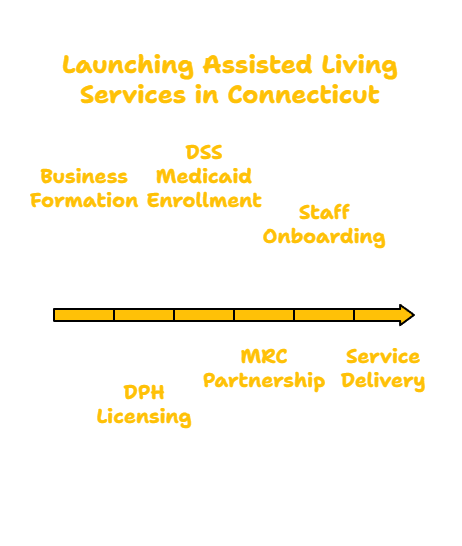
Establishing an ALSA requires a sequenced approach to business registration, licensing, and payer enrollment. Initially, a provider must formalize the business entity with the Connecticut Secretary of the State and secure an EIN and a Type 2 NPI. Once the organizational foundation is set, the agency must apply to the DPH for licensure as an Assisted Living Services Agency. This process involves submitting detailed care policies, nursing protocols, staffing structures, and emergency procedures, followed by a formal site review.
After achieving DPH licensure, the agency must enroll with the DSS to become an authorized Medicaid provider. This step involves utilizing the Medicaid Provider Enrollment Portal to link the ALSA license with the agency’s professional and tax credentials. Enrollment is specific to the waiver programs in which the agency intends to participate, such as the CHCPE or the Assisted Living Demonstration Project. Success in this phase relies on demonstrating capacity to provide services in accordance with state and federal regulations.
Essential Documentation and Operational Compliance
Maintaining operational compliance is a continuous process that hinges on rigorous record-keeping and robust internal policies. Agencies must prepare and implement a comprehensive policy and procedure manual that satisfies both state licensing surveyors and Medicaid auditors. This manual serves as the operational blueprint for every aspect of care delivery, from clinical interventions to administrative oversight.
Required documentation and systems include:
- Comprehensive service plans and nurse delegation forms.
- Accurate ADL support logs and medication administration records.
- Emergency response, fall prevention, and incident reporting protocols.
- HIPAA-compliant privacy and grievance procedures to protect client rights.
- Detailed staff orientation, ongoing training logs, and annual competency review records.
- Formal collaboration agreements between the ALSA and the Managed Residential Community (MRC).
Staffing, Credentialing, and Professional Requirements
The quality of care provided by an ALSA is directly tied to the qualifications and supervision of its staff. At a minimum, every agency must employ a Supervising Registered Nurse (RN) who holds a valid Connecticut license and possesses relevant experience in home care or geriatric nursing. This RN is responsible for the oversight of all health-related services and ensures that all care provided is within the scope of practice and state regulations.
Direct care staff, such as Personal Care Assistants, must hold appropriate credentials, such as a Certified Nurse Aide (CNA) or Home Health Aide (HHA) certification. Beyond initial credentialing, all staff must undergo thorough background checks, TB testing, and CPR/First Aid certification. Furthermore, agencies are required to conduct regular in-service training covering infection control, elder abuse prevention, mandatory reporting, and incident documentation to ensure all personnel remain competent in their duties.
Frequently Asked Questions
What is the primary role of an ALSA in a managed residential community?
An ALSA is responsible for providing personal care, health monitoring, and nurse-delegated services to residents. They work in tandem with the residential community operator to ensure that the resident's health and daily care needs are met in a home-like environment.
Can an ALSA provide services in any residential setting?
No, services are typically provided in Managed Residential Communities (MRCs) or specific affordable housing developments, such as those overseen by the Connecticut Housing Finance Authority (CHFA) for the Assisted Living Demonstration Project.
What is the typical timeline for an ALSA to begin operations?
The launch process is comprehensive, with DPH licensing typically taking 90–120 days and DSS Medicaid enrollment requiring an additional 30–60 days. Including business formation and staff onboarding, the total launch process generally spans several months of preparation.
Key Takeaway
Launching a successful Assisted Living Services Agency in Connecticut requires a disciplined approach to DPH licensing, DSS Medicaid enrollment, and adherence to strict clinical documentation standards. By prioritizing regulatory compliance and establishing strong partnerships with Managed Residential Communities, providers can effectively navigate the requirements to deliver essential care to the aging and disabled population.
Last verified: October 2023. Disclaimer: This information is for educational purposes only and does not constitute legal or professional advice. Always verify current state regulations and policy updates directly with the Connecticut Department of Public Health and the Department of Social Services.