ASSISTED LIVING FACILITY SERVICES PROVIDER IN ALABAMA
By Fatumata Kaba · 2025-06-27 · 5 min read
Assisted Living Facility (ALF) services in Alabama represent a critical component of the state’s long-term care infrastructure, providing residential support for individuals with intellectual and developmental disabilities (IDD) who require daily assistance but not 24-hour nursing home oversight. By operating under Alabama’s Home and Community-Based Services (HCBS) Medicaid Waivers, these facilities serve as community-integrated homes that balance personal autonomy with structured, high-quality care.
What Are the Regulatory Foundations for Alabama Assisted Living Providers?
Operating an Assisted Living Facility in Alabama requires navigating a multi-layered regulatory environment. Providers must maintain compliance with the Alabama Department of Public Health (ADPH), which governs physical safety, licensure, and general health standards, alongside the Alabama Department of Mental Health (ADMH), which oversees the specific requirements for IDD populations within the HCBS waiver framework. Success in this sector depends on a provider's ability to satisfy both sets of mandates simultaneously.
Beyond state agencies, the Centers for Medicare & Medicaid Services (CMS) provides federal oversight. Compliance with the federal HCBS Settings Rule is mandatory, ensuring that all residents receive services in environments that are truly community-integrated and support the individual’s right to personal choice, privacy, and full access to the broader community. Providers must demonstrate that their operational model reflects these values to maintain eligibility for Medicaid reimbursement.
How Do You Achieve Operational Readiness and Licensure?
The journey toward becoming an approved ALF provider begins with formal business entity formation and physical site compliance. Founders must register their business with the Alabama Secretary of State, secure an Employer Identification Number (EIN), and obtain a Type 2 National Provider Identifier (NPI). These foundational steps provide the legal and administrative infrastructure necessary to engage with state agencies.
Physical site compliance is equally rigorous. An applicant must secure an Assisted Living Facility License from the ADPH, which includes satisfying strict building codes, fire safety protocols, ADA accessibility requirements, and infection control standards. Before an application for Medicaid reimbursement can be fully processed, the facility must be operational, inspected, and deemed safe for vulnerable populations.
- Register business entity with the Alabama Secretary of State.
- Obtain a Type 2 NPI and IRS EIN.
- Secure ADPH Assisted Living Facility License.
- Verify compliance with state-mandated fire, safety, and ADA building codes.
- Develop a comprehensive, ADMH-compliant policy and procedure manual.
What Does the ADMH Provider Enrollment Process Entail?
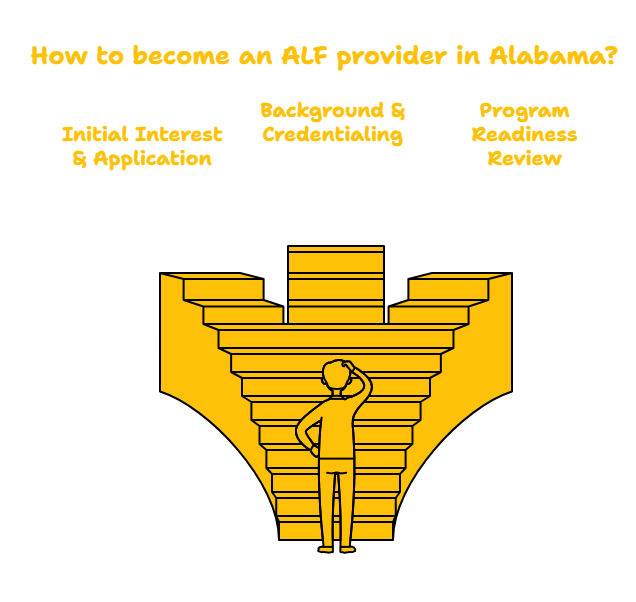
Once the facility is licensed, the provider must navigate the ADMH enrollment process to become authorized to serve participants under the Intellectual Disabilities (ID) Waiver or the State of Alabama Community Waiver Program. This process involves submitting an extensive facility operations plan, which details the organization’s approach to staffing, emergency response, medication administration, and daily care coordination. ADMH officials review these documents to ensure the provider’s philosophy aligns with person-centered planning standards.
Following the document review, a program readiness inspection is conducted. During this stage, state auditors examine the facility’s daily schedules, resident rights policies, and service documentation systems. They evaluate whether the facility can adequately support residents with varying levels of need while maintaining confidentiality and health services coordination. Only upon successful completion of this inspection can a provider finalize their enrollment with Alabama Medicaid and begin billing for waiver-funded services.
What Are the Core Requirements for Staffing and Care Delivery?
Human resources management is a primary focus for ADMH auditors. Every facility must designate a qualified administrator who meets ADPH and ADMH credentials, typically requiring a proven history in healthcare or residential management for the IDD population. Direct care staff must hold at least a high school diploma or GED and receive specialized training in activities of daily living (ADLs), medication administration protocols, and the protection of resident rights.
Ongoing professional development is a mandatory operational cost. Staff must undergo rigorous initial orientation, followed by annual training modules regarding ethics, abuse prevention, and emergency intervention. If the resident population requires medical oversight, the facility must ensure licensed nurses (RNs or LPNs) are available to manage clinical tasks, such as complex medication administration and chronic health monitoring, as specified in the individual’s person-centered plan.
What Documentation Is Required for Ongoing Compliance?
Maintaining status as an approved provider requires meticulous documentation. Agencies must be able to produce records demonstrating consistent care for every resident. This includes individualized care plans, signed consent forms, and detailed service logs that track the delivery of daily support services. These documents serve as the primary evidence of compliance during state audits and quality assurance reviews.
In addition to resident-specific files, the facility must maintain a comprehensive, up-to-date policy and procedure manual. This manual should cover the full spectrum of operations, including admission and discharge criteria, grievance procedures, incident reporting systems, and infection control protocols. Having these policies clearly defined and accessible to all staff is essential for operational consistency and regulatory success.
Frequently Asked Questions
How long does the entire startup process typically take?
The timeline varies by facility, but it generally ranges from six months to over a year. Business formation is rapid (0–1 weeks), while licensing with the ADPH and application reviews with the ADMH and Medicaid each take approximately 60–120 days, depending on regulatory backlogs and administrative efficiency.
Which Medicaid waivers cover assisted living services in Alabama?
Services are authorized specifically under the Intellectual Disabilities (ID) Waiver and the State of Alabama Community Waiver Program. Providers must be enrolled with the Alabama Medicaid Agency to bill for these specific waiver services.
What is the role of the facility administrator?
The administrator is responsible for the overall management of the facility, ensuring it meets all ADPH licensing requirements and ADMH service standards. They must manage staffing schedules, ensure all employees are trained in HCBS compliance, and serve as the primary point of contact for resident care coordination and regulatory inquiries.
Key Takeaway
Successfully operating an Assisted Living Facility for individuals with IDD in Alabama requires a dual commitment to facility safety and person-centered care. Providers must bridge the gap between physical health regulations mandated by the ADPH and the intellectual and developmental support standards required by the ADMH. By prioritizing thorough policy development, rigorous staff training, and meticulous documentation, new providers can establish a sustainable and compliant operation that meets the critical needs of the waiver participant population.
Last verified: September 2023. This information is for educational purposes only and does not constitute legal or professional advice. Always consult directly with the Alabama Department of Mental Health, the Alabama Department of Public Health, and the Alabama Medicaid Agency for the most current regulatory requirements and guidance for your specific facility.